• Fri frakt över 249 kr
  • •
  • Snabba leveranser
  • •
  • Billiga böcker
Kundservice

Du är på sajten för privatpersoner.

Företag, bibliotek eller offentlig verksamhet?

Du handlar på classic.bokus.com, där alla dina funktioner finns intakta.
Till classic.bokus.com
Bokus logotyp. Gå till startsidan.
  • Erbjudanden
  • Nyheter
  • Student
  • Topplistor
  • Barn & ungdom
  • Bokus Play
  • E-böcker
  • Pocketböcker
  • Spel & pussel

10% rabatt på allt med kod NYSTART10 →

Sidfot

Mina sidor

    Hjälp

    • Kundservice
    • Vanliga frågor och svar
    • Frakt och leverans
    • Retur vid ångerrätt
    • Reklamera vara
    • Betalning
    • Köpvillkor
    • Allmänna villkor
    • Information om webbplatsens tillgänglighet

    Om Bokus

    • Om oss
    • Pressrum
    • För studenter
    • För företag
    • För bibliotek och offentlig verksamhet
    • För leverantörer
    • Hållbarhet

    Populärt

    • Aktuella erbjudanden
    • Presentkort
    • Studentlitteratur
    • Nya böcker
    • Topplistor
    • Signerade böcker
    • Engelska böcker

    Inspiration

    • Boktips
    • BookTok
    • Populära bokserier
    • Barnbokskaraktärer
    • Populära författare
    Logotyp för Bokus
    Följ oss på Facebook (extern länk)Följ oss på Instagram (extern länk)Följ oss på YouTube (extern länk)Följ oss på TikTok (extern länk)
    bokus @ CookiesAnpassa cookiesIntegritetspolicyKöpvillkor
    Till Citymail hemsida (extern länk)Till Budbee hemsida (extern länk)Till Postnord hemsida (extern länk)Till Schenker hemsida (extern länk)Till Early Bird hemsida (extern länk)Till Walleys hemsida (extern länk)
    1. Samhälle och politik
    2. Sociologi och antropologi
    3. Sociologi

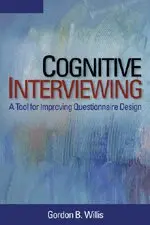
    Cognitive Interviewing

    A Tool for Improving Questionnaire Design

    AvGordon B. Willis,Gordon B. Willis

    Häftad, Engelska, 2004

    2 712 kr

    Beställningsvara. Skickas inom 3-6 vardagar. Fri frakt över 249 kr.

    Fler format och utgåvor

    Inbunden

    3 863 kr

    Beskrivning

    "As both an academic instructor in questionnaire design and a research design methodologist for the federal government, I feel this book is very timely, useful for students and practitioners, and unique in its use of real world practical examples that most everyone can relate."
    —Terry Richardson, General Accounting Office

    "The combination of theory and practical application will make this a useful book for students as well as professionals who want to learn how to incorporate cognitive interviewing into the questionnaire design process."
    —Rachel Caspar, RTI International

    The design and evaluation of questionnaires—and of other written and oral materials—is a challenging endeavor, fraught with potential pitfalls. Cognitive Interviewing: A Tool for Improving Questionnaire Design describes a means of systematically developing survey questions through investigations that intensively probe the thought processes of individuals who are presented with those inquiries. The work provides general guidance about questionnaire design, development, and pre-testing sequence, with an emphasis on the cognitive interview. In particular, the book gives detailed instructions about the use of verbal probing techniques, and how one can elicit additional information from subjects about their thinking and about the manner in which they react to tested questions. These tools help researchers discover how well their questions are working, where they are failing, and determine what they can do to rectify the wide variety of problems that may surface while working with questionnaires.

    Cognitive Interviewing is ideally suited as a course text for advanced undergraduate and graduate research courses across the social sciences. Professional researchers and faculty in the social sciences, as well as practice fields such as medicine, business, and education, will also find this an invaluable reference for survey research. There is no other book on the market that covers cognitive interviewing as applied to questionnaire design.

    Produktinformation

    • Utgivningsdatum:2004-11-22
    • Mått:152 x 228 x 21 mm
    • Vikt:510 g
    • Format:Häftad
    • Språk:Engelska
    • Antal sidor:352
    • Upplaga:1
    • Förlag:SAGE Publications
    • ISBN:9780761928041

    Utforska kategorier

    • Sociologi inom Samhälle och politik

    Mer om författaren

    Gordon B. Willis is a cognitive psychologist in the Applied Research Program, National Cancer Institute, National Institutes of Health; and lectures for the Joint Program for Survey Methodology (JPSM). Prior to that, he was a research methodologist at Research Triangle Institutes in Rockville, Maryland, where he established a cognitive laboratory facility. He also worked for over a decade in the Questionnaire Design Research Laboratory at the National Center for Health Statistics, CDC, developing and applying cognitive interviewing techniques. Dr. Willis attended Oberlin College, and received a Ph.D. in cognitive psychology from Northwestern University. He now works mainly on the development and evaluation of questionnaires that collect information on cancer risk factors. His main research interest is the evaluation of survey pretesting techniques, especially the cognitive interview. Dr. Willis is an authority on the use of cognitive interviewing, based on his work on developing and practicing these methods at three different organizations. He has personally conducted hundreds of cognitiv interviews and overseen the work of teams of interviewers. He has taught cognitive interviewing in short courses at survey conferences and in university lectures. Willis has also written extensively on the practice and theoretical and empirical evaluation of cognitive interviewing techniques.

    Recensioner i media

    “As both an academic instructor in questionnaire design and a research design methodologist for the federal government, I feel this book is very timely, useful for students and practitioners, and unique in its use of real world practical examples that most everyone can relate.”

    Innehållsförteckning

    • ORIENTATION AND BACKGROUNDIntroduction to Cognitive InterviewingWhat is (and isn′t) cognitive interviewing?A broader perspective: The cognitive testing processSetting the Stage: First Principles of Questionnaire DesignQuestionnaire-related (and other) sources of error in self-report surveysWhy do survey questions produce response error? A sociolinguistic perspective How can we avoid problems in survey questions? If we are proficient designers, why do we need to test questions?Chapter summaryExercise: Question evaluationThe CASM Approach to Questionnaire DesignOrigins of CASM Applications of Basic CASM ResearchCognitive interviewing as Applied CASM Research Chapter summaryCognitive Interviewing in Practice: Think-Aloud, Verbal Probing, and Other TechniquesThink-Aloud interviewingVerbal Probing TechniquesConcurrent versus retrospective interviewingChoosing between think-aloud and probing techniquesVignettes, card sorts, and field-based probesChapter summaryTHE INTRICACIES OF VERBAL PROBINGDeveloping Standard Cognitive ProbesExamples of cognitive probingLogical and structural problemsA systematic approach to probe development: The Question Pitfalls ModelChapter summaryExercise: Using the QAS to develop probe questionsBeyond the Standard Model of Verbal ProbingA classification of probe typesProactive versus Reactive probingStandardized versus free-form probesChapter summaryExercise: Emergent probingA Further Perspective: Probing as Expansive InterviewingA broad view of cognitive interviewing The Ethnographic Interview as an alternative perspective Merging Cognitive and Expansive interviewingChapter summaryAvoiding Probing PitfallsAre we in danger of finding problems that don′t exist?Practices that avoid artificial problemsChapter summaryTHE COGNITIVE TESTING PROCESSTraining of Cognitive InterviewersWho makes a good cognitive interviewer?Technical background of the cognitive interviewerHow should cognitive interviewer training be accomplished?Continuing education in cognitive interviewingChapter summaryPlanning and Conducting Cognitive InterviewsFitting cognitive testing into the overall design sequencePreparing for the interview: Subject recruitmentThe interviewing processLogistic issues in the cognitive interviewChapter summaryAnalyzing and Documenting Cognitive Interview ResultsCharacterizing cognitive interview outcomesThe analysis of think-aloud interview resultsAnalysis of the probed interviewPersistent analysis issuesChapter summaryExercise: Analyzing cognitive interviewsOTHER ISSUES AND TOPICSSpecial Applications of Cognitive Interviewing Adjusting to survey administration modeCognitive testing of sensitive questionsCognitive interviewing and establishment surveys Testing questions on attitudes and opinionsInterviewing across the age rangeTesting non-questionnaire materialsChapter summaryEvaluation of Cognitive Interviewing TechniquesTheoretical perspectives Empirical evaluation of cognitive interviewingAre we evaluating the right outcome? Limitations to cognitive interviewsChapter summaryBeyond Cognitive Testing: Affiliated Pretesting MethodsExpert ReviewFocus GroupsBehavior Coding Reinterview surveys How do pretesting methods compare?Chapter summaryRecommendations and Future Directions Twelve recommendations for cognitive interviewing practiceFuture directions for cognitive interviewingA final case studyIn conclusionReferencesAppendix 1.Sample cognitive testing protocolAppendix 2. Example