• Fri frakt över 249 kr
  • •
  • Snabba leveranser
  • •
  • Billiga böcker
Kundservice

Du är på sajten för privatpersoner.

Företag, bibliotek eller offentlig verksamhet?

Du handlar på classic.bokus.com, där alla dina funktioner finns intakta.
Till classic.bokus.com
Bokus logotyp. Gå till startsidan.
  • Erbjudanden
  • Nyheter
  • Student
  • Topplistor
  • Barn & ungdom
  • Bokus Play
  • E-böcker
  • Pocketböcker
  • Spel & pussel

10% rabatt på allt med kod: NYSTART10 →

Sidfot

Mina sidor

    Hjälp

    • Kundservice
    • Vanliga frågor och svar
    • Frakt och leverans
    • Retur vid ångerrätt
    • Reklamera vara
    • Betalning
    • Köpvillkor
    • Allmänna villkor
    • Information om webbplatsens tillgänglighet

    Om Bokus

    • Om oss
    • Pressrum
    • För studenter
    • För företag
    • För bibliotek och offentlig verksamhet
    • För leverantörer
    • Hållbarhet

    Populärt

    • Aktuella erbjudanden
    • Presentkort
    • Studentlitteratur
    • Nya böcker
    • Topplistor
    • Signerade böcker
    • Engelska böcker

    Inspiration

    • Boktips
    • BookTok
    • Populära bokserier
    • Barnbokskaraktärer
    • Populära författare
    Logotyp för Bokus
    Följ oss på Facebook (extern länk)Följ oss på Instagram (extern länk)Följ oss på YouTube (extern länk)Följ oss på TikTok (extern länk)
    bokus @ CookiesAnpassa cookiesIntegritetspolicyKöpvillkor
    Till Citymail hemsida (extern länk)Till Budbee hemsida (extern länk)Till Postnord hemsida (extern länk)Till Schenker hemsida (extern länk)Till Early Bird hemsida (extern länk)Till Walleys hemsida (extern länk)
    1. Data och IT
    2. Människa – datorinteraktion

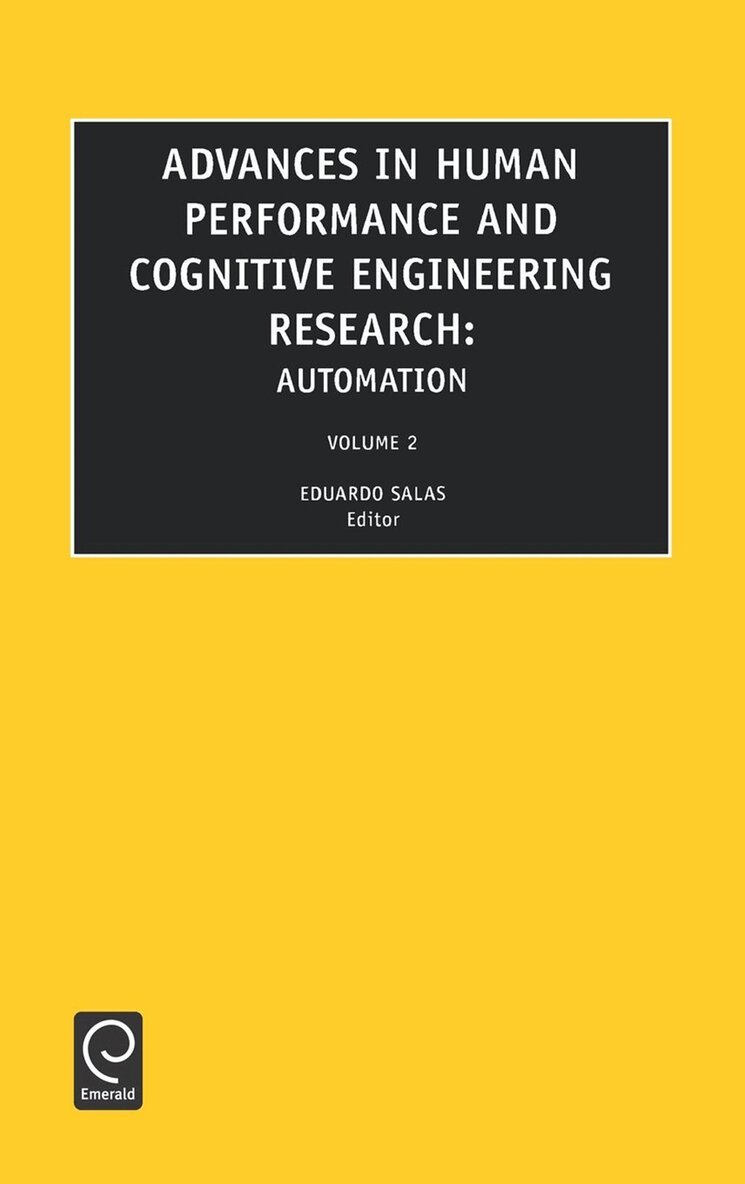
    Automation

    AvEduardo Salas

    Inbunden, Engelska, 2002

    Del 2 i serien Advances in Human Performance and Cognitive Engineering Research

    1 430 kr

    Beställningsvara. Skickas inom 5-8 vardagar. Fri frakt över 249 kr.

    Beskrivning

    We live in an ever complex, dynamic and technological-based world. A world where industries, businesses and agencies rely ever increasingly on automated systems to maintain efficiency, increase productivity, minimize human error or gain a competitive edge. Moreover, automation is now seen by many organizations as the solution to human performance problems. These organizations continue to invest significant resources to implement automated systems wherever possible and there is no doubt that automation has helped such organizations manage their sophisticated, information-rich environments, where humans have limited capabilities. Therefore, automation has helped to improve industrial and commercial progress to the extent that organizations now depend upon it for their own benefit. However, new and unresolved problems have arisen as more individuals, groups and teams interact with automated systems. Hence, the need and motivation of this volume. The chapters contained in this volume explore some of the key human performance issues facing organizations as they implement or manage automated systems. Dealing with a range of topics, from how to design optional use, avoiding misuse, to creating training strategies for automated systems, this volume also explores which theories may help us understand automation better and what research needs to be conducted. This publication attempts to illustrate how human performance research on automation can help organizations design better systems and also hopes to motivate more theoretically-based but practically-relevant research in the technological-based world of the 21st century.

    Produktinformation

    • Utgivningsdatum:2002-06-10
    • Mått:156 x 234 x 15 mm
    • Vikt:532 g
    • Format:Inbunden
    • Språk:Engelska
    • Serie:Advances in Human Performance and Cognitive Engineering Research
    • Antal sidor:252
    • Förlag:Emerald Publishing Limited
    • ISBN:9780762308644

    Utforska kategorier

    • Människa – datorinteraktion inom Data och IT

    Innehållsförteckning

    • EDITORIAL BOARD.List of Contributors. Preface. 1. How to make automated systems team players. 2. Multimodal information presentation in support of human-automation communication and coordination. 3. Operators' automation usage decisions and the sources of misuse and disuse. 4. A comparison of automation and mechanical related accidents in air carrier operations (1983–1999). 5. Automation and cognition: maintaining coherence in the electronic cockpit. 6. Identifying training areas for advanced automated aircraft: application of an information-processing model. 7. Human factors issues regarding automated flight systems. 8. Automation issues in regional airline operations. 9. Automation and aging: Issues and considerations.