Häftad, Engelska, 1991
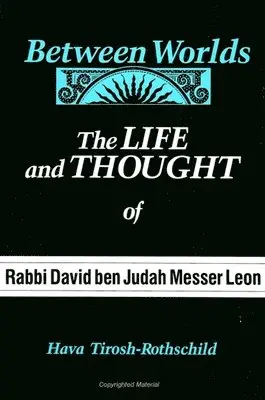
Between Worlds
The Life and Thought of Rabbi David ben Judah Messer Leon
Del i serien SUNY series in Judaica: Hermeneutics, Mysticism, and Religion
414 kr
Tillfälligt slut
Beskrivning
Produktinformation
- Utgivningsdatum: 1991-01-24
- Mått: 152 x 235 x 25 mm
- Vikt: 517 g
- Format: Häftad
- Språk: Engelska
- Serie: SUNY series in Judaica: Hermeneutics, Mysticism, and Religion
- Antal sidor: 385
- Förlag: State University of New York Press
- ISBN: 9780791404485
Utforska kategorier
Mer om författaren
Hava Tirosh-Rothschild is Assistant Professor in the Department of Religion at Emory University.
Recensioner i media
"The author clearly is at home in the study of both history and philosophy. This rare combination lends the book its unique quality. This is not just a biography of an Italian Renaissance Jew, but a history of the Jews in fifteenth- and sixteenth-century Italy and the Ottoman Empire, from both a social and a cultural perspective. Its comprehensiveness in tracing the intellectual origins of the significant issues facing David ben Judah Messer Leon makes the book valuable to both medieval and early modern historians, whether or not their field of specialization is the study of Judaism." — Benjamin R. Gampel, Jewish Theological Seminary of America"The author's discussion of Maimonides' lingering influence even in this late period, and the reshaping of his positions to meet new existential needs, is also important." — David B. Ruderman, Yale University"Between Worlds is a serious, scholarly, well-researched book on an important figure in early modern Jewish history and thought. It presents a great overview of Jewish life during the Renaissance, the historiographic issues, and the man's place in the larger spectrum of Jewish philosophical thinking. It is important as a study of both Italian and Ottoman Jewry and of the history of responses to Maimonides." — Howard Adelman, Smith College"This deals with a figure who lived during an important transitional period that remains relatively neglected by modern scholarship, and whose life and writings touch upon a wide range of social, communal, and intellectual issues involving four distinct Jewish subcultures (Sephardi, Ashkenazi, Italian, and Ottoman) all having to face up to the major external movement of the times—the Italian Renaissance." — Benjamin Ravid, Brandeis University
Betyg & recensioner
0 recensioner
Inga recensioner tillgängliga.