• Fri frakt över 249 kr
  • •
  • Snabba leveranser
  • •
  • Billiga böcker
Kundservice

Du är på sajten för privatpersoner.

Företag, bibliotek eller offentlig verksamhet?

Du handlar på classic.bokus.com, där alla dina funktioner finns intakta.
Till classic.bokus.com
Bokus logotyp. Gå till startsidan.
  • Erbjudanden
  • Nyheter
  • Student
  • Topplistor
  • Barn & ungdom
  • Bokus Play
  • E-böcker
  • Pocketböcker
  • Spel & pussel

10% rabatt på allt med kod: NYSTART10 →

Sidfot

Mina sidor

    Hjälp

    • Kundservice
    • Vanliga frågor och svar
    • Frakt och leverans
    • Retur vid ångerrätt
    • Reklamera vara
    • Betalning
    • Köpvillkor
    • Allmänna villkor
    • Information om webbplatsens tillgänglighet

    Om Bokus

    • Om oss
    • Pressrum
    • För studenter
    • För företag
    • För bibliotek och offentlig verksamhet
    • För leverantörer
    • Hållbarhet

    Populärt

    • Aktuella erbjudanden
    • Presentkort
    • Studentlitteratur
    • Nya böcker
    • Topplistor
    • Signerade böcker
    • Engelska böcker

    Inspiration

    • Boktips
    • BookTok
    • Populära bokserier
    • Barnbokskaraktärer
    • Populära författare
    Logotyp för Bokus
    Följ oss på Facebook (extern länk)Följ oss på Instagram (extern länk)Följ oss på YouTube (extern länk)Följ oss på TikTok (extern länk)
    bokus @ CookiesAnpassa cookiesIntegritetspolicyKöpvillkor
    Till Citymail hemsida (extern länk)Till Budbee hemsida (extern länk)Till Postnord hemsida (extern länk)Till Schenker hemsida (extern länk)Till Early Bird hemsida (extern länk)Till Walleys hemsida (extern länk)
    1. Skönlitteratur
    2. Litteraturvetenskap
    3. Litteraturteori

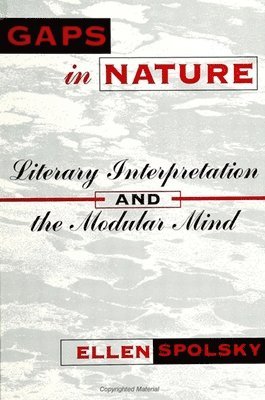
    Gaps in Nature

    Literary Interpretation and the Modular Mind

    AvEllen Spolsky

    Häftad, Engelska, 1993

    Del i serien SUNY series, The Margins of Literature

    447 kr

    Tillfälligt slut

    Beskrivning

    This book is a study of the relation between cognitive linguistics and literary theory. Theory of literary interpretation is reinterpreted in terms of current debate in cognitive science. While research in the humanities and social sciences is reasonably concerned with charting the power of culture to structure and constrain, Spolsky suggests that it is worthwhile to investigate the role of biological materialism as co-legislator of human life and understanding. The inevitable slippage we have come to acknowledge between words and the world has at least an analogue, and presumably also a source, in the workings of the human brain.

    Produktinformation

    • Utgivningsdatum:1993-07-01
    • Mått:152 x 229 x 25 mm
    • Vikt:340 g
    • Format:Häftad
    • Språk:Engelska
    • Serie:SUNY series, The Margins of Literature
    • Antal sidor:247
    • Förlag:State University of New York Press
    • ISBN:9780791413883

    Utforska kategorier

    • Litteraturteori inom Skönlitteratur

    Mer om författaren

    Ellen Spolsky is Associate Professor of English and Director of the Lechter Institute for Literary Research at Bar-Ilan University, Israel.

    Recensioner i media

    "Cognitive Science is arguably the most important intellectual development of the post World War II period. Literary theory, however, has failed almost completely to cope with this fundamental change in the intellectual climate. Spolsky's book is a pioneering effort in this regard. The argument is adventuresome and fresh. Unlike so much of the work which is now being published, it is not a rehash of a re-hash, etc. This is news."It deals significantly with a literature from a wide-range of historical periods and with a number of important literary theoretical positions—feminism (most notably, consistently, and insightfully), New Historicism, Marxism, Deconstruction, and psychoanalysis." — Don Byrd, State University of New York at Albany"The idea that art grows from an inherent attribute not only of mind but of the physical brain gains special poignance in the context from which the author views it: as an explanation of the enduring power and compulsiveness of the literary based in the biological urgency in the structure of mind/brain to fill in the gaps. For literature, biology is also destiny." — David Porush, Rensselaer Polytechnic Institute

    Innehållsförteckning

    • IntroductionEllen Spolsky 1. Power and Constraint: Convenantal Hermeneutics in MiltonHarold Fisch THEORETICAL PERSPECTIVES 2. Biblical Covenants as Performative LanguageGerda Elata-Alster and Rachel Salmon 3. Facing the Other: Levinas, Perelman, and RosenzweigSusan Handelman 4. The Difficulty of Finding a Moral Basis for Accepting the CovenantDaniel Statman 5. The Perpetual Covenant of Jewish LearningMenachem Fisch 6. The Sign of the CovenantBetty Rojtman COVENANTS AND TEXTS 7. Redesigning Redemption: Covenant in The Testament of MosesBetsy Halpern-Amaru 8. Placing Reading: Ancient Israel and Medieval EuropeDaniel Boyarin 9. Binding and Unbinding: The Summons to Interpretation in The Merchant of VeniceElizabeth Freund 10. American Literature's Declaration of In/dependence: Stanley Cavell, Nathanial Hawthorne, and the Covenant of ConsentEmily Miller Budick 11. Intertextuality and Reader Resonsibility: Living On in Malamud's "The Mourners"Sharon Deykin Baris 12. "The New Covenant" and the Dilemma of Dissensus: Bercovitch, Roth, and DoctorowSam B. Girgus Contributors