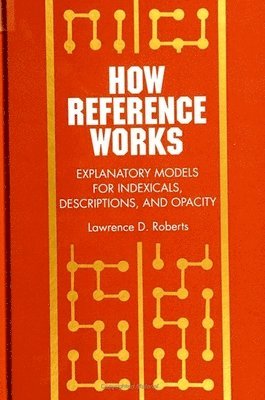
Inbunden, Engelska, 1993
How Reference Works
Explanatory Models for Indexicals, Descriptions, and Opacity
Del i serien SUNY series, Scientific Studies in Natural and Artificial Intelligence
1144 kr
Tillfälligt slut
Fler format och utgåvor
Beskrivning
Produktinformation
- Utgivningsdatum: 1993-08-31
- Vikt: 454 g
- Format: Inbunden
- Språk: Engelska
- Serie: SUNY series, Scientific Studies in Natural and Artificial Intelligence
- Antal sidor: 192
- Förlag: State University of New York Press
- ISBN: 9780791415757
Utforska kategorier
Mer om författaren
Lawrence D. Roberts is Associate Professor in the Program in Philosophy, Computers, and System Science in the Department of Philosophy at State University of New York at Binghamton.
Recensioner i media
"This is a book about how certain referring expressions in a natural language (English) manage to refer to objects in the world when used by speakers. Within the philosophy of language, the problem of reference has never been adequately solved. When viewed as a work in the philosophy of language, this book offers an interesting approach (if not a solution) to the problem of reference. However, the book's appeal is much broader than the philosophy of language. The problem of reference is also important to the philosophy of mind and cognitive science. This is probably why philosophers of language never developed a theory of reference in the first place: they were looking at words only. Roberts, on the other hand, looks not only at words (referring expressions), but also at minds."The book's approach to the philosophy of mind and cognitive science is novel, and has something important to say to philosophers of mind and cognitive scientists as well as philosophers of language. Both perception and context have been concerns of philosophers of mind and cognitive scientists for years, but not much progress has been made. This book is definitely progress." — Eric Dietrich, State University of New York at Binghamton
Betyg & recensioner
0 recensioner
Inga recensioner tillgängliga.