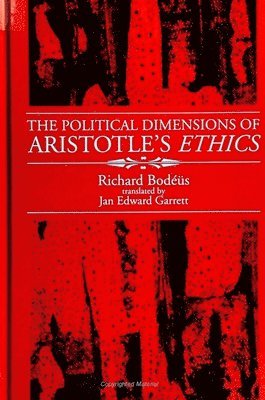
Del i serien SUNY series in Ancient Greek Philosophy
566 kr
Beställningsvara. Skickas inom 3-6 vardagar. Fri frakt över 249 kr.
Beskrivning
Produktinformation
- Utgivningsdatum:1993-11-18
- Mått:228 x 152 x 21 mm
- Vikt:454 g
- Format:Häftad
- Språk:Engelska
- Serie:SUNY series in Ancient Greek Philosophy
- Antal sidor:250
- Förlag:State University of New York Press
- ISBN:9780791416105
- Översättare:Jan Garrett
Utforska kategorier
Mer om författaren
Richard Bodeus is Professor of Philosophy at the University of Montreal. He is author of Politique et philosophie chez Aristote. Jan Garrett is Associate Professor in the Department of Philosophy and Religion at Western Kentucky University.
Recensioner i media
"By renewing, with an economy of means and a rare discretion, our reading of an entire panorama of Aristotelianism, The Political Dimensions of Aristotle's Ethics seems to me to be epoch-making in current Aristotelian studies. The astonishing originality of Bodeus's text begins by taking the form of a reassembly: like those dismembered mythic heroes whose parts rearrange themselves of their own accord, the territories hitherto disjoined of the ethical and political continent of Aristotle organized themselves into a system—into an assemblage that makes sense. Hence the strange impression, not of deja-vu, for the originality of Bodeus's work is incontestable, but of astonishment that no one had previously defended the theses he proposes."Bodeus provides answers to questions too enormous to have been posed clearly before: For whom did Aristotle write his ethical and political treatises? For Aristotle, it was essential that legislators be developed who would endow the state, no matter what its geographical, political, or social location, with excellent laws that would spread virtue, and thus happiness, in society. The philosopher concerned with ethics and politics thus found that he had been assigned a new task, but one perfectly in agreement with the expectations of the Greeks of his time. Bodeus has produced a great book. After him many opinions about Aristotelian practical philosophy, and consequently also about the very structure of Aristotelianism, have become unsustainable." — Pierre Pellegrin
Innehållsförteckning
- Author's Preface to the English Edition Translator's Preface Abbreviations Introduction Chapter 1 In Search of Aristotle's Project I. Difficulties peculiar to the interpretation of Aristotle II. 1. The Corpus in the catalog of Andronicus of Rhodes 2. Conceptions inherent in the principles of division 3. The supposed foundations of the systematizing interpretation III. 1. The first set of interpretive categories 2. A second set of interpretive categories 3. A third set of interpretive categories 4. Provisional balance sheet IV. 1. The common plan of the Ethics and the Politics : Ancient testimonies 2. Modern exegesis V. 1. A key-concept: 2. Prudential knowledge 3. Conclusions VI. The meaning of Aristotle's project Chapter 2 The Justification for a Political Teaching I. 1. A privileged document 2. A reflection in the Socratic-Platonic tradition 3. The limits of discourse in education II. 1. On the insufficiency of discourse for forming the good person 2. On the need for laws 3. On the formation of the lawgiver III. 1. The purpose of the lectures contained in the Ethics and the Politics 2. The intellectual nature of legislative activityIV. Philosophy to the aid of the lawgiver Chapter 3 The Development of Aristotle's Philosophy and Aristotle's Position in the Development of Philosophy I. The problem II. 1. Affinities with Politics vii-viii 2. Affinities with the Protrepticus III. Aristotle and the development of philosophy Chapter 4 The Public Character of Aristotle's Discourses I. Introduction 1. The complex nature of the documents 2. Oral communications 3. Lectures of a more or less private nature 4. An opening of the school to the city? 5. Differences with Plato II. 1. Obscure material circumstances 2. The traces of didactic precaution 3. A basic aspect of the discourse: The methodological statements Chapter 5 The Audience of the Political Discourses I. The concerns of the "speaker" II. Prerequisites for the discourse 1. The limits of language as instrument of knowledge 2. The experience required of the listener 3. The faculty of "comprehension" III. Education and critical aptitude 1. In music 2. In drawing 3. In medicine 4. Conclusion IV. The need to be educated 1. The unity of the concept "educated" 2. The deficiencies of the traditional interpretation 3. Results of to be avoided 4. General education and politics V. The practical relevance of education 1. New preliminaries for the discourse 2. "Good moral habits" and practical education Conclusion Education, Ethics and Politics Notes Bibliography Index of Passages from Plato and Aristotle Index of Ancient and Medieval Names Index of More Important Greek Terms Subject Index
Du kanske också är intresserad av
- Nyhet
- -30%
- Nyhet
- Signerad!
- Nyhet
Hjärnans akilleshälar : hur din hjärna lurar dig, och vad du kan göra åt det
Anders Hansen
289 kr
- -22%
- Nyhet
- -30%
- -30%