• Fri frakt över 249 kr
  • •
  • Snabba leveranser
  • •
  • Billiga böcker
Kundservice

Du är på sajten för privatpersoner.

Företag, bibliotek eller offentlig verksamhet?

Du handlar på classic.bokus.com, där alla dina funktioner finns intakta.
Till classic.bokus.com
Bokus logotyp. Gå till startsidan.
  • Erbjudanden
  • Nyheter
  • Student
  • Topplistor
  • Barn & ungdom
  • Bokus Play
  • E-böcker
  • Pocketböcker
  • Spel & pussel

10% rabatt på allt med kod NYSTART10 →

Sidfot

Mina sidor

    Hjälp

    • Kundservice
    • Vanliga frågor och svar
    • Frakt och leverans
    • Retur vid ångerrätt
    • Reklamera vara
    • Betalning
    • Köpvillkor
    • Allmänna villkor
    • Information om webbplatsens tillgänglighet

    Om Bokus

    • Om oss
    • Pressrum
    • För studenter
    • För företag
    • För bibliotek och offentlig verksamhet
    • För leverantörer
    • Hållbarhet

    Populärt

    • Aktuella erbjudanden
    • Presentkort
    • Studentlitteratur
    • Nya böcker
    • Topplistor
    • Signerade böcker
    • Engelska böcker

    Inspiration

    • Boktips
    • BookTok
    • Populära bokserier
    • Barnbokskaraktärer
    • Populära författare
    Logotyp för Bokus
    Följ oss på Facebook (extern länk)Följ oss på Instagram (extern länk)Följ oss på YouTube (extern länk)Följ oss på TikTok (extern länk)
    bokus @ CookiesAnpassa cookiesIntegritetspolicyKöpvillkor
    Till Citymail hemsida (extern länk)Till Budbee hemsida (extern länk)Till Postnord hemsida (extern länk)Till Schenker hemsida (extern länk)Till Early Bird hemsida (extern länk)Till Walleys hemsida (extern länk)
    1. Ekonomi och Ledarskap
    2. Nationalekonomi
    3. Internationell ekonomi

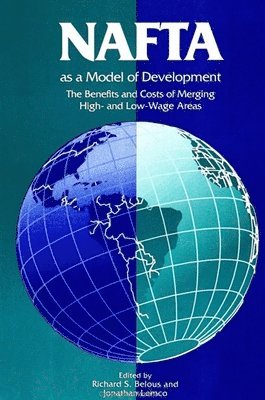
    NAFTA as a Model of Development

    The Benefits and Costs of Merging High- and Low-Wage Areas

    AvRichard S. Belous,Jonathan Lemco

    Häftad, Engelska, 1995

    359 kr

    Tillfälligt slut

    Beskrivning

    Examines whether NAFTA will produce increased or decreased wages in the regional trading blocs emerging in Europe, North America, and East Asia as a result of its uniting of high and low wage areas and identifies the winners and losers in various labor markets.This book discusses the North American Free Trade Agreement (NAFTA) in terms of its implications for job creation, reduced tariffs, and increased investment. Although the regional trading blocs merging in Europe, North America, and East Asia differ strikingly, there is one basic feature common to each—the formation of regional trading blocs involves a uniting of high- and low-wage areas. The authors address this issue directly, questioning whether NAFTA will promote upward or downward convergence of compensation rates, unit labor costs, and benefit levels. Equally important, they consider whether this trading arrangement will promote economic growth, investment, and efficiency. Viewpoints from the U.S., Canada, and Mexico and from the business and labor communities are included.

    Produktinformation

    • Utgivningsdatum:1995-08-10
    • Mått:153 x 229 x 12 mm
    • Vikt:308 g
    • Format:Häftad
    • Språk:Engelska
    • Antal sidor:216
    • Förlag:State University of New York Press
    • ISBN:9780791425701

    Utforska kategorier

    • Internationell ekonomi inom Ekonomi och Ledarskap
    • Folkrätt inom Juridik

    Mer om författaren

    Richard S. Belous is Vice President and Chief Economist at the National Planning Association and Adjunct Professor at George Washington University. Jonathan Lemco is Executive Director of the International Center for Family Enterprise, a Senior Fellow at the National Planning Association, and Adjunct Professor for Political Science at Johns Hopkins University-SAIS.

    Recensioner i media

    "Appropriate for general audiences as well as for classes in economic development, political economy, and North American integration, this book could also be useful for courses in international economics because it describes so many important theoretical concerns. Most appealing is the explicit attention paid to NAFTA as the first major attempt at freer trade and investment between countries at such widely different stages of development." — Sarah Stevens, St. Lawrence University"The book provides an excellent introduction to the debate of economic integration and its benefits as a model for development. It supplies a good overview of both negative and positive reactions to NAFTA, with about a third of the contributors in favor, a third neutral, and a third against. It is an evenhanded compilation of views on the subject by academics, business, and labor." — Gilbert R. Winham, Dalhousie University

    Innehållsförteckning

    • Forewordby Malcolm R. Lovell, Jr., Dieter Dettke, and Paul H.BoekerAcknowledgmentsAbout the EditorsAbout the AuthorsNAFTA as a Model of Development: The Benefits and Costs of Merging High- and Low-Wage Areasby Richard S. Belous and Jonathan LemcoEditorsPart I. Setting the Stage1. The NAFTA Development Model of Combining High- and Low-Wage Areas: An Introductionby Richard S. Belous and Jonathan LemcoPart II. Implications of the NAFTA for Wages and Investment2. The NAFTA and Wage Convergence: A Case of Winners and Losersby Clark W. Reynolds3. The NAFTA, a Social Charter, and Economic Growthby Harley Shaiken4. The NAFTA's Winners and Losers: A Focus on Investmentby Isaac Cohen5. The NAFTA and Downward Wage Pressureby Richard Rothstein6. Dynamic Integration, Foreign Investment, and Open Regionalism in the NAFTA and the Americasby Van R. Whiting, Jr.Part III. Implications of the NAFTA for Development7. Expanding the NAFTA? From Early Pan-Americanism to Hemispheric Economic Integrationby Joseph Grunwald8. The NAFTA and Developing Countriesby Sidney Weintraub9. Dynamic Gains from Intra-regional Trade in Latin Americaby Rudolf M. BuitelaarPart IV. Mexican Perspectives10. A Critical View of a NAFTA Including Mexicoby Adolfo Aguilar Zinser11. The NAFTA: A Mexican Search for Developmentby Gustavo del Castillo V.12. Mexican Economic Development and the NAFTAby Daniel Szabo13. Mexico's Interests and the NAFTAby Jorge BustamantePart V. Canadian Perspectives14. Canada's Interests and the NAFTAby Ronald Wonnacott15. The Development Impact of the NAFTA: A Canadian Perspectiveby Ann WestonPart VI. Industry and Labor Perspectives16. Global Trends and the Impact on Business in Latin America in the 1990sby John D. Tessier17. A Labor Perspective on the NAFTAby William C. Doherty18. The Sector Advisory Process and the NAFTAby Eugene W. Zeltmann19. Trade Liberalization and Mexicoby Juan de NigrisPart VII. Regional Trading Blocs, Social Policies, and Cross-Border Constituencies20. Can the EC Social Charter Be a Model for the NAFTA?by Reiner Hoffmann21. The Role of Nongovernmental Organizations and the NAFTAby Cathryn L. ThorupIndex