• Fri frakt över 249 kr
  • •
  • Snabba leveranser
  • •
  • Billiga böcker
Kundservice

Du är på sajten för privatpersoner.

Företag, bibliotek eller offentlig verksamhet?

Du handlar på classic.bokus.com, där alla dina funktioner finns intakta.
Till classic.bokus.com
Bokus logotyp. Gå till startsidan.
  • Erbjudanden
  • Nyheter
  • Student
  • Topplistor
  • Barn & ungdom
  • Bokus Play
  • E-böcker
  • Pocketböcker
  • Spel & pussel

10% rabatt på allt med kod: NYSTART10 →

Sidfot

Mina sidor

    Hjälp

    • Kundservice
    • Vanliga frågor och svar
    • Frakt och leverans
    • Retur vid ångerrätt
    • Reklamera vara
    • Betalning
    • Köpvillkor
    • Allmänna villkor
    • Information om webbplatsens tillgänglighet

    Om Bokus

    • Om oss
    • Pressrum
    • För studenter
    • För företag
    • För bibliotek och offentlig verksamhet
    • För leverantörer
    • Hållbarhet

    Populärt

    • Aktuella erbjudanden
    • Presentkort
    • Studentlitteratur
    • Nya böcker
    • Topplistor
    • Signerade böcker
    • Engelska böcker

    Inspiration

    • Boktips
    • BookTok
    • Populära bokserier
    • Barnbokskaraktärer
    • Populära författare
    Logotyp för Bokus
    Följ oss på Facebook (extern länk)Följ oss på Instagram (extern länk)Följ oss på YouTube (extern länk)Följ oss på TikTok (extern länk)
    bokus @ CookiesAnpassa cookiesIntegritetspolicyKöpvillkor
    Till Citymail hemsida (extern länk)Till Budbee hemsida (extern länk)Till Postnord hemsida (extern länk)Till Schenker hemsida (extern länk)Till Early Bird hemsida (extern länk)Till Walleys hemsida (extern länk)
    1. Filosofi och religion
    2. Filosofi
    3. Filosofiska discipliner

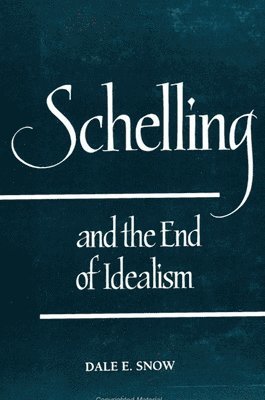
    Schelling and the End of Idealism

    AvDale E. Snow

    Häftad, Engelska, 1996

    Del i serien SUNY series in Hegelian Studies

    450 kr

    Beställningsvara. Skickas inom 5-8 vardagar. Fri frakt över 249 kr.

    Fler format och utgåvor

    Inbunden

    Tillf. slut

    Beskrivning

    This comprehensive, general introduction to Schelling's philosophy shows that it was Schelling who set the agenda for German idealism and defined the term of its characteristic problems.Schelling is finally beginning to emerge from the long shadow cast by the eminence and influence of Hegel. This book demonstrates that, far from merely forming a step on the royal road to Hegel, it was Schelling who set the agenda for German Idealism and defined the terms of its characteristic problems. Ultimately, it was also Schelling who explored the possibility of idealistic system-building from within and thus brought an end to idealism

    Produktinformation

    • Utgivningsdatum:1996-02-01
    • Mått:152 x 229 x 17 mm
    • Vikt:445 g
    • Format:Häftad
    • Språk:Engelska
    • Serie:SUNY series in Hegelian Studies
    • Antal sidor:271
    • Förlag:State University of New York Press
    • ISBN:9780791427460

    Utforska kategorier

    • Filosofiska discipliner inom Filosofi och religion

    Mer om författaren

    Dale E. Snow is Assistant Professor of Philosophy at Loyola College.

    Recensioner i media

    "It gives a very clear account (in relatively brief compass) of a long series of extremely difficult and obscure texts." — H. S. Harris, York University"The book is remarkably clear and straightforward. This is particularly impressive in the field of Schelling scholarship, given the notorious obscurity of Schelling's works. Dr. Snow has obviously taken great pains to report only what she thoroughly understands, and that is certainly enough to provide the reader with a comprehensive general introduction to Schelling's philosophy. There is, moreover, a definite need for such an introduction. One must recall that in virtually every country outside of England and the United States, Schelling has long been recognized as Hegel's equal, if not his philosophical superior. The project of introducing his philosophy here is an important one." — Joseph P. Lawrence, Holy Cross College

    Innehållsförteckning

    • Acknowledgments Introduction 1. The Enlightenment under Attack I. Kant's Early ReceptionII. Jacobi and the Pantheism ControversyIII. Faith or Reason?2. The Knowledge of Reality I. The Problem of the Thing in ItselfII. Fichte: The Self as First PrincipleIII. The Early Schelling's Concept of the SelfIV. How Is Knowledge of Reality Possible?V. Genius: The "Sunday's Children"Problem3. The Philosophy of Nature I. The Essential Role of the Philosophy of NatureII. Arguments against the Mechanistic Model of NatureIII. The Development of the Concept of MatterIV. Necessity and Scientific ObjectivityV. On the World SoulVI. Dynamism, Polarity, and the Philosophy of Organism4. Metaphors for Nature I. From the Philosophy of Nature to the SystemII. Metaphors of Dominance and ControlIII. KantIV. FichteV. HegelVI. Schelling5. The Emergence of the Unconscious I. The Purpose of the SystemII. A Clash of ParadigmsIII. Paradoxes in the SystemIV. Aesthetic Idealism6. Of Human Freedom I. The Idealism of FreedomII. DifficultiesIII. The Introduction: A Redefinition of FreedomIV. The "Real and Vital Conception of Freedom"V. "Man's Being Is Essentially His Own Deed"VI. An End of Idealism?7. Beyond Idealism? The Ages of the World I. Schelling's Later PhilosophyII. The Doctrine of the FallIII. The Historical Character of Reality: The Philosophy of TimeIV. Gottsein and Dasein: The Ontology of What is NotV. The Controversy of 1811—12 and BeyondVI. ConclusionNotes Selected Bibliography Index