• Fri frakt över 249 kr
  • •
  • Snabba leveranser
  • •
  • Billiga böcker
Kundservice

Du är på sajten för privatpersoner.

Företag, bibliotek eller offentlig verksamhet?

Du handlar på classic.bokus.com, där alla dina funktioner finns intakta.
Till classic.bokus.com
Bokus logotyp. Gå till startsidan.
  • Erbjudanden
  • Nyheter
  • Student
  • Topplistor
  • Barn & ungdom
  • Bokus Play
  • E-böcker
  • Pocketböcker
  • Spel & pussel

10% rabatt på allt med kod: NYSTART10 →

Sidfot

Mina sidor

    Hjälp

    • Kundservice
    • Vanliga frågor och svar
    • Frakt och leverans
    • Retur vid ångerrätt
    • Reklamera vara
    • Betalning
    • Köpvillkor
    • Allmänna villkor
    • Information om webbplatsens tillgänglighet

    Om Bokus

    • Om oss
    • Pressrum
    • För studenter
    • För företag
    • För bibliotek och offentlig verksamhet
    • För leverantörer
    • Hållbarhet

    Populärt

    • Aktuella erbjudanden
    • Presentkort
    • Studentlitteratur
    • Nya böcker
    • Topplistor
    • Signerade böcker
    • Engelska böcker

    Inspiration

    • Boktips
    • BookTok
    • Populära bokserier
    • Barnbokskaraktärer
    • Populära författare
    Logotyp för Bokus
    Följ oss på Facebook (extern länk)Följ oss på Instagram (extern länk)Följ oss på YouTube (extern länk)Följ oss på TikTok (extern länk)
    bokus @ CookiesAnpassa cookiesIntegritetspolicyKöpvillkor
    Till Citymail hemsida (extern länk)Till Budbee hemsida (extern länk)Till Postnord hemsida (extern länk)Till Schenker hemsida (extern länk)Till Early Bird hemsida (extern länk)Till Walleys hemsida (extern länk)
    1. Filosofi och religion
    2. Filosofi
    3. Filosofiska discipliner

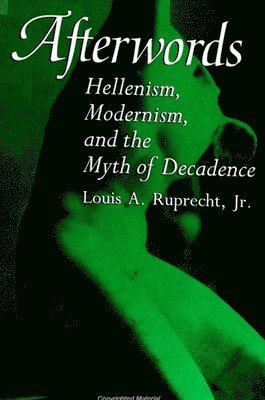
    Afterwords

    Hellenism, Modernism, and the Myth of Decadence

    AvLouis A. Ruprecht Jr.

    Häftad, Engelska, 1996

    389 kr

    Tillfälligt slut

    Beskrivning

    Reading both philosophical and theological texts, this book presents an argument against nostalgia: against the myth of a Golden Age, against the posture that sees "modernity" as a problem to be solved.This book about nostalgia raises the question of why it has become such a dominant and influential posture in contemporary philosophical and theological writing. The author notes the presence of the word "after" in a great many contemporary academic titles, and notes a spiritual sort of alienation that many feel in the "modern age." Out of this scholarly discontent emerges one of two related attempts: the attempt to return to a pre-modern manner of thinking and being (nostalgia); and the playful flight into some vaguely defined "postmodernity" (utopia). In either case, the common perception is that modernity is a problem, a problem to be avoided or escaped.Bringing philosophical and theological texts into conversation with one another, the book discovers a startling similarity in the accounts of modernness offered in these disparate idioms. Both are telling a story-a story which, the author argues, is as seductive as it is misguided.

    Produktinformation

    • Utgivningsdatum:1996-07-03
    • Mått:149 x 228 x 17 mm
    • Vikt:386 g
    • Format:Häftad
    • Språk:Engelska
    • Antal sidor:260
    • Förlag:State University of New York Press
    • ISBN:9780791429341

    Utforska kategorier

    • Filosofiska discipliner inom Filosofi och religion

    Mer om författaren

    Louis A. Ruprecht, Jr. is Visiting Professor, Department of Religion, Emory University

    Recensioner i media

    "The fundamental argument is a badly needed correction to the uncritical use of periodization in contemporary critical, philosophical, ethical, theological, and general cultural discourse. The specific periodization in question is the set of distinctions between 'modern,' 'premodern,' 'postmodern,' 'classical,' and 'Biblical' moments in the history of thought and ideas. The book represents a frontal assault upon the positions generated by several key contemporary writers (MacIntyre, Stout, Taylor in philosophy and ethics; Hauerwas in theology) who allegedly rely upon these distinctions. There is an extraordinarily effective analysis of Nietzsche in this connection, using Wir Philologen, a previously untranslated manuscript. This part is one of the high moments in the book. The author also has an unimpeachable command of Homer, Plato, Aristotle, Pauline theology, and the Greek tragedians. He's one of that endangered species, the Christian classicist. The book is written with wit, passion, a great wealth of allusion and learning. Outstanding." — Ralph V. Norman, Jr."The topic is at the heart of much contemporary debate about the relation of philosophy to religion and the role of religious faith not only in the academy but in Euro-American society at large. No one has gotten a clearer bead on these issues than the author. I emphatically recommend this book." — Bruce Lawrence, Duke University

    Innehållsförteckning

    • Preface: On Living After Greece A Premonition 1. After Nietzsche? When Un-modern Turned Anti-modernPhilosophical Texts 2. After the Polis? On the Use and Abuse of Aristotle's Political Animal3. After Virtue? On Distorted Philosophical NarrativesTheological Texts 4. After Christendom? On Distorted Theological Narratives5. After Belief? Fundamentalism, Secularization, and the Tragic PosturePremonition Fulfilled 6. Aftermath? On Modernist Prejudices and the PastAfterword: A Post-Mortem on Post-Modernity Select Bibliography Index