• Fri frakt över 249 kr
  • •
  • Snabba leveranser
  • •
  • Billiga böcker
Kundservice

Du är på sajten för privatpersoner.

Företag, bibliotek eller offentlig verksamhet?

Du handlar på classic.bokus.com, där alla dina funktioner finns intakta.
Till classic.bokus.com
Bokus logotyp. Gå till startsidan.
  • Erbjudanden
  • Nyheter
  • Student
  • Topplistor
  • Barn & ungdom
  • Bokus Play
  • E-böcker
  • Pocketböcker
  • Spel & pussel

10% rabatt på allt med kod NYSTART10 →

Sidfot

Mina sidor

    Hjälp

    • Kundservice
    • Vanliga frågor och svar
    • Frakt och leverans
    • Retur vid ångerrätt
    • Reklamera vara
    • Betalning
    • Köpvillkor
    • Allmänna villkor
    • Information om webbplatsens tillgänglighet

    Om Bokus

    • Om oss
    • Pressrum
    • För studenter
    • För företag
    • För bibliotek och offentlig verksamhet
    • För leverantörer
    • Hållbarhet

    Populärt

    • Aktuella erbjudanden
    • Presentkort
    • Studentlitteratur
    • Nya böcker
    • Topplistor
    • Signerade böcker
    • Engelska böcker

    Inspiration

    • Boktips
    • BookTok
    • Populära bokserier
    • Barnbokskaraktärer
    • Populära författare
    Logotyp för Bokus
    Följ oss på Facebook (extern länk)Följ oss på Instagram (extern länk)Följ oss på YouTube (extern länk)Följ oss på TikTok (extern länk)
    bokus @ CookiesAnpassa cookiesIntegritetspolicyKöpvillkor
    Till Citymail hemsida (extern länk)Till Budbee hemsida (extern länk)Till Postnord hemsida (extern länk)Till Schenker hemsida (extern länk)Till Early Bird hemsida (extern länk)Till Walleys hemsida (extern länk)
    1. Språk och ordböcker
    2. Språkvetenskap och lingvistik

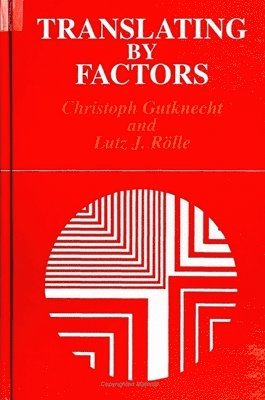
    Translating by Factors

    AvChristoph Gutknecht,Lutz J. Rolle

    Häftad, Engelska, 1996

    Del i serien SUNY series in Linguistics

    422 kr

    Tillfälligt slut

    Beskrivning

    By emphasizing, using English-German examples, the notion of factor set, this book fosters the awareness that successful and adequate translation requires properly accounting for the pertinent translation factors in each individual case. The factor approach gives translation criticism an objective yardstick for assessing the quality of translations. The authors explore the linguistic factors, including treatment of illocution and its indeterminacy, and perlocution, as well as non-linguistic factors such as factuality, situation, and culture. The book also includes aspects more genuinely linked to the notion of translation itself, such as translation units and word class and the nature and status of factors in translation theory.

    Produktinformation

    • Utgivningsdatum:1996-07-03
    • Mått:148 x 224 x 22 mm
    • Vikt:481 g
    • Format:Häftad
    • Språk:Engelska
    • Serie:SUNY series in Linguistics
    • Antal sidor:346
    • Förlag:State University of New York Press
    • ISBN:9780791429587

    Utforska kategorier

    • Språkvetenskap och lingvistik inom Språk och ordböcker

    Mer om författaren

    Christoph Gutknecht is Professor of English Linguistics in the Department of English Studies at Hamburg University. His previous publications include Die mittelhochdeutsche Versnovelle 'Von zwein koufmannen' des Ruprecht von Wurzburg; Friedrich der Grosse: De la litterature allemande. Mit der Moserschen Gegenschrift; Generative Linguistik: Ergebnisse moderner Sprachforschung; the Spanish edition of Linguistica generativa. Moderna investigacion del lenguaje; Practical English Phonetics: A Programmed Course in English Pronunciation; Grundbegriffe und Hauptstromungen der Linguistik; and Kontrastive Linguistik: Zielsprache Englisch. He is the editor of the international series Forum Linguisticum and Anglo-American Forum and co-editor of Beitrage zur Phonetik und Linguistik. Lutz J. Rolle teaches and researches in the English Department of Hamburg University. He is co-author of 'Die multifaktorielle Translationssituation bei den Modalverben des Sprachenpaares Deutsch-Englisch', in Quast (ed.): Einheit in der Vielfalt. Festschrift fur Peter Lang zum 60. Geburtstag.

    Recensioner i media

    "The notion of factor is essential to translation studies since all important aspects relating to them can be expressed in terms of it. By systematically exploring all possible kinds of translation factors, the authors make a substantial and remarkable contribution to the evolution of translation studies. There is no study which examines aspects of translation in such imaginative and instructive ways. This book represents a supreme standard of scientific accomplishment." — Christian Todenhagen, California State University, Chico"I like the authors' willingness and ability to analytically address thorny and subtle problems of translation which are all too often simply avoided as unbreachable—their heavy reliance on naturalistic as opposed to contrived examples." — Joseph L. Malone, Barnard College and Columbia University

    Innehållsförteckning

    • AcknowledgmentsList of FiguresList of TablesKey to Symbols 1. Introduction 1.1 Translating by Factors1.2 The Modals for a Case Study1.3 Goal of This Study 2. Formal Factors: Syntax and Morphology 2.1 Conjugation and Suffixation2.2 No Imperative Mood2.3 Direct Linkage to a Full Verb2.4 No DO Periphrasis2.5 No Nonfinite Forms2.6 Word Order2.7 Ellipsis2.8 Word Class2.9 Selection Restrictions 3. Semantic Factors 3.1 Polysemy3.2 The Modal System3.3 Types of Meaning3.4 Voice3.5 Tense3.6 Indirect Speech 4. Pragmatic Factors 4.1 Illocutionary Force4.2 Perlocution4.3 Factuality4.4 Situation4.5 Permanent Language Varieties4.6 Culture 5. Factors Relating to Spoken and Written Languages 5.1 Relative Frequency of Forms5.2 Prosody5.3 Punctuation5.4 Syntactic Anticipation 6. Factors Relating to Translation Units and Types of Equivalents 6.1 Zero Equivalence6.2 Morpheme6.3 Word6.4 Phrase6.5 Clause6.6 Sentence6.7 Paragraph6.8 Whole Text 7. Essential Factors of the Translation Situation 7.1 The SL Speaker7.2 The SL Text7.3 The Client7.4 The Translator7.5 The TL Hearer7.6 Translation Direction 8. Factors in Translation Theory 8.1 Sets of Factors8.2 Relationships between Factors8.3 Identity of Factors8.4 Translation Principles8.5 Equivalence8.6 Translation or Adaptation?8.7 Coexistence of Change Factors and Invariance Factors8.8 Retrospect and Prospect NotesReferencesAuthor IndexSubject Index