• Fri frakt över 249 kr
  • •
  • Snabba leveranser
  • •
  • Billiga böcker
Kundservice

Du är på sajten för privatpersoner.

Företag, bibliotek eller offentlig verksamhet?

Du handlar på classic.bokus.com, där alla dina funktioner finns intakta.
Till classic.bokus.com
Bokus logotyp. Gå till startsidan.
  • Erbjudanden
  • Nyheter
  • Student
  • Topplistor
  • Barn & ungdom
  • Bokus Play
  • E-böcker
  • Pocketböcker
  • Spel & pussel

10% rabatt på allt med kod: NYSTART10 →

Sidfot

Mina sidor

    Hjälp

    • Kundservice
    • Vanliga frågor och svar
    • Frakt och leverans
    • Retur vid ångerrätt
    • Reklamera vara
    • Betalning
    • Köpvillkor
    • Allmänna villkor
    • Information om webbplatsens tillgänglighet

    Om Bokus

    • Om oss
    • Pressrum
    • För studenter
    • För företag
    • För bibliotek och offentlig verksamhet
    • För leverantörer
    • Hållbarhet

    Populärt

    • Aktuella erbjudanden
    • Presentkort
    • Studentlitteratur
    • Nya böcker
    • Topplistor
    • Signerade böcker
    • Engelska böcker

    Inspiration

    • Boktips
    • BookTok
    • Populära bokserier
    • Barnbokskaraktärer
    • Populära författare
    Logotyp för Bokus
    Följ oss på Facebook (extern länk)Följ oss på Instagram (extern länk)Följ oss på YouTube (extern länk)Följ oss på TikTok (extern länk)
    bokus @ CookiesAnpassa cookiesIntegritetspolicyKöpvillkor
    Till Citymail hemsida (extern länk)Till Budbee hemsida (extern länk)Till Postnord hemsida (extern länk)Till Schenker hemsida (extern länk)Till Early Bird hemsida (extern länk)Till Walleys hemsida (extern länk)
    1. Filosofi och religion
    2. Filosofi
    3. Filosofiska discipliner

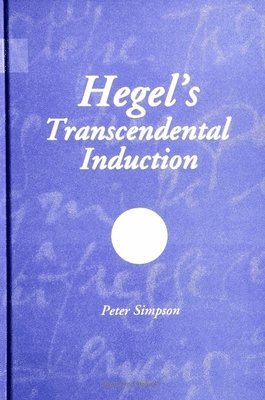
    Hegel's Transcendental Induction

    AvPeter Simpson

    Häftad, Engelska, 1997

    Del i serien SUNY series in Hegelian Studies

    383 kr

    Tillfälligt slut

    Beskrivning

    Challenges the orthodox account of Hegelian phenomenology as hyper-rationalism, arguing that Hegel's insistence on the primacy of experience in the development of scientific knowledge amounts to a kind of empiricism, or inductive epistemology.Hegel's Transcendental Induction challenges the orthodox account of Hegelian phenomenology as a hyper-rationalism, arguing that Hegel's insistence on the primacy of experience in the development of scientific knowledge amounts to a kind of empiricism, or inductive epistemology. While the inductive element does not exclude an emphasis on deductive demonstration as well, Hegel's phenomenological description of knowledge demonstrates why knowing becomes scientific only to the extent that it recognizes its dependence on experience.Simpson's argument closely parallels Hegel's own in the Phenomenology of Spirit, highlighting those sections, like Hegel's analysis of mastery and slavery, that contribute to the argument that knowing is both vulnerable and responsive to the way in which experience resists our attempts to make sense of things. Simpson's argument connects his account of Hegelian phenomenology with traditional accounts of induction, and with a number of other commentators.

    Produktinformation

    • Utgivningsdatum:1997-12-18
    • Mått:150 x 227 x 10 mm
    • Vikt:249 g
    • Format:Häftad
    • Språk:Engelska
    • Serie:SUNY series in Hegelian Studies
    • Antal sidor:159
    • Förlag:State University of New York Press
    • ISBN:9780791432761

    Utforska kategorier

    • Filosofiska discipliner inom Filosofi och religion

    Mer om författaren

    Peter Simpson is Assistant Professor of Philosophy at Laurentian University.

    Recensioner i media

    "The central thesis about the inductive development of the Phenomenology is worked out with care. This thesis allows the author to present fresh and often compelling re-readings of such often commented on themes as the natural consciousness, desire, slavery, morality, and forgiveness. Since Hegel himself does not describe his method in terms of induction, this book suggests a truly interesting shift of perspective on the Phenomenology." — Daniel Berthold-Bond, Bard College

    Innehållsförteckning

    • Introduction 1. The Experience of Conscious Life IntroductionSensuous CertaintyPerceptionConclusion2. Understanding, Desiring, and Death IntroductionThe Experience of the UnderstandingThe Emergence of ThinkingThe Realm of Law and the Role of AppearanceThe Crisis of UnderstandingDesiring Self-ConsciousnessThe Concept of Life as Desire In-ItselfLife and Natural ConsciousnessDesire For-Itself as Natural Self-ConsciousnessConclusion3. Induction and the Experience of the Singular Self IntroductionThe Experience of the Life of SlaveryThe Experience of the Institution of SlaveryThe Experience of SlaveryConclusion4. The Experience of the Institutional Self IntroductionThe Experience of SittlichkeitThe Experience of BildungMorality and ConscienceConclusion5. Induction and the Experience of Phenomenology IntroductionForgiveness, Phenomenology, and Absolute KnowingThe Unity of Induction and DeductionImplications for Reading HegelConclusionNotes Bibliography Index