• Fri frakt över 249 kr
  • •
  • Snabba leveranser
  • •
  • Billiga böcker
Kundservice

Du är på sajten för privatpersoner.

Företag, bibliotek eller offentlig verksamhet?

Du handlar på classic.bokus.com, där alla dina funktioner finns intakta.
Till classic.bokus.com
Bokus logotyp. Gå till startsidan.
  • Erbjudanden
  • Nyheter
  • Student
  • Topplistor
  • Barn & ungdom
  • Bokus Play
  • E-böcker
  • Pocketböcker
  • Spel & pussel

10% rabatt på allt med kod: NYSTART10 →

Sidfot

Mina sidor

    Hjälp

    • Kundservice
    • Vanliga frågor och svar
    • Frakt och leverans
    • Retur vid ångerrätt
    • Reklamera vara
    • Betalning
    • Köpvillkor
    • Allmänna villkor
    • Information om webbplatsens tillgänglighet

    Om Bokus

    • Om oss
    • Pressrum
    • För studenter
    • För företag
    • För bibliotek och offentlig verksamhet
    • För leverantörer
    • Hållbarhet

    Populärt

    • Aktuella erbjudanden
    • Presentkort
    • Studentlitteratur
    • Nya böcker
    • Topplistor
    • Signerade böcker
    • Engelska böcker

    Inspiration

    • Boktips
    • BookTok
    • Populära bokserier
    • Barnbokskaraktärer
    • Populära författare
    Logotyp för Bokus
    Följ oss på Facebook (extern länk)Följ oss på Instagram (extern länk)Följ oss på YouTube (extern länk)Följ oss på TikTok (extern länk)
    bokus @ CookiesAnpassa cookiesIntegritetspolicyKöpvillkor
    Till Citymail hemsida (extern länk)Till Budbee hemsida (extern länk)Till Postnord hemsida (extern länk)Till Schenker hemsida (extern länk)Till Early Bird hemsida (extern länk)Till Walleys hemsida (extern länk)
    1. Samhälle och politik
    2. Sociologi och antropologi

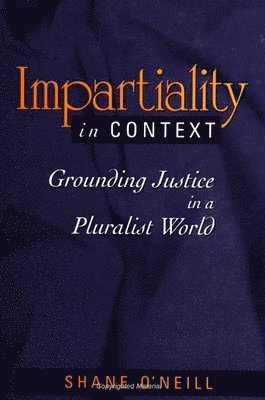
    Impartiality in Context

    Grounding Justice in a Pluralist World

    AvShane O'Neill

    Häftad, Engelska, 1997

    Del i serien SUNY series in Social and Political Thought

    390 kr

    Tillfälligt slut

    Beskrivning

    Assesses critically the work of Rawls, Walzer, and Habermas and presents a theory of justice that responds to two senses of pluralism.In this book, Shane O'Neill argues that the theory of justice must take seriously two dimensions of pluralism in the modern world. While it must acknowledge the plurality of individual conceptions of the good that is characteristic of every modern society, it must also reckon with the plurality of historically unique, culturally specific, political societies.O'Neill offers a distinctive perspective on an extremely significant current debate about universalism and particularism in political philosophy. Justice, he maintains, must be understood both in terms of an impartial point of view that respects differing conceptions of the good and in relation to the particular contexts in which disputes about norms and principles arise. Liberals, most notably John Rawls, have tended to privilege the former aspect of justice, while communitarians, especially Michael Walzer, have stressed the latter. O'Neill shows how Habermas's discourse ethics can overcome the limitations of these alternatives by providing theoretical tools that allow us to ground impartiality in particular contexts. This position is developed through an exploration of the complementary roles of moral and ethical discourses and an application of the theory to the political conflict in Northern Ireland.This careful and detailed philosophical argument offers a valuable critical introduction to a range of important topics, including the communitarian critique of liberalism, feminist perspectives on justice, the interpretive turn in political philosophy, the theory of communicative action, the dynamics of a discursive democracy, and the politics of recognition.

    Produktinformation

    • Utgivningsdatum:1997-07-10
    • Mått:152 x 228 x 17 mm
    • Vikt:408 g
    • Format:Häftad
    • Språk:Engelska
    • Serie:SUNY series in Social and Political Thought
    • Antal sidor:288
    • Förlag:State University of New York Press
    • ISBN:9780791433881

    Utforska kategorier

    • Sociologi och antropologi inom Samhälle och politik

    Mer om författaren

    Shane O'Neill teaches in the Department of Politics, Queen's University of Belfast, Northern Ireland.

    Recensioner i media

    "Shane O'Neill's book is an interesting analysis of Rawls's and Walzer's theories of justice and Habermas's discourse ethics. Its major contribution is to defend the superiority of Habermas's approach against those of Rawls and Walzer and to bring the feminist literature into the discussion of the connections between these three theorists." — Georgia Warnke, University of California, Riverside"O'Neill's book breaks new ground. The overall structure of the argument is very attractive and convincing: moving between Rawls's monological impartialism and Walzer's dialogical contextualism to open a space for Habermas's discourse ethics. I honestly couldn't put it down." — William Rehg, Saint Louis University

    Innehållsförteckning

    • Acknowledgments Introduction Part I. John Rawls's Impartialism 1. The Isolation of the Political Social Justice and ImpartialityPolitical Constructivism and the Idea of an Overlapping ConsensusJustice as Political and the Charge of AtomismNeutrality and Its LimitsCitizenship and the Public Sphere2. The Feminist Challenge The Original Position and the Danger of MarginalizationJustice in the FamilyGender Blindness in Rawls's TheoryJustice, Care, and SolidarityImpartiality and DifferencePart II. Michael Walzer's Contextualism 3. Hermeneutics and Justice Complex EqualityJustice without ProceduresInterpretation and Connected CriticismRival InterpretationsThe Dialogue of Justice4. The Limits of Walzer's Immanent Critique Social Power, Moral Universalism, and the Impartialist ProjectImmanent Critique and IdeologyHermeneutics and Critical TheoryExtending the Universalist Moral CodeAvoiding PartialityPart III. Jürgen Habermas's Discourse Ethics 5. The Priority of Communicative Action The Theoretical Roots of Discourse EthicsPhilosophy and Rational ReconstructionCommunicative and Strategic ActionIllocutions, Perlocutions, and Communicative Action's PriorityThe Reproduction of the Lifeworld and Critical Social Theory6. Discourse and Impartiality Discourse as Reflective Communicative ActionIdealization and RationalityArguing against ScepticismThe Advantages of Dialogical ImpartialityPart IV. Impartiality in Context 7. Morality and Ethical Life Habermas and the Contextualist ChallengeThe Scope of the Moral DomainHermeneutics and DiscourseEthical Discourse and Cultural DifferencesAn Impartialist Politics of Recognition8. The Case of Northern Ireland Justice and Pluralism in Northern IrelandToward a Constitutional PatriotismDiscursive Legitimation and Northern Ireland's ConstitutionConclusion Notes Bibliography Index