• Fri frakt över 249 kr
  • •
  • Snabba leveranser
  • •
  • Billiga böcker
Kundservice

Du är på sajten för privatpersoner.

Företag, bibliotek eller offentlig verksamhet?

Du handlar på classic.bokus.com, där alla dina funktioner finns intakta.
Till classic.bokus.com
Bokus logotyp. Gå till startsidan.
  • Erbjudanden
  • Student
  • Topplistor
  • Barn & ungdom
  • Bokus Play
  • E-böcker
  • Ljudböcker
  • Pocketböcker
  • Spel och pussel

5% studentrabatt – använd koden KURSBOK27 →

Sidfot

Mina sidor

    Hjälp

    • Kundservice
    • Vanliga frågor och svar
    • Frakt och leverans
    • Retur vid ångerrätt
    • Reklamera vara
    • Betalning
    • Köpvillkor
    • Allmänna villkor
    • Information om webbplatsens tillgänglighet

    Om Bokus

    • Om oss
    • Pressrum
    • För studenter
    • För företag
    • För bibliotek och offentlig verksamhet
    • För leverantörer
    • Hållbarhet

    Populärt

    • Aktuella erbjudanden
    • Presentkort
    • Studentlitteratur
    • Nya böcker
    • Topplistor
    • Signerade böcker
    • Engelska böcker

    Inspiration

    • Boktips
    • BookTok
    • Barnbokskaraktärer
    • Populära författare
    Logotyp för Bokus
    Följ oss på Facebook (extern länk)Följ oss på Instagram (extern länk)Följ oss på YouTube (extern länk)Följ oss på TikTok (extern länk)
    bokus @ CookiesAnpassa cookiesIntegritetspolicyKöpvillkor
    Till Citymail hemsida (extern länk)Till Budbee hemsida (extern länk)Till Postnord hemsida (extern länk)Till Schenker hemsida (extern länk)Till Early Bird hemsida (extern länk)Till Walleys hemsida (extern länk)
    1. Data och IT
    2. Systemvetenskap och AI

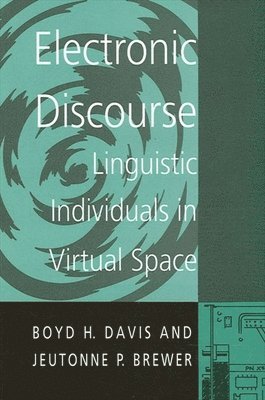
    Electronic Discourse

    Linguistic Individuals in Virtual Space

    AvBoyd H. Davis,Jeutonne P. Brewer

    Häftad, Engelska, 1997

    Del i serien SUNY series in Computer-Mediated Communication

    462 kr

    Beställningsvara. Skickas inom 5-8 vardagar. Fri frakt över 249 kr.

    Beskrivning

    Investigates the new world of computer conferencing and details how writers use language when their social interaction is exclusively enacted through text on screens.This book examines interactive electronic discourse, exposing use of language that has the immediacy characteristic of speech and the permanence characteristic of writing. The authors created an asynchronous mainframe conference for language and linguistics classes in which they presented students with the task of analyzing the language used in original newspaper reports of the 1960s Civil Rights Sit-Ins. The authors observed how students wrote to each other across a wide range of social and virtual settings, how they built a real, if short-lived community within and across campus boundaries, and how they handled conflict while avoiding confrontation on sensitive issues of race and power. The result is a study that details how people use language when their social interaction is exclusively enacted through text on screens, and how their exchange is affected by computer conferencing.The students who wrote in the electronic conferences faced two interrelated tasks: participating in a multiparty "conversation" and negotiating the individual identities they presented to one another in their virtual space. Individual writers used their own idiolects to influence the form and content of electronic discourse, adapting their own tacit knowledge of conversational strategies and written discourse to the new medium, as they created a real, although temporary, community.In the electronic universe, writers adapt conventions of oral and written discourse to their own individual communicative ends. Electronic discourse, sometimes called computer mediated communication, presents us with texts in contact, and through those texts, their writers. Intertextuality in electronic conferences replaced a variety of conversational conventions. This book examines evidence for change, some trace of being and human interaction in virtual space, a domain where footprints are not in moondust but in ether.

    Produktinformation

    • Utgivningsdatum:1997-10-02
    • Mått:229 x 151 x 18 mm
    • Vikt:327 g
    • Format:Häftad
    • Språk:Engelska
    • Serie:SUNY series in Computer-Mediated Communication
    • Antal sidor:217
    • Förlag:State University of New York Press
    • ISBN:9780791434765

    Utforska kategorier

    • Systemvetenskap och AI inom Data och IT

    Mer om författaren

    Boyd H. Davis is Professor in the Department of English, University of North Carolina, Charlotte. Her work includes Dimensions of Language and Writing about Literature and Film (with Margaret B. Bryan), among others. Jeutonne P. Brewer is Associate Professor in the Department of English, University of North Carolina, Greensboro. She has written Dialect Clash in America: Issues and Answers (with Paul D. Brandes), among others.

    Recensioner i media

    "This book describes a longitudinal study of college students acquiring and using one type of this new discourse, computer conferencing. The work is especially valuable because it describes use in as natural a setting as possible." —Denise Murray, San Jose State University

    Innehållsförteckning

    • Preface 1:// A first look at electronic discourse On defining electronic discourseWriting that reads like conversationSpeaking and writing: Biber's dimensionsMultidisciplinary perspectivesSelected approaches to discourse analysisDescription of the corpusUsing the concordance: An example2:// Context and contact in electronic discourse Repetition in electronic conference discourseAn emergent registerElectronic conferences as "Town meetings"Changing contexts within a conferenceSome purposes behind repetition in electronic discourse3:// Entering the conferences: Challenges of time and space Electronic writing: The "early" periodThe subject of the conferences: What students brought as "given"Setting and participants: A closer lookAccessing the conference: The challenge of spacesSpace and time in the arrangement of conference textsThe impact of realigned times and settings on monitor screensThe challenge of expectations about genreReplies as new frames4:// Titles: Form and function in electronic discourse The impact of conference topographyConventions of direct address in titlesTitles as suggestive of self-disclosureThe titling game and its impactManaging community: Software and moderator impact5:// Defining the territory Individual views of the territoryGuarding the territorySyntactic cues: Personal pronounsIt behaves differentlyGenderin the territoryBrent's territorial moves6:// Taking a stance: Text, self, and other Aspects of modalityModality: A range of definitionsThe individual and the textVerb classesContexts and modal verbsA change in audience7:// Aspects of emulation Popularity and rhythmMoving to reflexive writingEmulation across distance and space in the Transparent ConferenceAdjacency-pairs in the Transparent ConferenceFrame and focus in Topic 2Some features of audience in the Transparent ConferenceFlocking behaviors in mainframe conferences8:// Emulating a strategy: The rhetorical question Features of rhetorical questionsRhetorical questions from the Stand-Alone ConferenceRhetorical questions in the Transparent Conference9://Conclusion Going across local boundariesReading the text after the conferenceA notion of virtual communityA final commentAppendices References Index