• Fri frakt över 249 kr
  • •
  • Snabba leveranser
  • •
  • Billiga böcker
Kundservice

Du är på sajten för privatpersoner.

Företag, bibliotek eller offentlig verksamhet?

Du handlar på classic.bokus.com, där alla dina funktioner finns intakta.
Till classic.bokus.com
Bokus logotyp. Gå till startsidan.
  • Erbjudanden
  • Nyheter
  • Student
  • Topplistor
  • Barn & ungdom
  • Bokus Play
  • E-böcker
  • Pocketböcker
  • Spel & pussel

10% rabatt på allt med kod: NYSTART10 →

Sidfot

Mina sidor

    Hjälp

    • Kundservice
    • Vanliga frågor och svar
    • Frakt och leverans
    • Retur vid ångerrätt
    • Reklamera vara
    • Betalning
    • Köpvillkor
    • Allmänna villkor
    • Information om webbplatsens tillgänglighet

    Om Bokus

    • Om oss
    • Pressrum
    • För studenter
    • För företag
    • För bibliotek och offentlig verksamhet
    • För leverantörer
    • Hållbarhet

    Populärt

    • Aktuella erbjudanden
    • Presentkort
    • Studentlitteratur
    • Nya böcker
    • Topplistor
    • Signerade böcker
    • Engelska böcker

    Inspiration

    • Boktips
    • BookTok
    • Populära bokserier
    • Barnbokskaraktärer
    • Populära författare
    Logotyp för Bokus
    Följ oss på Facebook (extern länk)Följ oss på Instagram (extern länk)Följ oss på YouTube (extern länk)Följ oss på TikTok (extern länk)
    bokus @ CookiesAnpassa cookiesIntegritetspolicyKöpvillkor
    Till Citymail hemsida (extern länk)Till Budbee hemsida (extern länk)Till Postnord hemsida (extern länk)Till Schenker hemsida (extern länk)Till Early Bird hemsida (extern länk)Till Walleys hemsida (extern länk)
    1. Filosofi och religion
    2. Filosofi
    3. Filosofiska discipliner

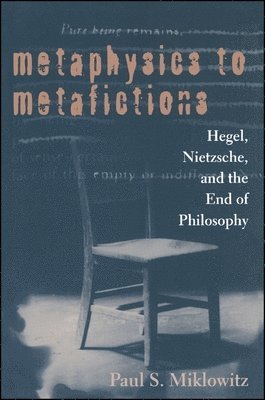
    Metaphysics to Metafictions

    Hegel, Nietzsche, and the End of Philosophy

    AvPaul S. Miklowitz

    Inbunden, Engelska, 1998

    Del i serien SUNY series in Hegelian Studies

    1 456 kr

    Beställningsvara. Skickas inom 3-6 vardagar. Fri frakt över 249 kr.

    Fler format och utgåvor

    Häftad

    449 kr

    Beskrivning

    Examines the key role played by Nietzsche in the undoing of the Hegelian system of totality.Through close reading and interpretive reflections, Paul Miklowitz examines key dialectics in Hegel's Phenomenology of Spirit in order to come to terms with the undoing of the Hegelian system of totality inaugurated by Nietzsche. In his interpretation of the Phenomenology, Miklowitz shows how Hegel skillfully manipulates narrative structures, even while disavowing them. Tracing the self-undermining implications latent in Hegel's strategy of retrospective phenomenological reconstruction through to their "coming to self-consciousness" in Nietzsche's central character of Zarathustra, Miklowitz argues that Hegel leaves a problematic legacy to philosophers, claiming to have achieved comprehensive wisdom in "absolute knowing," and that Nietzsche responds by undermining the authority of the philosopher. Thus metaphysical questions are reformulated and resolved in narratives self-consciously mediated by irony: they become "metafictions," philosophic imperatives that expressly acknowledge their own createdness and call into question their universality.In examining Nietzsche's post-apocalyptic and anti-Hegelian perspectivism, Miklowitz focuses on Thus Spoke Zarathustra, offering a new interpretation of "eternal return" in light of the problematic character of repetition intrinsic to the narrative structure of metaphysical illumination: Nietzsche's project, unlike Hegel's metaphysics, proposes to serve philosophy not as a uniquely true source of doctrine, but rather as an exemplary experiment in metafiction. Finally, Miklowitz also briefly examines some of the "postmodern" effects of this intellectual history and its consequences for the theoretical discourse of philosophy-whose end (in the sense of a telos) was reached in Hegel, only to have its end (in the sense of death or destruction) proclaimed by Nietzsche.

    Produktinformation

    • Utgivningsdatum:1998-08-13
    • Mått:152 x 229 x 23 mm
    • Vikt:499 g
    • Format:Inbunden
    • Språk:Engelska
    • Serie:SUNY series in Hegelian Studies
    • Antal sidor:248
    • Förlag:State University of New York Press
    • ISBN:9780791438770

    Utforska kategorier

    • Filosofiska discipliner inom Filosofi och religion

    Mer om författaren

    Paul S. Miklowitz is Associate Professor and Chair of Philosophy at California Polytechnic State University.

    Recensioner i media

    "This is a very good book. It has an important thesis—the fictionalization of discourse as the quintessentially modern reaction to the presumptive realization of metaphysics in Hegel's philosophy of the absolute. The work outlines in exemplary, if schematic, fashion the key role played by Nietzsche in the undoing of the Hegelian system of totality and marks the points in Hegel that Nietzsche can capitalize on." — Cyril O'Regan, author of The Heterodox Hegel

    Innehållsförteckning

    • Acknowledgments Citation Conventions Preface Introduction Chapter One. Language and Truth: The Aufhebung of Immediacy Part I: Sense-Certainty and Expression1. Deferral of the Vorrede and the "immediate" beginning2. Critiques of object- and subject-centered philosophical starting points3. The "divine nature of language": Mystery and equivocationPart II: On Reading Sense-Certainty1. The Immediacy demanded by the Logic2. "Sensualism" versus the always already linguisticChapter Two. Self and Other: The Mastery of Mediation Part I: Self-Certainty and Mediation1. The place of "Lordship and Bondage" in the structure of the Phenomenology2. The dialectic of Desire: Self as relation3. The dialectic of Lordship and Bondage proper4. Turning the tables on the lord and recuperating the bondsmanPart II: The Scrutiny of Self-Certainty: Further Mediations1. The fragment on "Love"; commentary by Freud, Solomon, and McTaggart2. Two critical themes: The primacy of thinghood; self-knowledge is self-creationChapter Three. Absolute Knowing: The End of Philosophy Part I: The Absolute from Beginning to End1. Stoicism and Skepticism as retreats into thought2. The internalized duplicity of unhappy consciousness3. Toward the Begriff, the form of absolute synthesis4. The structure of absolute knowingPart II: Re-Reading the Absolute: A New Beginning1. The Hegelian fundamentalism of Kojève2. The materialist critique of MarxChapter Four. Anticipatory Repetition: Heterodox Spirituality and Hegel's Philosophical Eschatology 1. Hegel and Joachim: A fateful syzygy (Löwith)2. Narrativity and Repetition: A textual resurrection (O'Regan and Murray)3. Conclusory transitionChapter Five. Eternal Return: Re-Telling the End Part I: After the End of Philosophy: The Perspective of an Aesthetic Attitude1. Nietzsche contra Hegel2. Regression to Vorstellungen: The pervasiveness of metaphor3. No facts, only interpretations: The world is a kind of fictionPart II: Discipleship and Eternal Return1. Zarathustra's "going under": Self-knowledge is deception2. The tightrope walker and the motley jester3. Eternal return as shibboleth for discipleship4. Beyond metaphysical solace: Redemption from the spirit of revenge5. Zarathustra's account of eternal return: A tale for adventurers only6. The failure of Zarathustra's disciples: Eternal return as rote repetition7. Closing the circle: Zarathustra's return to solitudeEpilogue: From Metaphysics to Metafictions Notes Bibliography Index