• Fri frakt över 249 kr
  • •
  • Snabba leveranser
  • •
  • Billiga böcker
Kundservice

Du är på sajten för privatpersoner.

Företag, bibliotek eller offentlig verksamhet?

Du handlar på classic.bokus.com, där alla dina funktioner finns intakta.
Till classic.bokus.com
Bokus logotyp. Gå till startsidan.
  • Erbjudanden
  • Student
  • Topplistor
  • Barn & ungdom
  • Bokus Play
  • E-böcker
  • Ljudböcker
  • Pocketböcker
  • Spel och pussel

Pocketfynda! Hundratals böcker för 49 kr/st →

Sidfot

Mina sidor

    Hjälp

    • Kundservice
    • Vanliga frågor och svar
    • Frakt och leverans
    • Retur vid ångerrätt
    • Reklamera vara
    • Betalning
    • Köpvillkor
    • Allmänna villkor
    • Information om webbplatsens tillgänglighet

    Om Bokus

    • Om oss
    • Pressrum
    • För studenter
    • För företag
    • För bibliotek och offentlig verksamhet
    • För leverantörer
    • Hållbarhet

    Populärt

    • Aktuella erbjudanden
    • Presentkort
    • Studentlitteratur
    • Nya böcker
    • Topplistor
    • Signerade böcker
    • Engelska böcker

    Inspiration

    • Boktips
    • BookTok
    • Barnbokskaraktärer
    • Populära författare
    Logotyp för Bokus
    Följ oss på Facebook (extern länk)Följ oss på Instagram (extern länk)Följ oss på YouTube (extern länk)Följ oss på TikTok (extern länk)
    bokus @ CookiesAnpassa cookiesIntegritetspolicyKöpvillkor
    Till Citymail hemsida (extern länk)Till Budbee hemsida (extern länk)Till Postnord hemsida (extern länk)Till Schenker hemsida (extern länk)Till Early Bird hemsida (extern länk)Till Walleys hemsida (extern länk)
    1. Psykologi och pedagogik
    2. Psykologi
    3. Psykologiska teorier och skolor

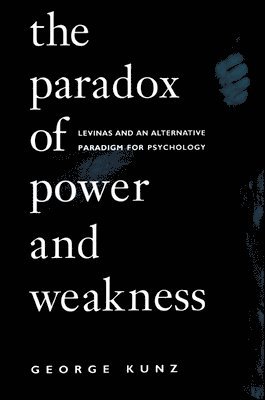
    Paradox of Power and Weakness

    Levinas and an Alternative Paradigm for Psychology

    AvGeorge Kunz

    Häftad, Engelska, 1998

    Del i serien SUNY series, Alternatives in Psychology

    449 kr

    Beställningsvara. Skickas inom 5-8 vardagar. Fri frakt över 249 kr.

    Beskrivning

    Offers an alternative paradigm for psychology, one that reflects Levinas's criticism of a self-centered notion of identity. Reveals the secret of an "authentic" altruism through a phenomenology of both power and weakness, and of the paradoxes of the weakness of power and the power of weakness.The metaethical philosophy of Emmanuel Levinas challenges Western egocentrism by describing the self as egoic yet nevertheless ethically called to transcend its own obsessions, compulsions, and addictions, and to respect and serve others. While power is powerful and weakness is weak, power can sabotage itself, and the weakness of others has power to command our attention and service. Levinas makes distinctions that offer psychology the basis for an alternative paradigm open to paradox. In The Paradox of Power and Weakness, George Kunz shows how the analyses of hagiography, cynicism, and limits on altruistic behavior by radical altruism contribute to this psychology of ethical responsibility for social sciences.

    Produktinformation

    • Utgivningsdatum:1998-07-16
    • Mått:229 x 151 x 18 mm
    • Vikt:363 g
    • Format:Häftad
    • Språk:Engelska
    • Serie:SUNY series, Alternatives in Psychology
    • Antal sidor:210
    • Förlag:State University of New York Press
    • ISBN:9780791438909

    Utforska kategorier

    • Psykologiska teorier och skolor inom Psykologi och pedagogik
    • Filosofiska discipliner inom Filosofi och religion

    Mer om författaren

    George Kunz is Associate Professor of Psychology at Seattle University.

    Recensioner i media

    "The Paradox of Power and Weakness is an important piece of work. Kunz writes a text accessible to a wide audience: to the ethical philosopher, to the public at large, to academics in many disciplines. For myself, I will enjoy reading it many times." — Ron Shaffer, Western Washington University"Kunz has straightforwardly and clearly exposed what a psychology would be like based in Levinasian thought. Although some psychologists have criticized the egology which is the center of modern psychology, few have a well-grounded philosophy upon which to found an alternative. Kunz has deftly connected the philosophy and the psychology." — David R. Harrington, Sheldon Jackson College"This book is interesting to read and extremely accessible. Kunz's use of examples taken from everyday life is extremely effective. He has adapted Levinas's proto-ethics so that it can more concretely address the day-to-day issues of living ethically. He has also demonstrated that one can think of Levinas's thought in a psychological framework—a possibility that many have argued might be fruitful but few have actually attempted to articulate. Kunz's elaboration of humility and simplicity as core characteristics of the human psyche offers a revolutionary critique of contemporary theories of human personality both in psychology and philosophy." — James Hatley, Salisbury State University

    Innehållsförteckning

    • Acknowledgments Prologue Part I: Psychology's Anomaly and an Alternative Paradigm Chapter One: Radical Altruism: An Anomaly to Modern Psychology A real distinction between altruism and self-interestPsychology's contribution to the cynicism of modern ideologiesPsychology: A psukhology as well as an egologyReflection on social problems shows the paradoxicalStatement of the paradoxThe paradox of the power of weaknessQuick survey of ethical theoriesThe paradox of the weakness of powerThe ItineraryChapter Two: An Alternative Paradigm: The Philosophy of Emmanuel Levinas The psukhe (breath, spirit, soul) is the-Other-in-meSix fundamental distinctions:Totality and infinityNeed and desireWillful activity and radical passivitySelf-initiated freedom and invested freedomSocial equality and ethical inequalityThe said and sayingPart II: The Egology of Power and Weakness Chapter Three: Power and the Power of Power Phenomenological method: disclosing and declaringPower and the power of power at three psychological levelsCognitive power: intelligence for understandingBehavioral power: exerted effort for successAffective Power: satisfaction for happinessHow power empowers powerConclusionChapter Four: Weakness and the Weakness of Weakness Phenomenological method: exposing and accusingWeakness and the weakness of weakness at three levelsCognitive weakness: ignorance for bad choicesBehavioral weakness: lazy and cowardly for failureAffective weakness: dissatisfaction for sufferingHow weakness weakens its weaknessConclusionPart III: The Psukhology of the Paradoxical Chapter Five: The Weakness of Power Phenomenological method: being exposed and confessingThe weakness of powerThe Gyges Complex: self-righteous and obsessiveThe Zeus Complex: manipulative and compulsiveThe Narcissus Complex: self-indulgent and addictiveHow power weakens powerConclusionChapter Six: The Power of Weakness Phenomenological method: listening to, being touched, and respondingThe power of weaknessSimplicity: the gift of self-skepticism for attentive understandingHumility: the gift of self-substitution for obedient servicePatience: the gift of self-sacrifice for compassionThe origin and direction of the selfHow the weakness of the Other empowers the self and empowers the OtherConclusionPart IV: The Paradox of Community Interlude: Social justice Based on Radical Altruism The appeal to hagiology: Edith WyschogrodThe cynicism of ideology: Peter SloterdijkThe limits to altruism: Roger BurggraeveChapter Seven: The Power of Community Phenomenological method: community communicates and assigns responsibilitiesCommunities understood by using the three levels of the psukhe: cognition, behavior, affectEducational communityPolitical communityCommercial communityThe power of the Common Good in schools, governments, and businessesConclusionEpilogue Bibliography Index