• Fri frakt över 249 kr
  • •
  • Snabba leveranser
  • •
  • Billiga böcker
Kundservice

Du är på sajten för privatpersoner.

Företag, bibliotek eller offentlig verksamhet?

Du handlar på classic.bokus.com, där alla dina funktioner finns intakta.
Till classic.bokus.com
Bokus logotyp. Gå till startsidan.
  • Erbjudanden
  • Nyheter
  • Student
  • Topplistor
  • Barn & ungdom
  • Bokus Play
  • E-böcker
  • Pocketböcker
  • Spel & pussel

10% rabatt på allt med kod: NYSTART10 →

Sidfot

Mina sidor

    Hjälp

    • Kundservice
    • Vanliga frågor och svar
    • Frakt och leverans
    • Retur vid ångerrätt
    • Reklamera vara
    • Betalning
    • Köpvillkor
    • Allmänna villkor
    • Information om webbplatsens tillgänglighet

    Om Bokus

    • Om oss
    • Pressrum
    • För studenter
    • För företag
    • För bibliotek och offentlig verksamhet
    • För leverantörer
    • Hållbarhet

    Populärt

    • Aktuella erbjudanden
    • Presentkort
    • Studentlitteratur
    • Nya böcker
    • Topplistor
    • Signerade böcker
    • Engelska böcker

    Inspiration

    • Boktips
    • BookTok
    • Populära bokserier
    • Barnbokskaraktärer
    • Populära författare
    Logotyp för Bokus
    Följ oss på Facebook (extern länk)Följ oss på Instagram (extern länk)Följ oss på YouTube (extern länk)Följ oss på TikTok (extern länk)
    bokus @ CookiesAnpassa cookiesIntegritetspolicyKöpvillkor
    Till Citymail hemsida (extern länk)Till Budbee hemsida (extern länk)Till Postnord hemsida (extern länk)Till Schenker hemsida (extern länk)Till Early Bird hemsida (extern länk)Till Walleys hemsida (extern länk)
    1. Samhälle och politik
    2. Politik och statsskick

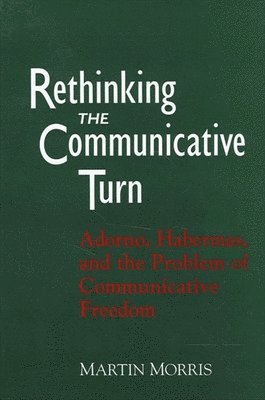
    Rethinking the Communicative Turn

    Adorno, Habermas, and the Problem of Communicative Freedom

    AvMartin Morris

    Häftad, Engelska, 2001

    Del i serien SUNY series in Social and Political Thought

    389 kr

    Tillfälligt slut

    Beskrivning

    Assesses linguistic versus aesthetic visions of critical theory and their capacity to contribute to the analysis of contemporary democratic society.Contrasting aesthetic versus linguistic centered visions for critical theory and the analysis of contemporary democratic theory and society, Martin Morris draws special attention to the concept of communicative freedom. He problematizes the paradigm shift within critical theory from the "philosophy of the subject" to the communicative action theory championed by Jürgen Habermas by opposing Habermas's reconstruction of critical theory to that of Theodor W. Adorno.

    Produktinformation

    • Utgivningsdatum:2001-01-11
    • Mått:150 x 226 x 15 mm
    • Vikt:340 g
    • Format:Häftad
    • Språk:Engelska
    • Serie:SUNY series in Social and Political Thought
    • Antal sidor:255
    • Förlag:State University of New York Press
    • ISBN:9780791447987

    Utforska kategorier

    • Politik och statsskick inom Samhälle och politik

    Mer om författaren

    Martin Morris has most recently taught politics at York University in Toronto.

    Recensioner i media

    "Morris makes a compelling argument for reevaluating Adorno's legacy and revitalizing critical theory as a whole." — International Studies in Philosophy"It is an original work in the area of critical theory in two ways. First it pushes critical theory forward through a reconstruction of centrally important, though misunderstood and neglected concepts, and second, it attempts to develop new insights and arguments on the philosophical foundation secured through this reconstruction. Despite the many historical treatments of his work, Adorno is, not to put too fine a point on it, relatively virgin territory for social and political theory, and it is in the area of explicating and beginning to develop the significance of Adorno's work that Morris succeeds where others have yet barely to venture." — Morton Schoolman, University at Albany, State University of New York"Morris provides a very strong Adornoesque critique of Habermas's 'communicative turn' and a spirited and engaging defense of Adorno against Habermas. He makes important contributions to critical theory that should interest a wide range of people concerned with the Frankfurt School and the work of Habermas and Adorno." — Douglas Kellner, author of Media Culture: Cultural Studies, Identity and Politics Between the Modern and the Postmodern

    Innehållsförteckning

    • ACKNOWLEDGMENTSABBREVIATIONS 1. INTRODUCTION 1.1 The Frankfurt School and Habermas: A Snapshot View 1.2 Conflicting Paradigmatic Issues 2. CRITICAL THEORY AND THE ECLIPSE OF 'IDEOLOGY': THE EARLY FRANKFURT VISION AND ITS TRANSFORMATION 2.1 The Program of Critical Theory and the Problem of 'Ideology' Critique2.2 The Dialectic of Enlightenment2.3 Concluding Remarks 3. HABERMAS AND THE CRITIQUE OF REIFICATION 3.1 The Habermasian Critique of Reification in Late Capitalism3.2 Capitalism and Social Crisis3.3 Real Abstraction and Ideology3.4 Concluding Remarks 4. FROM THE PURSUIT OF TRUTH TO THE PARADOXES OF APORIA AND CONTRADICTION: HABERMAS AND ADORNO 4.1 The Primacy of Language-Use4.2 Validity and the Ethical Force of Language-Use 4.3 The Performative Contradiction in the Radical Critique of Domination4.4 A Concluding Note on Contradiction and Dialectic 5. RECOVERING THE ETHICAL AND POLITICAL FORCE OF ADORNO'S AESTHETIC-CRITICAL THEORY 5.1 The Priority of the Object and the Passion for Critique5.2 Language and the Subject: Adorno5.3 Art and the Recovery of Negativity and Non-Identity: Toward a Politics of the 'Mimetic Shudder' 6. CONCLUSION NotesBibliographyIndex