• Fri frakt över 249 kr
  • •
  • Snabba leveranser
  • •
  • Billiga böcker
Kundservice

Du är på sajten för privatpersoner.

Företag, bibliotek eller offentlig verksamhet?

Du handlar på classic.bokus.com, där alla dina funktioner finns intakta.
Till classic.bokus.com
Bokus logotyp. Gå till startsidan.
  • Erbjudanden
  • Nyheter
  • Student
  • Topplistor
  • Barn & ungdom
  • Bokus Play
  • E-böcker
  • Pocketböcker
  • Spel & pussel

Må bättre, för mindre! Upp till 50% rabatt på hälsoböcker

Sidfot

Mina sidor

    Hjälp

    • Kundservice
    • Vanliga frågor och svar
    • Frakt och leverans
    • Retur vid ångerrätt
    • Reklamera vara
    • Betalning
    • Köpvillkor
    • Allmänna villkor
    • Information om webbplatsens tillgänglighet

    Om Bokus

    • Om oss
    • Pressrum
    • För studenter
    • För företag
    • För bibliotek och offentlig verksamhet
    • För leverantörer
    • Hållbarhet

    Populärt

    • Aktuella erbjudanden
    • Presentkort
    • Studentlitteratur
    • Nya böcker
    • Topplistor
    • Signerade böcker
    • Engelska böcker

    Inspiration

    • Boktips
    • BookTok
    • Populära bokserier
    • Barnbokskaraktärer
    • Populära författare
    Logotyp för Bokus
    Följ oss på Facebook (extern länk)Följ oss på Instagram (extern länk)Följ oss på YouTube (extern länk)Följ oss på TikTok (extern länk)
    bokus @ CookiesAnpassa cookiesIntegritetspolicyKöpvillkor
    Till Citymail hemsida (extern länk)Till Budbee hemsida (extern länk)Till Postnord hemsida (extern länk)Till Schenker hemsida (extern länk)Till Early Bird hemsida (extern länk)Till Walleys hemsida (extern länk)
    1. Historia och arkeologi
    2. Historia
    3. Asiens historia

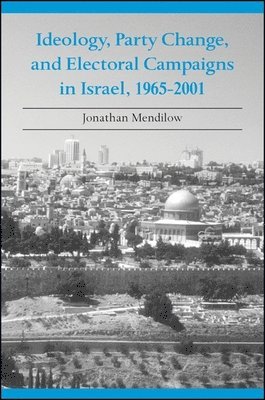
    Ideology, Party Change, and Electoral Campaigns in Israel, 1965-2001

    AvJonathan Mendilow

    Inbunden, Engelska, 2003

    Del i serien SUNY series in Israeli Studies

    1 108 kr

    Tillfälligt slut

    Fler format och utgåvor

    Häftad

    Tillf. slut

    Beskrivning

    Explores the turbulent changes in Israel party politics since the mid-1960s.The tumultuous and rapid political change experienced by Israel since 1965 has been reflected in the history of its party system. In this book, Jonathan Mendilow examines the party and party system transformations through the lens of the electoral campaigns that defined and reflected them. He shows that the relative stability of the dominant party system bequeathed from the pre-independence era was shattered in the 1960s, and replaced by cluster parties that vied for power in the ideological center, only to decline and be replaced in turn in the 1980s and early 1990s by ideological party blocs locked in centrifugal competition. With the separate direct election of the prime minister since the mid-1990s, there has been yet a third profound realignment in party structures, ideologies, and modes of campaigning, according to Mendilow.

    Produktinformation

    • Utgivningsdatum:2003-01-09
    • Mått:152 x 229 x 16 mm
    • Vikt:526 g
    • Format:Inbunden
    • Språk:Engelska
    • Serie:SUNY series in Israeli Studies
    • Antal sidor:300
    • Förlag:State University of New York Press
    • ISBN:9780791455876

    Utforska kategorier

    • Asiens historia inom Historia och arkeologi

    Mer om författaren

    Jonathan Mendilow is Professor of Political Science at Rider University. He is the author of The Romantic Tradition in British Political Thought, and the editor of Political Theory From the French Revolution to the Rise of Fascism.

    Innehållsförteckning

    • Tables Acknowledgments 1. Introduction I. Four Variants of the Israeli Party System, 1965–2001II. The Literature on Party System Change and the Case of IsraelIII. Some Methodological Considerations Part I. The Cluster Party System 2. The Formation of the Cluster Parties I. Introduction: The First Israeli Party SystemII. Party Clustering on the Right, 1955–1965III. Party Clustering on the Left, 1959–1965 3. The Logic of the New Party System I. Cluster Parties: Organizational and Ideological DimensionsII. Ideological DepolarizationIII. Structural PolarizationIV. Changes in Party Competition, Membership, and FinanceV. The Yom Kippur War and its EffectsVI. Summary and Conclusions Part II. The Party-Bloc System 4. The Transition to the Party-Bloc System I. Introduction: The Twilight of the Cluster Party SystemII. Party Cluster Stability and the Elections of 1981III. Campaign 1984: The Turning Point 5. The Campaigns of 1988 and 1992 and the Heyday of the Party-Bloc System I. 1988, 1992, and the New Rules of the GameII. The Campaign of 1988 and Labor's Forced ConversionIII. 1992—The Coercion of the Labor and Likud Campaigns IV. Summary and Conclusions Part III. The Parlia-Presidential System 6. The Logic of the New System: Candidates in Search of Centers I. Introduction: On Feeble Parties, Weak-Strong Prime Ministers, and Other Schemes of Mice and MenII. From Oslo to the Opening of the 1996 Campaign: The Likud in Crisis III. Campaign 1996 and the Strategy of Contrived Bipolarity 7. Straddling the Millennium I. The Center That Could Not HoldII. Barak, Mordechai, and Netanyahu: Alternative Routes to the CenterIII. Again the Center Cannot HoldIV. Parlia-Presidentialism's Last HurrahV. Summary 8. Epilogue: A Comparative Perspective I. The Cases of India and FranceII. A Note on the Future of Change Notes Bibliography Index