• Fri frakt över 249 kr
  • •
  • Snabba leveranser
  • •
  • Billiga böcker
Kundservice

Du är på sajten för privatpersoner.

Företag, bibliotek eller offentlig verksamhet?

Du handlar på classic.bokus.com, där alla dina funktioner finns intakta.
Till classic.bokus.com
Bokus logotyp. Gå till startsidan.
  • Erbjudanden
  • Nyheter
  • Student
  • Topplistor
  • Barn & ungdom
  • Bokus Play
  • E-böcker
  • Pocketböcker
  • Spel & pussel

10% rabatt på allt med kod NYSTART10 →

Sidfot

Mina sidor

    Hjälp

    • Kundservice
    • Vanliga frågor och svar
    • Frakt och leverans
    • Retur vid ångerrätt
    • Reklamera vara
    • Betalning
    • Köpvillkor
    • Allmänna villkor
    • Information om webbplatsens tillgänglighet

    Om Bokus

    • Om oss
    • Pressrum
    • För studenter
    • För företag
    • För bibliotek och offentlig verksamhet
    • För leverantörer
    • Hållbarhet

    Populärt

    • Aktuella erbjudanden
    • Presentkort
    • Studentlitteratur
    • Nya böcker
    • Topplistor
    • Signerade böcker
    • Engelska böcker

    Inspiration

    • Boktips
    • BookTok
    • Populära bokserier
    • Barnbokskaraktärer
    • Populära författare
    Logotyp för Bokus
    Följ oss på Facebook (extern länk)Följ oss på Instagram (extern länk)Följ oss på YouTube (extern länk)Följ oss på TikTok (extern länk)
    bokus @ CookiesAnpassa cookiesIntegritetspolicyKöpvillkor
    Till Citymail hemsida (extern länk)Till Budbee hemsida (extern länk)Till Postnord hemsida (extern länk)Till Schenker hemsida (extern länk)Till Early Bird hemsida (extern länk)Till Walleys hemsida (extern länk)
    1. Filosofi och religion
    2. Filosofi
    3. Filosofiska discipliner

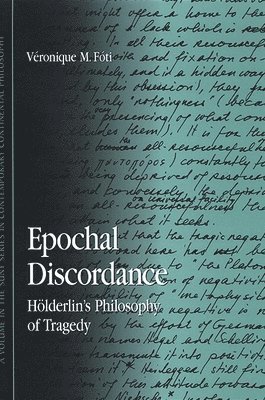
    Epochal Discordance

    Hölderlin's Philosophy of Tragedy

    AvVéronique M. Fóti

    Häftad, Engelska, 2007

    Del i serien SUNY series in Contemporary Continental Philosophy

    382 kr

    Tillfälligt slut

    Fler format och utgåvor

    Inbunden

    Tillf. slut

    Beskrivning

    Examines the German poet Hölderlin's philosophical insights into tragedy.Friedrich Hölderlin must be considered not only a significant poet but also a philosophically important thinker within German Idealism. In both capacities, he was crucially preoccupied with the question of tragedy, yet, surprisingly, this book is the first in English to explore fully his philosophy of tragedy. Focusing on the thought of Hegel, Nietzsche, Heidegger, and Reiner Schürmann, Véronique M. Fóti discusses the tragic turning in German philosophy that began at the close of the eighteenth century to provide a historical and philosophical context for an engagement with Hölderlin. She goes on to examine the three fragmentary versions of Hölderlin's own tragedy, The Death of Empedocles, together with related essays, and his interpretation of Sophoclean tragedy. Fóti also addresses the relationship of his character Empedocles to the pre-Socratic philosopher and concludes by examining Heidegger's dialogue with Hölderlin concerning tragedy and the tragic.

    Produktinformation

    • Utgivningsdatum:2007-06-01
    • Mått:155 x 227 x 10 mm
    • Vikt:227 g
    • Format:Häftad
    • Språk:Engelska
    • Serie:SUNY series in Contemporary Continental Philosophy
    • Antal sidor:155
    • Förlag:State University of New York Press
    • ISBN:9780791468609

    Utforska kategorier

    • Filosofiska discipliner inom Filosofi och religion

    Mer om författaren

    Véronique M. Fóti is Professor of Philosophy at Penn State at University Park and the author of Vision's Invisibles: Philosophical Explorations, also published by SUNY Press, and Heidegger and the Poets: Poiēsis/Sophia/Technē..

    Innehållsförteckning

    • Prefatory NotePrologue 1. The Tragic Turning and Tragic Paradigm in Philosophy 2. Communing with the Pure Elements: The First Two Versions of The Death of Empedocles 3. Singularity and Reconciliation: The Third Version of The Death of Empedocles 4. Between Hölderlin’s Empedocles and Empedocles of Akragas 5. The Faithless Turning: Hölderlin’s Reading of Oedipus Tyrannos 6. Dys-Limitation and the "Patriotic Turning": Sophocles’s Antigone 7. From an Agonistic of Powers to a Homecoming: Heidegger, Hölderlin, and Sophocles EpilogueNotesBibliographyIndex of Persons Index of Topics