• Fri frakt över 249 kr
  • •
  • Snabba leveranser
  • •
  • Billiga böcker
Kundservice

Du är på sajten för privatpersoner.

Företag, bibliotek eller offentlig verksamhet?

Du handlar på classic.bokus.com, där alla dina funktioner finns intakta.
Till classic.bokus.com
Bokus logotyp. Gå till startsidan.
  • Erbjudanden
  • Nyheter
  • Student
  • Topplistor
  • Barn & ungdom
  • Bokus Play
  • E-böcker
  • Pocketböcker
  • Spel & pussel

Må bättre, för mindre! Upp till 50% rabatt på hälsoböcker

Sidfot

Mina sidor

    Hjälp

    • Kundservice
    • Vanliga frågor och svar
    • Frakt och leverans
    • Retur vid ångerrätt
    • Reklamera vara
    • Betalning
    • Köpvillkor
    • Allmänna villkor
    • Information om webbplatsens tillgänglighet

    Om Bokus

    • Om oss
    • Pressrum
    • För studenter
    • För företag
    • För bibliotek och offentlig verksamhet
    • För leverantörer
    • Hållbarhet

    Populärt

    • Aktuella erbjudanden
    • Presentkort
    • Studentlitteratur
    • Nya böcker
    • Topplistor
    • Signerade böcker
    • Engelska böcker

    Inspiration

    • Boktips
    • BookTok
    • Populära bokserier
    • Barnbokskaraktärer
    • Populära författare
    Logotyp för Bokus
    Följ oss på Facebook (extern länk)Följ oss på Instagram (extern länk)Följ oss på YouTube (extern länk)Följ oss på TikTok (extern länk)
    bokus @ CookiesAnpassa cookiesIntegritetspolicyKöpvillkor
    Till Citymail hemsida (extern länk)Till Budbee hemsida (extern länk)Till Postnord hemsida (extern länk)Till Schenker hemsida (extern länk)Till Early Bird hemsida (extern länk)Till Walleys hemsida (extern länk)
    1. Filosofi och religion
    2. Filosofi
    3. Filosofiska discipliner

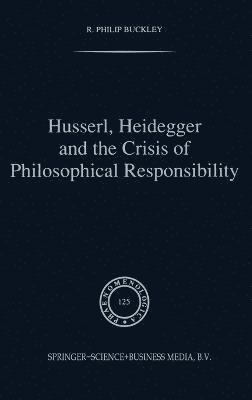
    Husserl, Heidegger and the Crisis of Philosophical Responsibility

    AvR.Philip Buckley

    Inbunden, Engelska, 1992

    Del i serien Phaenomenologica

    870 kr

    Beställningsvara. Skickas inom 10-15 vardagar. Fri frakt över 249 kr.

    Beskrivning

    This volume sheds light upon the omnipresent discussion of 'crisis' in our times by returning to the thought of the two philosophers upon which much of this talk is consciously (or unconsciously) based, namely, Edmund Husserl and Martin Heidegger. By tracing the narrative of the 'crisis' from Husserl's early treatment of arithmetic and logic through to Heidegger's meditations on the essence of technology, the author not only proposes a unified reading of both Husserl's and Heidegger's work, but points to important elements of the often underplayed continuity between these phenomenologists. At the same time, the concept of 'crisis' also illustrates the difference between Husserl and Heidegger. Though both define the crisis as one of 'forgetting', and both view this 'forgetting' as a matter of philosophical responsibility, essential divergence emerges in their interpretation of this phenomenon. Three questions uncover these points of convergence and divergence. First, does not the 'forgetfulness' reveal itself as a type of felix culpa, a necessary decay that now reveals itself in a positive light, indeed, as the precondition of history itself?Second, what is presupposed when the subjects is held responsible for forgetting? Third, what are the political consequences of such 'crisis'-philosophy? This last question allows access not only to hidden political aspects of Husserl's thought, but opens a further perspective for considering Heidegger's overt political activities.

    Produktinformation

    • Utgivningsdatum:1992-06-30
    • Mått:156 x 234 x 20 mm
    • Vikt:632 g
    • Format:Inbunden
    • Språk:Engelska
    • Serie:Phaenomenologica
    • Antal sidor:324
    • Förlag:Kluwer Academic Publishers
    • ISBN:9780792316336

    Utforska kategorier

    • Filosofiska discipliner inom Filosofi och religion

    Innehållsförteckning

    • Part 1 Husserl and the crisis as loss: Husserl's description of the crisis; the genesis of the crisis; the "crisis" as "Leitmotiv" of Husserl's thought; the overcoming of the crisis of forgetting; the limits of responsibility. Part 2 Heidegger and the crisis as possibility: Heidegger's account of the crisis; fundamental ontology and the crisis as paradox; philosophical responsibility in the age of technology.