• Fri frakt över 249 kr
  • •
  • Snabba leveranser
  • •
  • Billiga böcker
Kundservice

Du är på sajten för privatpersoner.

Företag, bibliotek eller offentlig verksamhet?

Du handlar på classic.bokus.com, där alla dina funktioner finns intakta.
Till classic.bokus.com
Bokus logotyp. Gå till startsidan.
  • Erbjudanden
  • Student
  • Topplistor
  • Barn & ungdom
  • Bokus Play
  • E-böcker
  • Ljudböcker
  • Pocketböcker
  • Spel och pussel

Pocketfynda! Hundratals böcker för 49 kr/st →

Sidfot

Mina sidor

    Hjälp

    • Kundservice
    • Vanliga frågor och svar
    • Frakt och leverans
    • Retur vid ångerrätt
    • Reklamera vara
    • Betalning
    • Köpvillkor
    • Allmänna villkor
    • Information om webbplatsens tillgänglighet

    Om Bokus

    • Om oss
    • Pressrum
    • För studenter
    • För företag
    • För bibliotek och offentlig verksamhet
    • För leverantörer
    • Hållbarhet

    Populärt

    • Aktuella erbjudanden
    • Presentkort
    • Studentlitteratur
    • Nya böcker
    • Topplistor
    • Signerade böcker
    • Engelska böcker

    Inspiration

    • Boktips
    • BookTok
    • Barnbokskaraktärer
    • Populära författare
    Logotyp för Bokus
    Följ oss på Facebook (extern länk)Följ oss på Instagram (extern länk)Följ oss på YouTube (extern länk)Följ oss på TikTok (extern länk)
    bokus @ CookiesAnpassa cookiesIntegritetspolicyKöpvillkor
    Till Citymail hemsida (extern länk)Till Budbee hemsida (extern länk)Till Postnord hemsida (extern länk)Till Schenker hemsida (extern länk)Till Early Bird hemsida (extern länk)Till Walleys hemsida (extern länk)
    1. Naturvetenskap och teknik
    2. Matematik och naturvetenskap
    3. Fysik

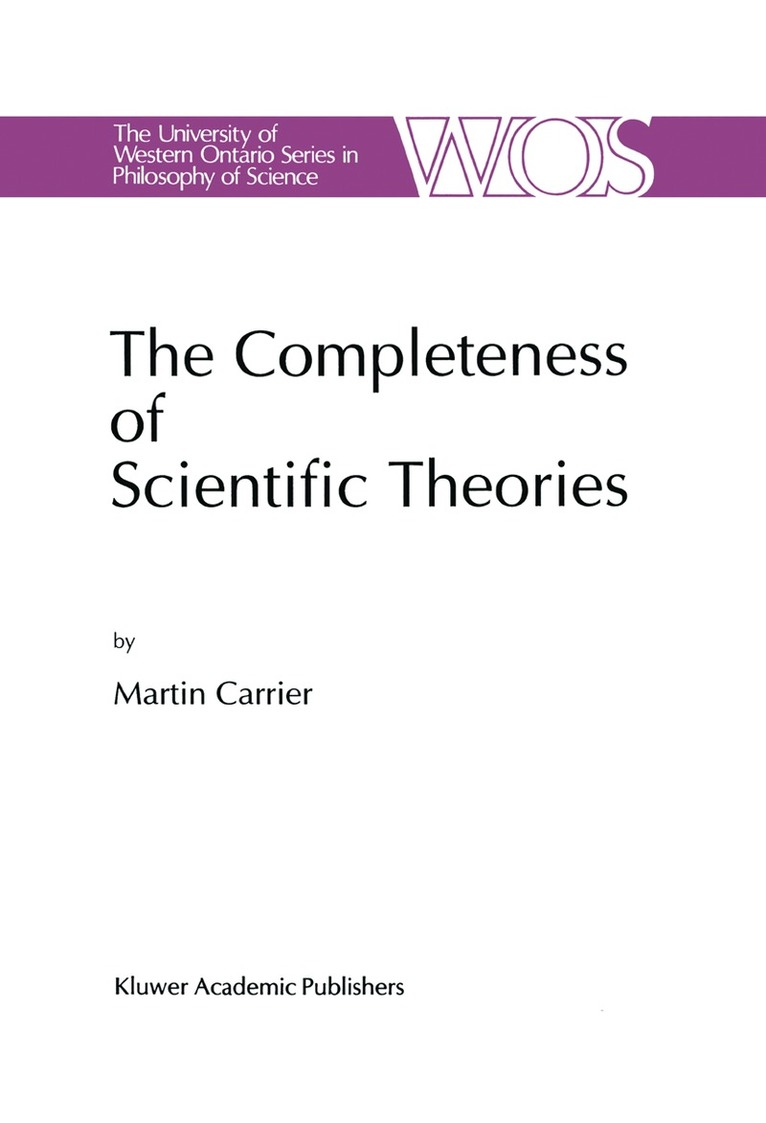
    Completeness of Scientific Theories

    On the Derivation of Empirical Indicators within a Theoretical Framework: The Case of Physical Geometry

    AvMartin Carrier

    Inbunden, Engelska, 1993

    Del 53 i serien Western Ontario Series in Philosophy of Science

    1 614 kr

    Beställningsvara. Skickas inom 10-15 vardagar. Fri frakt över 249 kr.

    Fler format och utgåvor

    Häftad

    1 614 kr

    E-bok

    2 044 kr

    Beskrivning

    Earlier in this century, many philosophers of science (for example, Rudolf Carnap) drew a fairly sharp distinction between theory and observation, between theoretical terms like 'mass' and 'electron', and observation terms like 'measures three meters in length' and 'is _2° Celsius'. By simply looking at our instruments we can ascertain what numbers our measurements yield. Creatures like mass are different: we determine mass by calculation; we never directly observe a mass. Nor an electron: this term is introduced in order to explain what we observe. This (once standard) distinction between theory and observation was eventually found to be wanting. First, if the distinction holds, it is difficult to see what can characterize the relationship between theory :md observation. How can theoretical terms explain that which is itself in no way theorized? The second point leads out of the first: are not the instruments that provide us with observational material themselves creatures of theory? Is it really possible to have an observation language that is entirely barren of theory? The theory-Iadenness of observation languages is now an accept­ ed feature of the logic of science. Many regard such dependence of observation on theory as a virtue. If our instruments of observation do not derive their meaning from theories, whence comes that meaning? Surely - in science - we have nothing else but theories to tell us what to try to observe.

    Produktinformation

    • Utgivningsdatum:1993-11-30
    • Mått:152 x 229 x 21 mm
    • Vikt:612 g
    • Format:Inbunden
    • Språk:Engelska
    • Serie:Western Ontario Series in Philosophy of Science
    • Antal sidor:278
    • Förlag:Kluwer Academic Publishers
    • ISBN:9780792324751

    Utforska kategorier

    • Fysik inom Naturvetenskap och teknik
    • Naturvetenskapens filosofi inom Naturvetenskap och teknik

    Innehållsförteckning

    • A. Theory and Evidence in Scientific Theories.- I / The Theory-Ladenness of Observation and Measurement.- II / The Completeness of Theories.- III / Completeness in Natural Science and Psychology.- B. Theory and Evidence in Physical Geometry.- IV / Reichenbach Loops in Operation: The Conventionality of Physical Geometry.- V / The Completeness of General Relativity Theory.- VI / The Conventionality of Physical Geometry: A Reconsideration.- Notes.- Index of Names.- Index of Subjects.