• Fri frakt över 249 kr
  • •
  • Snabba leveranser
  • •
  • Billiga böcker
Kundservice

Du är på sajten för privatpersoner.

Företag, bibliotek eller offentlig verksamhet?

Du handlar på classic.bokus.com, där alla dina funktioner finns intakta.
Till classic.bokus.com
Bokus logotyp. Gå till startsidan.
  • Erbjudanden
  • Nyheter
  • Student
  • Topplistor
  • Barn & ungdom
  • Bokus Play
  • E-böcker
  • Pocketböcker
  • Spel & pussel

10% studentrabatt med kod TERM26

Sidfot

Mina sidor

    Hjälp

    • Kundservice
    • Vanliga frågor och svar
    • Frakt och leverans
    • Retur vid ångerrätt
    • Reklamera vara
    • Betalning
    • Köpvillkor
    • Allmänna villkor
    • Information om webbplatsens tillgänglighet

    Om Bokus

    • Om oss
    • Pressrum
    • För studenter
    • För företag
    • För bibliotek och offentlig verksamhet
    • För leverantörer
    • Hållbarhet

    Populärt

    • Aktuella erbjudanden
    • Presentkort
    • Studentlitteratur
    • Nya böcker
    • Topplistor
    • Signerade böcker
    • Engelska böcker

    Inspiration

    • Boktips
    • BookTok
    • Populära bokserier
    • Barnbokskaraktärer
    • Populära författare
    Logotyp för Bokus
    Följ oss på Facebook (extern länk)Följ oss på Instagram (extern länk)Följ oss på YouTube (extern länk)Följ oss på TikTok (extern länk)
    bokus @ CookiesAnpassa cookiesIntegritetspolicyKöpvillkor
    Till Citymail hemsida (extern länk)Till Budbee hemsida (extern länk)Till Postnord hemsida (extern länk)Till Schenker hemsida (extern länk)Till Early Bird hemsida (extern länk)Till Walleys hemsida (extern länk)
    1. Naturvetenskap och teknik
    2. Matematik och naturvetenskap
    3. Biologi
    4. Biovetenskap

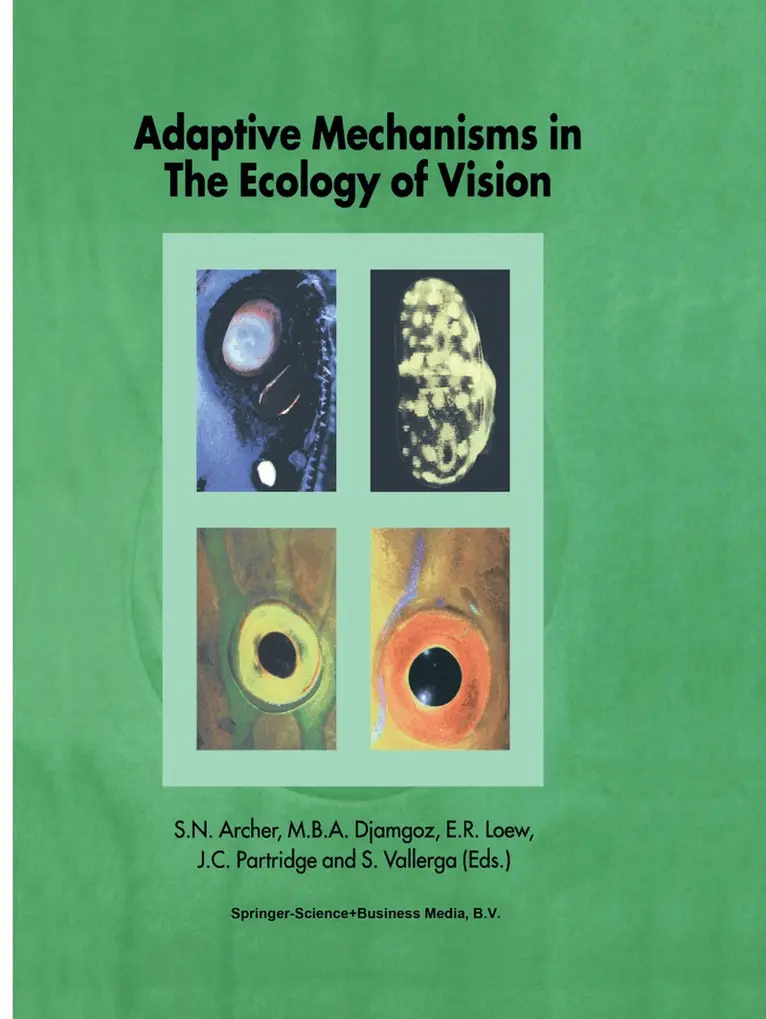
    Adaptive Mechanisms in the Ecology of Vision

    AvS. Archer,M.B. Djamgoz

    Inbunden, Engelska, 1999

    3 261 kr

    Beställningsvara. Skickas inom 10-15 vardagar. Fri frakt över 249 kr.

    Beskrivning

    John Lythgoe was one of the pioneers of the 'Ecology of Vision', a subject that he ably delineated in his classic and inspirational book published some 20 years ago [1]. At heart, the original book aimed generally to identify inter-relationships between vision, animal behaviour and the environment. John Lythgoe excelled at identifying the interesting 'questions' in the ecology of an animal that fitted the 'answers' presented by an analysis of the visual system. Over the last twenty years, however, since Lythgoe's landmark publication, much progress has been made and the field has broadened considerably. In particular, our understanding of the 'adaptive mechanisms' underlying the ecology of vision has reached considerable depths, extending to the molecular dimension, partly as a result of development and application of new techniques. This complements the advances made in parallel in clinically oriented vision research [2]. The current book endeavours to review the progress made in the ecology of vision field by bringing together many of the major researchers presently active in the expanded subject area. The contents deal with theoretical and physical considerations of light and photoreception, present examples of visual system structure and function, and delve into aspects of visual behaviour and communi­ cation. Throughout the book, we have tried to emphasise one of the major themes to emerge within the ecology of vision: the high degree of adaptability that visual mechanisms are capable of undergoing in response to diverse, and dynamic, environments and behaviours.

    Produktinformation

    • Utgivningsdatum:1999-01-31
    • Mått:155 x 235 x 42 mm
    • Vikt:1 197 g
    • Format:Inbunden
    • Språk:Engelska
    • Antal sidor:668
    • Upplaga:1999
    • Förlag:Kluwer Academic Publishers
    • ISBN:9780792353195

    Utforska kategorier

    • Biovetenskap inom Naturvetenskap och teknik

    Innehållsförteckning

    • I. General Principles.- 1a. Light and Photoreception: Physical principles.- 1b. Light and Photoreception: Visual pigments and photoreception.- II. Biophysical Adaptations.- 2. Compound eye structure: matching eye to environment.- 3. Vertebrate optical structure.- 4. A review of vertebrate and invertebrate optical filters.- 5. Vertebrate photoreceptors.- 6. The extraretinal photoreceptors of non-mammalian vertebrates.- 7. The regulation of vertebrate biological clocks by light.- III. Biochemical and Physiological Adaptations.- 8. Adaptation of visual pigments to the aquatic environment.- 9. Visual adaptations in crustaceans: spectral sensitivity in diverse habitats.- 10. Functional organization of the outer retina in aquatic and terrestrial vertebrates: comparative aspects and possible significance to the ecology of vision.- 11. Inner retinal signal processing: adaptation to environmental light.- 12. Ecological aspects of vertebrate visual ontogeny.- 13. Molecular biology of photoreceptor spectral sensitivity.- IV. Behaviour and Communication.- 14. Visual systems, behaviour and environment in cephalopods.- 15. Optical structure and visual fields in birds: their relationship with foraging behaviour and ecology.- 16. Behavioural ecology and retinal cell topography.- 17. Flower advertisement for insects: Bees, a case study.- 18. Bioluminescence.- 19. The behavior of animals around twilight with emphasis on coral reef communities.- 20. Vision and behavior in primates.