• Fri frakt över 249 kr
  • •
  • Snabba leveranser
  • •
  • Billiga böcker
Kundservice

Du är på sajten för privatpersoner.

Företag, bibliotek eller offentlig verksamhet?

Du handlar på classic.bokus.com, där alla dina funktioner finns intakta.
Till classic.bokus.com
Bokus logotyp. Gå till startsidan.
  • Erbjudanden
  • Student
  • Topplistor
  • Barn & ungdom
  • Bokus Play
  • E-böcker
  • Ljudböcker
  • Pocketböcker
  • Spel och pussel

Pocketfynda! Hundratals böcker för 49 kr/st →

Sidfot

Mina sidor

    Hjälp

    • Kundservice
    • Vanliga frågor och svar
    • Frakt och leverans
    • Retur vid ångerrätt
    • Reklamera vara
    • Betalning
    • Köpvillkor
    • Allmänna villkor
    • Information om webbplatsens tillgänglighet

    Om Bokus

    • Om oss
    • Pressrum
    • För studenter
    • För företag
    • För bibliotek och offentlig verksamhet
    • För leverantörer
    • Hållbarhet

    Populärt

    • Aktuella erbjudanden
    • Presentkort
    • Studentlitteratur
    • Nya böcker
    • Topplistor
    • Signerade böcker
    • Engelska böcker

    Inspiration

    • Boktips
    • BookTok
    • Barnbokskaraktärer
    • Populära författare
    Logotyp för Bokus
    Följ oss på Facebook (extern länk)Följ oss på Instagram (extern länk)Följ oss på YouTube (extern länk)Följ oss på TikTok (extern länk)
    bokus @ CookiesAnpassa cookiesIntegritetspolicyKöpvillkor
    Till Citymail hemsida (extern länk)Till Budbee hemsida (extern länk)Till Postnord hemsida (extern länk)Till Schenker hemsida (extern länk)Till Early Bird hemsida (extern länk)Till Walleys hemsida (extern länk)
    1. Djur och Natur
    2. Djurböcker
    3. Vilda djur
    4. Fjärilar, insekter, spindlar

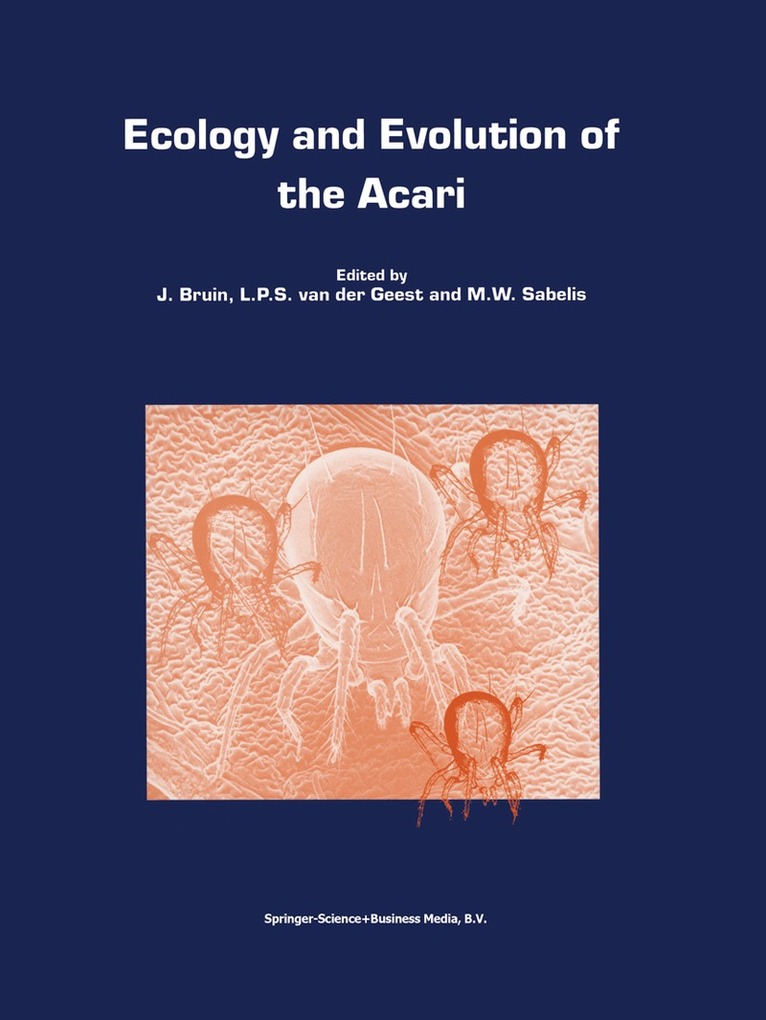
    Ecology and Evolution of the Acari

    Proceedings of the 3rd Symposium of the European Association of Acarologists 1–5 July 1996, Amsterdam, The Netherlands

    AvJ. Bruin,Leo P.S. van der Geest

    Inbunden, Engelska, 1999

    Del i serien Series Entomologica

    3 220 kr

    Beställningsvara. Skickas inom 10-15 vardagar. Fri frakt över 249 kr.

    Beskrivning

    For a long time the development of acarology as a field of biological science has been dominated by systematists and applied scientists. In the last 15 years, however, Acari have been increasingly recognized as highly suitable for the testing of theories in ecological and evolutionary sciences. The growing interest in mites and ticks, from evolutionary and molecular biologists and from population and community ecologists, has had a strong impetus on the field of acarology. This book contains many chapters that illustrate the recent progress in the mainly evolutionary and ecological aspects of acarology.

    Produktinformation

    • Utgivningsdatum:1999-05-31
    • Mått:193 x 260 x 42 mm
    • Vikt:1 477 g
    • Format:Inbunden
    • Språk:Engelska
    • Serie:Series Entomologica
    • Antal sidor:677
    • Upplaga:1999
    • Förlag:Kluwer Academic Publishers
    • ISBN:9780792356585

    Utforska kategorier

    • Fjärilar, insekter, spindlar inom Djur och Natur
    • Insekter inom Naturvetenskap och teknik
    • Biologi inom Naturvetenskap och teknik

    Innehållsförteckning

    • Evolution and systematics of the Chelicerata.- Canalized pathways of change and constraints in the evolution of reproductive modes of microarthropods.- Morphological evidence for the evolutionary origin of Astigmata (Acari: Acariformes).- Evolution of phytophagy in trombidiform mites.- Origin and evolution of feather mites (Astigmata).- Phylogeny and co-speciation in feather mites of the subfamily Avenzoariinae (Analgoidea: Avenzoariidae).- Loss of larval parasitism in parasitengonine mites.- Life-history evolution in Parasitengonae (Acari: Prostigmata): constraints on number and size of offspring.- Sperm competition in the Acari.- Distribution of asymmetrical and symmetrical sperm storage in the Eriophyoidea and its phylogenetic implications.- Host plant associations in the spider mite Tetranychus urticae (Acari: Tetranychidae): insights from molecular phylogeography.- Genetic differentiation in Tetranychus urticae (Acari: Tetranychidae) from greenhouses in France.- The role of adaptation to host plants in the evolution of reproductive isolation: Negative evidence from Tetranychus urticae.- Geographic differences in host specialization between the symbiotic water mites Unionicola formosa and U. foili (Acari: Unionicolidae).- Interactions between arthropod predators and plants: A conspiracy against herbivorous arthropods?.- Behaviour and indirect interactions in food webs of plant-inhabiting arthropods.- Behavioural ecology of plant—phytoseiid interactions mediated by herbivore-induced plant volatiles.- The ecology of Lyme borreliosis vector ticks.- Biology and ecology of trombidiid mites (Acari: Trombidioidea).- Reflections on the biology, morphology and ecology of the Macrochelidae.- Phoresy by Hemisarcoptes (Acari: Hemisarcoptidae) on Chilocorus (Coleoptera:Coccinellidae): Influence of subelytral ultrastructure.- When to leave the brood chamber? Routes of dispersal in mites associated with burying beetles.- Functional morphology as an aid in determining trophic behaviour: The placement of astigmatic mites in food webs of water-filled tree hole communities.- Natural selection of Varroa jacobsoni explains the differential reproductive strategies in colonies of Apis cerana and Apis mellifera.- Regaining the water: a simulation model approach for Arrenurus larvae (Hydrachnellae) parasitizing damselflies (Coenagrion puella: Odonata).- Juvenile survival and development in Euseius finlandicus, Typhlodromus pyri and Kampimodromus aberrans (Acari: Phytoseiidae) feeding on con- and heterospecific immatures.- Do western flower thrips avoid plants infested with spider mites? Interactions between potential competitors.- Food and feeding behaviour of deutonymphs and adults of the water mite Hydrachna skorikowi (Acari: Hydrachnellae), with notes on the structure of their mouthparts.- Leaf hairs influence searching efficiency and predation rate of the predatory mite Phytoseiulus persimilis (Acari: Phytoseiidae).- Life-history parameters of two closely related forms of the Tetranychus urticae-complex on different host plants.- The contribution of extrafloral nectar to survival and reproduction of the predatory mite Iphiseius degenerans on Ricinus communis.- Pollen as a medium for rearing plant-feeding acarid mites (Acari: Acaridae).- Bionomics of Carpoglyphus lactis (Acari: Carpoglyphidae) on honey.- Mass-rearing of Amblyseius californicus (Acari: Phytoseiidae) on two alternative food sources.- The influence of various kinds of food on the distribution and life cycle of Metarhombognathus armatus (Halacaridae: Rhombognathinae).- Populationbiology of a phytophagous mite of marine and estuarine rocky shores (Astigmata, Hyadesiidae).- Diel and seasonal drift of water mites (Acari, Hydrachnidia) in two streams of the North German Lowland.- Water mites (Acari: Hydrachnidia, Halacaridae) from the hyporheic habitat of the Mugnone stream (Tuscany, Italy).- Water mites of typical habitats in four Polish national parks situated in different landscapes.- Remarks on the morphology, life cycle, distribution and taxonomy of water mites of the subfamily Acherontacarinae in the Western Palaearctic.- Water mites of small boreal forest lakes (Central Finland).- Presence of acetabula-like structures on the coxae of the neotropical water mite genus Neotyrrellia (Tyrrelliinae, Limnesiidae, Prostigmata).- Oribatid mites of the Galápagos Islands: Faunistics, ecology and speciation.- Gamasina in a succession of thirteen years.- Oribatid mites of a riverine forest in the Central Alps (Austria).- Comparison of adult oribatid mites (Acari, Oribatida) from three mountain forests in Poland: I. Abundance, biomass and species richness.- Compact aggregation and life history strategy in a continental Antarctic mite.- A biometrical study of Berniniella serratirostris (Acari: Oribatei) and some related species.- Morphological variability in populations of a thelytokous mite, Trhypochthoniellus longisetus (Oribatida), with notes on synonymy.- Fine structure of the humeral organ of juvenile Edwardzetes edwardsii (Ceratozetidae, Oribatida).- Observations on the fine structure of the vagina of pergamasid mites (Pergamasidae, Parasitina, Gamasida).- Ultrastructural cell modification in tomato (Lycopersicon esculentum) leaf tissue in response to the carmine spider mite (Tetranychus cinnabarinus) feeding.- Influence of soil management on mitepopulations in a vineyard agroecosystem.- Overwintering of phytoseiid mites (Parasitiformes, Phytoseiidae) on hazelnut (Corylus avellana) in Sicily (Italy).- Prosomal glands in Typhlodromus spp. females (Mesostigmata: Phytoseiidae).- Allergenic mites associated with bird nests in Poland (Astigmata: Pyroglyphidae, Acaridae, Glycyphagidae).- Body weight characteristics of some ixodid ticks: Reflecting adaptations to conditions of their habitats?.- Species validity of the soft-tick Argas polonicus (Acari: Argasidae) based on 16S rDNA sequence analysis.