• Fri frakt över 249 kr
  • •
  • Snabba leveranser
  • •
  • Billiga böcker
Kundservice

Du är på sajten för privatpersoner.

Företag, bibliotek eller offentlig verksamhet?

Du handlar på classic.bokus.com, där alla dina funktioner finns intakta.
Till classic.bokus.com
Bokus logotyp. Gå till startsidan.
  • Erbjudanden
  • Student
  • Topplistor
  • Barn & ungdom
  • Bokus Play
  • E-böcker
  • Ljudböcker
  • Pocketböcker
  • Spel & pussel

Upp till 25% på utvalda nyheter →

Sidfot

Mina sidor

    Hjälp

    • Kundservice
    • Vanliga frågor och svar
    • Frakt och leverans
    • Retur vid ångerrätt
    • Reklamera vara
    • Betalning
    • Köpvillkor
    • Allmänna villkor
    • Information om webbplatsens tillgänglighet

    Om Bokus

    • Om oss
    • Pressrum
    • För studenter
    • För företag
    • För bibliotek och offentlig verksamhet
    • För leverantörer
    • Hållbarhet

    Populärt

    • Aktuella erbjudanden
    • Presentkort
    • Studentlitteratur
    • Nya böcker
    • Topplistor
    • Signerade böcker
    • Engelska böcker

    Inspiration

    • Boktips
    • BookTok
    • Populära bokserier
    • Barnbokskaraktärer
    • Populära författare
    Logotyp för Bokus
    Följ oss på Facebook (extern länk)Följ oss på Instagram (extern länk)Följ oss på YouTube (extern länk)Följ oss på TikTok (extern länk)
    bokus @ CookiesAnpassa cookiesIntegritetspolicyKöpvillkor
    Till Citymail hemsida (extern länk)Till Budbee hemsida (extern länk)Till Postnord hemsida (extern länk)Till Schenker hemsida (extern länk)Till Early Bird hemsida (extern länk)Till Walleys hemsida (extern länk)
    1. Naturvetenskap och teknik
    2. Matematik och naturvetenskap
    3. Matematik
    4. Matematikens grunder

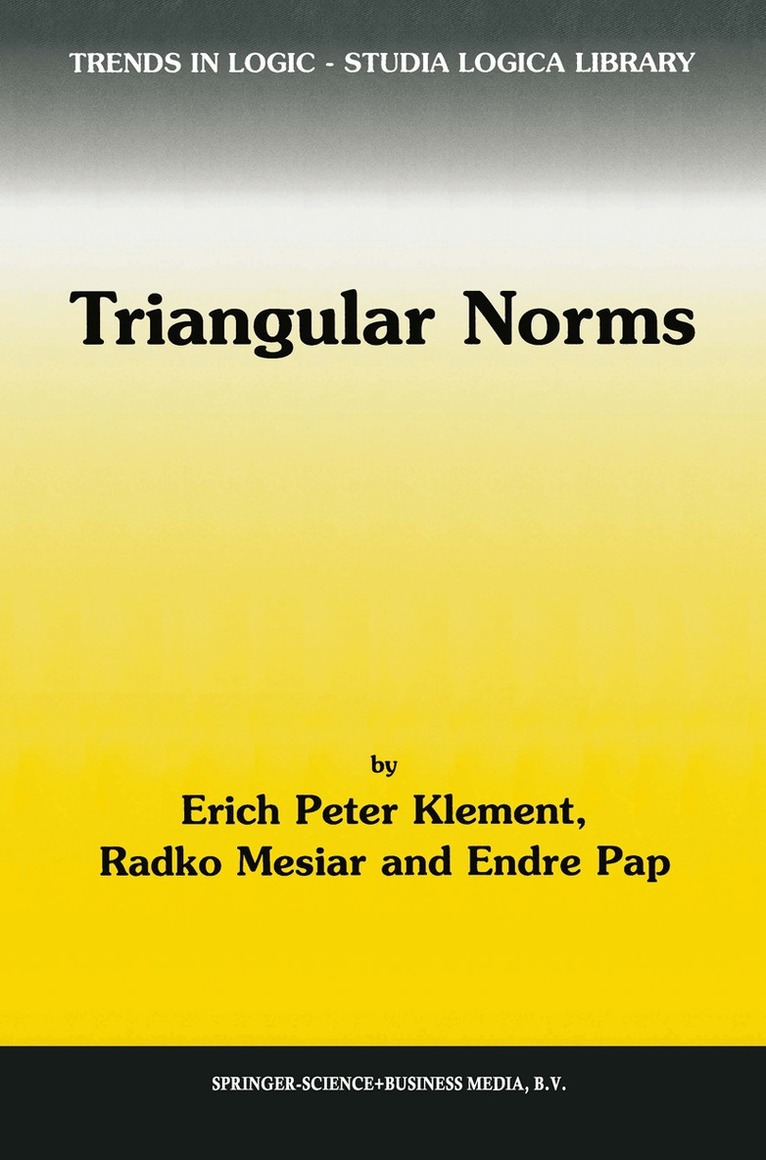
    Triangular Norms

    AvErich Peter Klement,R. Mesiar

    Inbunden, Engelska, 2000

    Del 8 i serien Trends in Logic

    2 166 kr

    Beställningsvara. Skickas inom 10-15 vardagar. Fri frakt över 249 kr.

    Fler format och utgåvor

    Häftad

    2 157 kr

    Beskrivning

    The history of triangular norms started with the paper "Statistical metrics" [Menger 1942]. The main idea of Karl Menger was to construct metric spaces where probability distributions rather than numbers are used in order to de­ scribe the distance between two elements of the space in question. Triangular norms (t-norms for short) naturally came into the picture in the course of the generalization of the classical triangle inequality to this more general set­ ting. The original set of axioms for t-norms was considerably weaker, including among others also the functions which are known today as triangular conorms. Consequently, the first field where t-norms played a major role was the theory of probabilistic metric spaces ( as statistical metric spaces were called after 1964). Berthold Schweizer and Abe Sklar in [Schweizer & Sklar 1958, 1960, 1961] provided the axioms oft-norms, as they are used today, and a redefinition of statistical metric spaces given in [Serstnev 1962]led to a rapid development of the field. Many results concerning t-norms were obtained in the course of this development, most of which are summarized in the monograph [Schweizer & Sklar 1983]. Mathematically speaking, the theory of (continuous) t-norms has two rather independent roots, namely, the field of (specific) functional equations and the theory of (special topological) semigroups.

    Produktinformation

    • Utgivningsdatum:2000-07-31
    • Mått:156 x 234 x 27 mm
    • Vikt:781 g
    • Format:Inbunden
    • Språk:Engelska
    • Serie:Trends in Logic
    • Antal sidor:387
    • Upplaga:2000
    • Förlag:Kluwer Academic Publishers
    • ISBN:9780792364160

    Utforska kategorier

    • Matematikens grunder inom Naturvetenskap och teknik

    Recensioner i media

    "The book is very well written and constitutes a valuable addition to the literature on t-norms and, in general fuzzy reasoning. It presents almost all of the most important developments of fuzzy sets and fuzzy logic by focusing on the central concept of triangular norm. It is divided into two parts and an appendix, which gives a summary of the existing families of t-norms." (Mathematical Reviews, 2002a)

    Innehållsförteckning

    • I.- 1. Basic definitions and properties.- 2. Algebraic aspects.- 3. Construction of t-norms.- 4. Families of t-norms.- 5. Representations of t-norms.- 6. Comparison of t-norms.- 7. Values and discretization of t-norms.- 8. Convergence of t-norms.- II.- 9. Distribution functions.- 10. Aggregation operators.- 11. Many-valued logics.- 12. Fuzzy set theory.- 13. Applications of fuzzy logic and fuzzy sets.- 14. Generalized measures and integrals.- A. Families of t-norms.- A.1 Aczél-Alsina t-norms.- A.2 Dombi t-norms.- A.3 Frank t-norms.- A.4 Hamacher t-norms.- A.5 Mayor-Torrens t-norms.- A.6 Schweizer-Sklar t-norms.- A.7 Sugeno-Weber t-norms.- A.8 Yager t-norms.- B. Additional t-norms.- B.1 Krause t-norm.- B.2 A family of incomparable t-norms.- Reference material.- List of Figures.- List of Tables.- List of Mathematical Symbols.