• Fri frakt över 249 kr
  • •
  • Snabba leveranser
  • •
  • Billiga böcker
Kundservice

Du är på sajten för privatpersoner.

Företag, bibliotek eller offentlig verksamhet?

Du handlar på classic.bokus.com, där alla dina funktioner finns intakta.
Till classic.bokus.com
Bokus logotyp. Gå till startsidan.
  • Erbjudanden
  • Nyheter
  • Student
  • Topplistor
  • Barn & ungdom
  • Bokus Play
  • E-böcker
  • Pocketböcker
  • Spel & pussel

10% rabatt på allt med kod: NYSTART10 →

Sidfot

Mina sidor

    Hjälp

    • Kundservice
    • Vanliga frågor och svar
    • Frakt och leverans
    • Retur vid ångerrätt
    • Reklamera vara
    • Betalning
    • Köpvillkor
    • Allmänna villkor
    • Information om webbplatsens tillgänglighet

    Om Bokus

    • Om oss
    • Pressrum
    • För studenter
    • För företag
    • För bibliotek och offentlig verksamhet
    • För leverantörer
    • Hållbarhet

    Populärt

    • Aktuella erbjudanden
    • Presentkort
    • Studentlitteratur
    • Nya böcker
    • Topplistor
    • Signerade böcker
    • Engelska böcker

    Inspiration

    • Boktips
    • BookTok
    • Populära bokserier
    • Barnbokskaraktärer
    • Populära författare
    Logotyp för Bokus
    Följ oss på Facebook (extern länk)Följ oss på Instagram (extern länk)Följ oss på YouTube (extern länk)Följ oss på TikTok (extern länk)
    bokus @ CookiesAnpassa cookiesIntegritetspolicyKöpvillkor
    Till Citymail hemsida (extern länk)Till Budbee hemsida (extern länk)Till Postnord hemsida (extern länk)Till Schenker hemsida (extern länk)Till Early Bird hemsida (extern länk)Till Walleys hemsida (extern länk)
    1. Språk och ordböcker
    2. Språkvetenskap och lingvistik

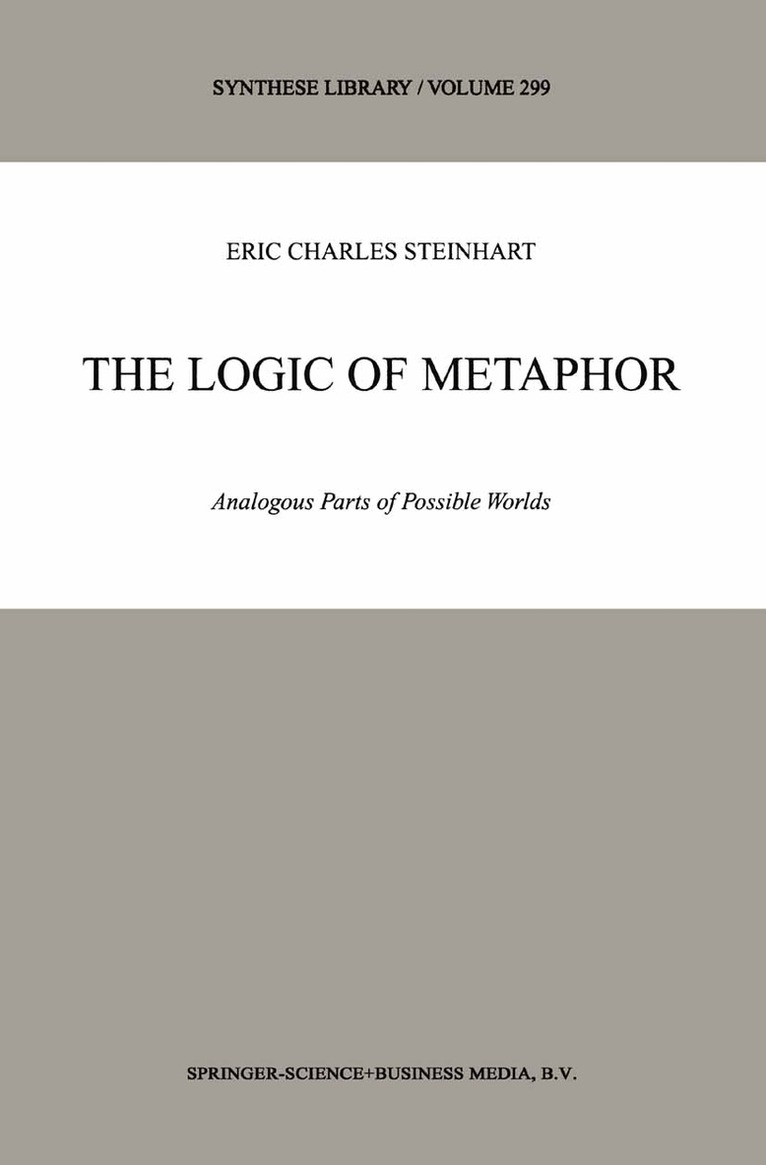
    Logic of Metaphor

    Analogous Parts of Possible Worlds

    AvEric Steinhart

    Inbunden, Engelska, 2001

    Del 299 i serien Synthese Library

    1 086 kr

    Beställningsvara. Skickas inom 10-15 vardagar. Fri frakt över 249 kr.

    Fler format och utgåvor

    Häftad

    1 086 kr

    E-bok

    1 416 kr

    Beskrivning

    1. Metaphors and Logic Metaphors are among the most vigorous offspring of the creative mind; but their vitality springs from the fact that they are logical organisms in the ecology of l- guage. I aim to use logical techniques to analyze the meanings of metaphors. My goal here is to show how contemporary formal semantics can be extended to handle metaphorical utterances. What distinguishes this work is that it focuses intensely on the logical aspects of metaphors. I stress the role of logic in the generation and int- pretation of metaphors. While I don't presuppose any formal training in logic, some familiarity with philosophical logic (the propositional calculus and the predicate c- culus) is helpful. Since my theory makes great use of the notion of structure, I refer to it as the structural theory of m etaphor (STM). STM is a semant ic theory of m etaphor : if STM is correct, then metaphors are cognitively meaningful and are n- trivially logically linked with truth. I aim to extend possible worlds semantics to handle metaphors. I'll argue that some sentences in natural languages like English have multiple meanings: "Juliet is the sun" has (at least) two meanings: the literal meaning "(Juliet is the sunkIT" and the metaphorical meaning "(Juliet is the sun)MET". Each meaning is a function from (possible) worlds to truth-values. I deny that these functions are identical; I deny that the metaphorical function is necessarily false or necessarily true.

    Produktinformation

    • Utgivningsdatum:2001-07-31
    • Mått:155 x 235 x 21 mm
    • Vikt:571 g
    • Format:Inbunden
    • Språk:Engelska
    • Serie:Synthese Library
    • Antal sidor:256
    • Upplaga:2001
    • Förlag:Kluwer Academic Publishers
    • ISBN:9780792370048

    Utforska kategorier

    • Språkvetenskap och lingvistik inom Språk och ordböcker
    • Filosofiska discipliner inom Filosofi och religion

    Innehållsförteckning

    • 1. Introduction.- 2. Language.- 3. Conceptual Structures.- 4. Analogy.- 5. Analogical Transference.- 6. Metaphorical Communication.- 7. Analogy and Truth.- 8. Metaphor and Inference.- 9. Lexical Meanings.- 10. Conclusion.- References.