• Fri frakt över 249 kr
  • •
  • Snabba leveranser
  • •
  • Billiga böcker
Kundservice

Du är på sajten för privatpersoner.

Företag, bibliotek eller offentlig verksamhet?

Du handlar på classic.bokus.com, där alla dina funktioner finns intakta.
Till classic.bokus.com
Bokus logotyp. Gå till startsidan.
  • Erbjudanden
  • Nyheter
  • Student
  • Topplistor
  • Barn & ungdom
  • Bokus Play
  • E-böcker
  • Pocketböcker
  • Spel & pussel

10% rabatt på allt med kod NYSTART10 →

Sidfot

Mina sidor

    Hjälp

    • Kundservice
    • Vanliga frågor och svar
    • Frakt och leverans
    • Retur vid ångerrätt
    • Reklamera vara
    • Betalning
    • Köpvillkor
    • Allmänna villkor
    • Information om webbplatsens tillgänglighet

    Om Bokus

    • Om oss
    • Pressrum
    • För studenter
    • För företag
    • För bibliotek och offentlig verksamhet
    • För leverantörer
    • Hållbarhet

    Populärt

    • Aktuella erbjudanden
    • Presentkort
    • Studentlitteratur
    • Nya böcker
    • Topplistor
    • Signerade böcker
    • Engelska böcker

    Inspiration

    • Boktips
    • BookTok
    • Populära bokserier
    • Barnbokskaraktärer
    • Populära författare
    Logotyp för Bokus
    Följ oss på Facebook (extern länk)Följ oss på Instagram (extern länk)Följ oss på YouTube (extern länk)Följ oss på TikTok (extern länk)
    bokus @ CookiesAnpassa cookiesIntegritetspolicyKöpvillkor
    Till Citymail hemsida (extern länk)Till Budbee hemsida (extern länk)Till Postnord hemsida (extern länk)Till Schenker hemsida (extern länk)Till Early Bird hemsida (extern länk)Till Walleys hemsida (extern länk)
    1. Naturvetenskap och teknik
    2. Teknik och industri
    3. Elektronik och kommunikationer

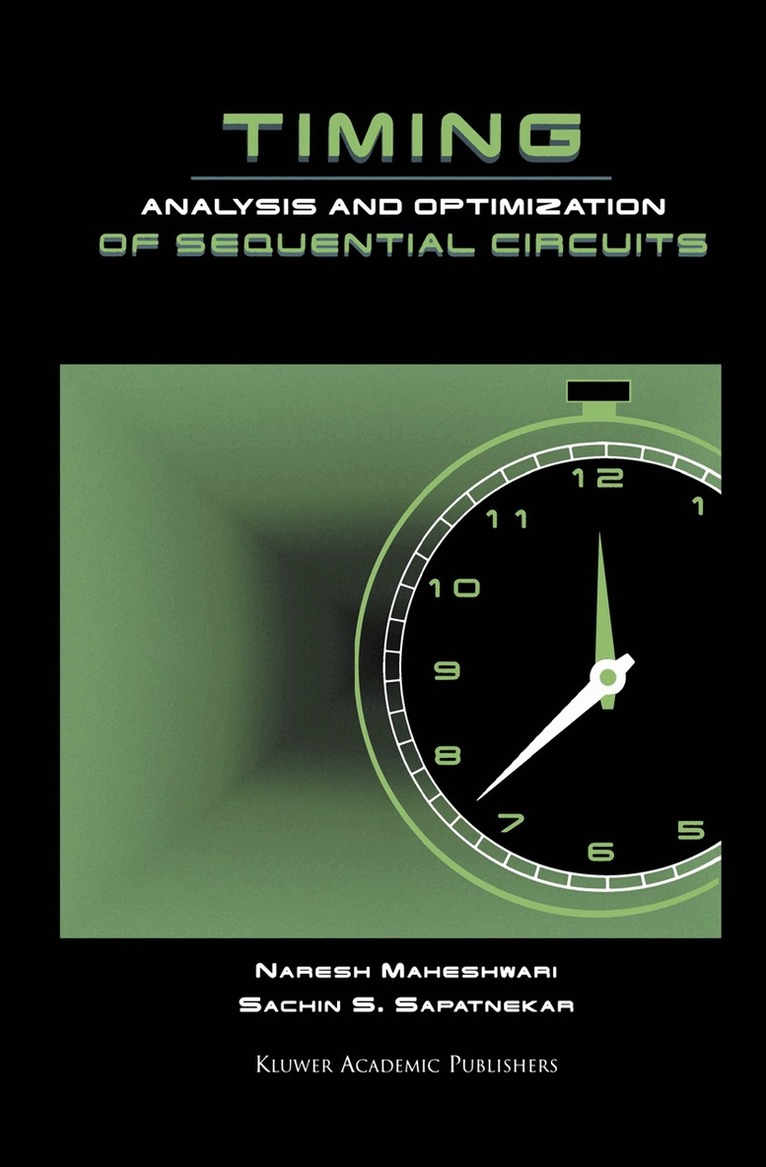
    Timing Analysis and Optimization of Sequential Circuits

    AvNaresh Maheshwari,S. Sapatnekar

    Inbunden, Engelska, 1998

    1 085 kr

    Beställningsvara. Skickas inom 10-15 vardagar. Fri frakt över 249 kr.

    Fler format och utgåvor

    Häftad

    1 085 kr

    Beskrivning

    Recent years have seen rapid strides in the level of sophistication of VLSI circuits. On the performance front, there is a vital need for techniques to design fast, low-power chips with minimum area for increasingly complex systems, while on the economic side there is the vastly increased pressure of time-to-market. These pressures have made the use of CAD tools mandatory in designing complex systems. Timing Analysis and Optimization of Sequential Circuits describes CAD algorithms for analyzing and optimizing the timing behavior of sequential circuits with special reference to performance parameters such as power and area. A unified approach to performance analysis and optimization of sequential circuits is presented. The state of the art in timing analysis and optimization techniques is described for circuits using edge-triggered or level-sensitive memory elements. Specific emphasis is placed on two methods that are true sequential timing optimizations techniques: retiming and clock skew optimization. Timing Analysis and Optimization of Sequential Circuits covers the following topics: Algorithms for sequential timing analysis Fast algorithms for clock skew optimization and their applications Efficient techniques for retiming large sequential circuits Coupling sequential and combinational optimizations. Timing Analysis and Optimization of Sequential Circuits is written for graduate students, researchers and professionals in the area of CAD for VLSI and VLSI circuit design.

    Produktinformation

    • Utgivningsdatum:1998-10-31
    • Mått:155 x 235 x 17 mm
    • Vikt:489 g
    • Format:Inbunden
    • Språk:Engelska
    • Antal sidor:190
    • Upplaga:1999
    • Förlag:Kluwer Academic Publishers
    • ISBN:9780792383215

    Utforska kategorier

    • Elektronik och kommunikationer inom Naturvetenskap och teknik
    • Systemvetenskap och AI inom Data och IT

    Recensioner i media

    'To sum it up it can be said that the authors have done a great job. The book is well written and can serve as a textbook for graduate students, researchers, and professionals in the area of CAD for VLSI and VLSI circuit design.' Zentral Blatt Mathematik, 987 (2002)

    Innehållsförteckning

    • 1. Introduction.- 1.1 Performance Optimization of VLSI Circuits.- 1.2 Outline of the Book.- 2. Timing Analysis of Sequential Circuits.- 2.1 Introduction.- 2.2 Combinational Delay Modeling.- 2.3 Clocking Disciplines: Edge-Triggered Circuits.- 2.4 Resolving Short Path Violations.- 2.5 Clocking Disciplines: Level-clocked Circuits.- 2.6 Clock Schedule Optimization for Level-Clocked Circuits.- 2.7 Timing Analysis of Domino Logic.- 2.8 Concluding Remarks.- 3. Clock Skew Optimization.- 3.1 The Notion of Deliberate Clock Skew.- 3.2 Is Clock Skew Optimization Safe?.- 3.3 Clock Tree Construction.- 3.4 Clock Skew Optimization.- 3.5 Clock Skew Optimization with Transistor Sizing.- 3.6 Wave Pipelining Issues.- 3.7 Deliberate Skews for Peak Current Reduction.- 3.8 Conclusion.- 4. The Basics of Retiming.- 4.1 Introduction to Retiming.- 4.2 A Broad Overview of Research on Retiming.- 4.3 Modeling and Assumptions for Retiming.- 4.4 Minperiod Optimization of Edge-triggered Circuits.- 4.5 Level-clocked Circuits.- 4.6 Concluding Remarks.- 5. Minarea Retiming.- 5.1 The Leiserson-Saxe Approach.- 5.2 The Minaret Algorithm.- 5.3 Minarea Retiming of Level-Clocked Circuits.- 6. Retiming Control Logic.- 6.1 Minperiod Initial State Retiming via the State Transition Graph.- 6.2 Minperiod Initial State Retiming via Reverse Retiming.- 6.3 Minarea Initial State Retiming.- 6.4 Maintaining Initial States With Explicit Reset Circuitry.- 7. Miscellaneous Issues in Retiming.- 7.1 Retiming and Testing.- 7.2 Verification Issues.- 7.3 Retiming for Low Power.- 7.4 Retiming with Logic Synthesis.- 7.5 Retiming for FPGA’s.- 7.6 Practical Issues.- 7.7 Conclusion.- 8. Conclusion.- References.