• Fri frakt över 249 kr
  • •
  • Snabba leveranser
  • •
  • Billiga böcker
Kundservice

Du är på sajten för privatpersoner.

Företag, bibliotek eller offentlig verksamhet?

Du handlar på classic.bokus.com, där alla dina funktioner finns intakta.
Till classic.bokus.com
Bokus logotyp. Gå till startsidan.
  • Erbjudanden
  • Nyheter
  • Student
  • Topplistor
  • Barn & ungdom
  • Bokus Play
  • E-böcker
  • Pocketböcker
  • Spel & pussel

10% rabatt på allt med kod NYSTART10 →

Sidfot

Mina sidor

    Hjälp

    • Kundservice
    • Vanliga frågor och svar
    • Frakt och leverans
    • Retur vid ångerrätt
    • Reklamera vara
    • Betalning
    • Köpvillkor
    • Allmänna villkor
    • Information om webbplatsens tillgänglighet

    Om Bokus

    • Om oss
    • Pressrum
    • För studenter
    • För företag
    • För bibliotek och offentlig verksamhet
    • För leverantörer
    • Hållbarhet

    Populärt

    • Aktuella erbjudanden
    • Presentkort
    • Studentlitteratur
    • Nya böcker
    • Topplistor
    • Signerade böcker
    • Engelska böcker

    Inspiration

    • Boktips
    • BookTok
    • Populära bokserier
    • Barnbokskaraktärer
    • Populära författare
    Logotyp för Bokus
    Följ oss på Facebook (extern länk)Följ oss på Instagram (extern länk)Följ oss på YouTube (extern länk)Följ oss på TikTok (extern länk)
    bokus @ CookiesAnpassa cookiesIntegritetspolicyKöpvillkor
    Till Citymail hemsida (extern länk)Till Budbee hemsida (extern länk)Till Postnord hemsida (extern länk)Till Schenker hemsida (extern länk)Till Early Bird hemsida (extern länk)Till Walleys hemsida (extern länk)
    1. Data och IT
    2. Systemvetenskap och AI

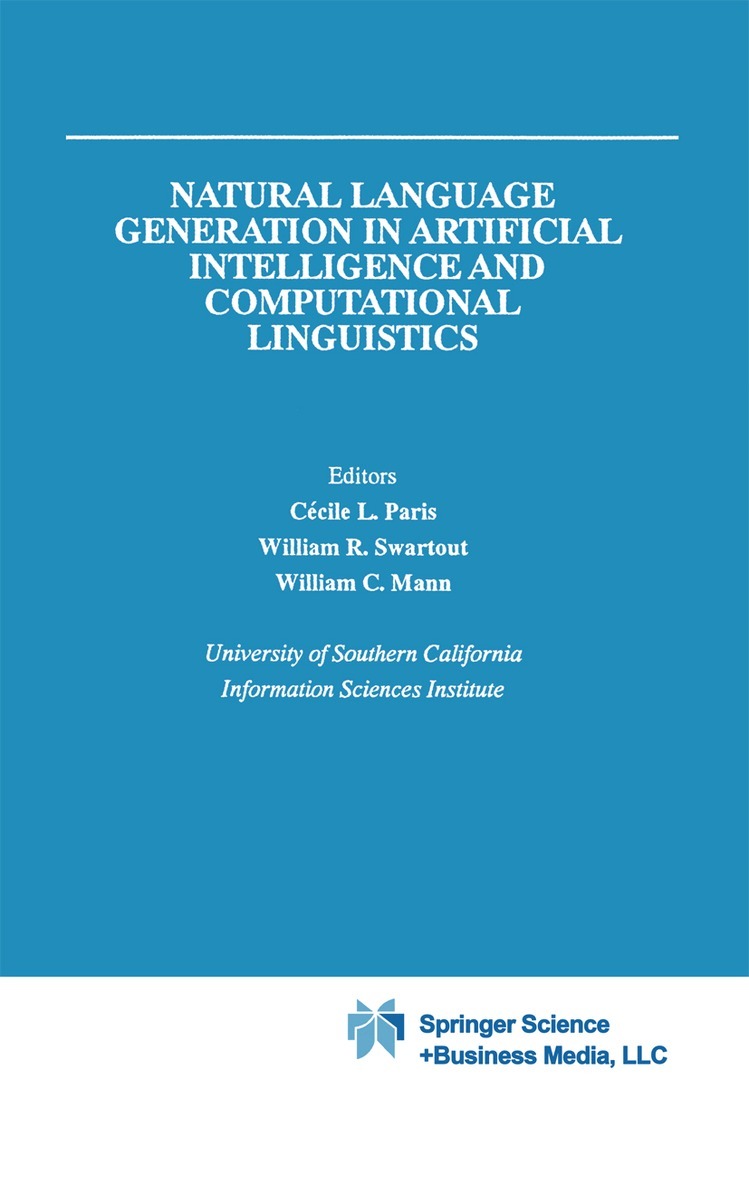
    Natural Language Generation in Artificial Intelligence and Computational Linguistics

    AvCecile L. Paris,William R. Swartout

    Inbunden, Engelska, 1990

    Del i serien Springer International Series in Engineering and Computer Science

    2 229 kr

    Beställningsvara. Skickas inom 10-15 vardagar. Fri frakt över 249 kr.

    Beskrivning

    One of the aims of Natural Language Processing is to facilitate .the use of computers by allowing their users to communicate in natural language. There are two important aspects to person-machine communication: understanding and generating. While natural language understanding has been a major focus of research, natural language generation is a relatively new and increasingly active field of research. This book presents an overview of the state of the art in natural language generation, describing both new results and directions for new research. The principal emphasis of natural language generation is not only to facili­ tate the use of computers but also to develop a computational theory of human language ability. In doing so, it is a tool for extending, clarifying and verifying theories that have been put forth in linguistics, psychology and sociology about how people communicate. A natural language generator will typically have access to a large body of knowledge from which to select information to present to users as well as numer­ of expressing it. Generating a text can thus be seen as a problem of ous ways decision-making under multiple constraints: constraints from the propositional knowledge at hand, from the linguistic tools available, from the communicative goals and intentions to be achieved, from the audience the text is aimed at and from the situation and past discourse. Researchers in generation try to identify the factors involved in this process and determine how best to represent the factors and their dependencies.

    Produktinformation

    • Utgivningsdatum:1990-12-31
    • Mått:156 x 234 x 28 mm
    • Vikt:811 g
    • Format:Inbunden
    • Språk:Engelska
    • Serie:Springer International Series in Engineering and Computer Science
    • Antal sidor:404
    • Upplaga:1991
    • Förlag:Kluwer Academic Publishers
    • ISBN:9780792390985

    Utforska kategorier

    • Systemvetenskap och AI inom Data och IT

    Innehållsförteckning

    • I Text Planning.- 1 A Reactive Approach to Explanation: Taking the User’s Feedback into Account.- 2 Generation and Explanation: Building an Explanation Facility for the Explainable Expert Systems Framework.- 3 Approaches to the Planning of Coherent Text.- 4 Focus of attention: Constraining what can be said next.- 5 Uncovering textual meanings: a case study involving systemic-functional resources for the generation of Japanese texts.- 6 The Implications of Revisions for Natural Language Generation.- 7 POPEL — A Parallel and Incremental Natural Language Generation System.- 8 Tailoring output to the user: What does user modelling in generation mean?.- II Lexical Choice.- 9 On the Place of Words In the Generation Process.- 10 Lexico(Grammatical) choice in text generation.- 11 Lexical Selection and Paraphrase in a Meaning-Text Generation Model.- III Grammatical Resources.- 12 Referent Grammar In Text Generation.- 13 Segment Grammar: a Formalism for Incremental Sentence Generation.- 14 A Contrastive Evaluation of Functional Unification Grammar for Surface Language Generation: A Case Study in Choice of Connectives.