Inbunden, Engelska, 1990
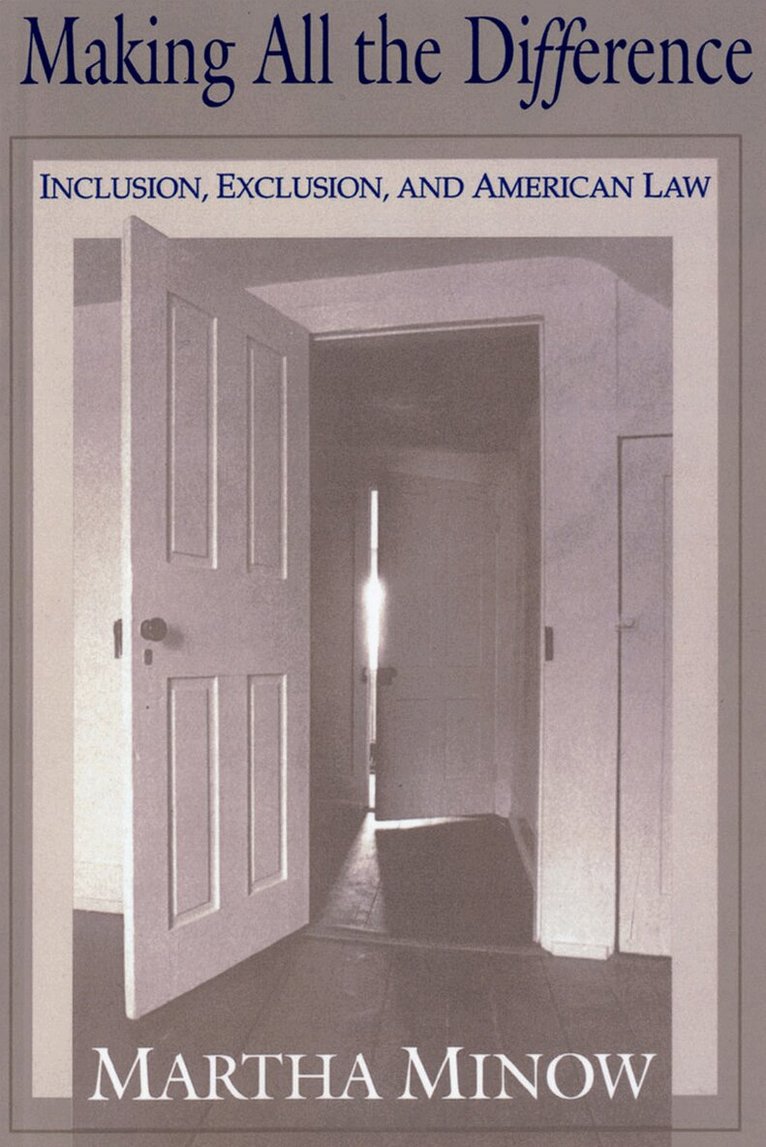
Making All the Difference
Av Martha Minow
659 kr
Beställningsvara. Skickas inom 10-15 vardagar. Fri frakt över 249 kr.
Beskrivning
Should a court order medical treatment for a severely disabled newborn in the face of the parents' refusal to authorize it? How does the law apply to a neighborhood that objects to a group home for developmentally disabled people? Does equality mean treating everyone the same, even if such treatment affects some people adversely? Does a state requirement of employee maternity leave serve or violate the commitment to gender equality?Martha Minow takes a hard look at the way our legal system functions in dealing with people on the basis of race, gender, age, ethnicity, religion, and disability. Minow confronts a variety of dilemmas of difference resulting from contradictory legal strategies—strategies that attempt to correct inequalities by sometimes recognizing and sometimes ignoring differences. Exploring the historical sources of ideas about difference, she offers challenging alternative ways of conceiving of traits that legal and social institutions have come to regard as "different." She argues, in effect, for a constructed jurisprudence based on the ability to recognize and work with perceptible forms of difference.Minow is passionately interested in the people—"different" people—whose lives are regularly (mis)shaped and (mis)directed by the legal system's ways of handling them. Drawing on literary and feminist theories and the insights of anthropology and social history, she identifies the unstated assumptions that tend to regenerate discrimination through the very reforms that are supposed to eliminate it. Education for handicapped children, conflicts between job and family responsibilities, bilingual education, Native American land claims—these are among the concrete problems she discusses from a fresh angle of vision.Minow firmly rejects the prevailing conception of the self that she believes underlies legal doctrine—a self seen as either separate and autonomous, or else disabled and incompetent in some way. In contrast, she regards the self as being realized through connection, capable of shaping an identity only in relationship to other people. She shifts the focus for problem solving from the "different" person to the relationships that construct that difference, and she proposes an analysis that can turn "difference" from a basis of stigma and a rationale for unequal treatment into a point of human connection. "The meanings of many differences can change when people locate and revise their relationships to difference," she asserts. "The student in a wheelchair becomes less different when the building designed without him in mind is altered to permit his access." Her book evaluates contemporary legal theories and reformulates legal rights for women, children, persons with disabilities, and others historically identified as different.Here is a powerful voice for change, speaking to issues that permeate our daily lives and form a central part of the work of law. By illuminating the many ways in which people differ from one another, this book shows how lawyers, political theorist, teachers, parents, students—every one of us—can make all the difference,
Produktinformation
- Utgivningsdatum: 1990-10-09
- Mått: 152 x 229 x 30 mm
- Vikt: 907 g
- Format: Inbunden
- Språk: Engelska
- Antal sidor: 424
- Förlag: Cornell University Press
- ISBN: 9780801424465
Utforska kategorier
Betyg & recensioner
0 recensioner
Inga recensioner tillgängliga.