• Fri frakt över 249 kr
  • •
  • Snabba leveranser
  • •
  • Billiga böcker
Kundservice

Du är på sajten för privatpersoner.

Företag, bibliotek eller offentlig verksamhet?

Du handlar på classic.bokus.com, där alla dina funktioner finns intakta.
Till classic.bokus.com
Bokus logotyp. Gå till startsidan.
  • Erbjudanden
  • Nyheter
  • Student
  • Topplistor
  • Barn & ungdom
  • Bokus Play
  • E-böcker
  • Pocketböcker
  • Spel & pussel

10% rabatt på allt med kod NYSTART10 →

Sidfot

Mina sidor

    Hjälp

    • Kundservice
    • Vanliga frågor och svar
    • Frakt och leverans
    • Retur vid ångerrätt
    • Reklamera vara
    • Betalning
    • Köpvillkor
    • Allmänna villkor
    • Information om webbplatsens tillgänglighet

    Om Bokus

    • Om oss
    • Pressrum
    • För studenter
    • För företag
    • För bibliotek och offentlig verksamhet
    • För leverantörer
    • Hållbarhet

    Populärt

    • Aktuella erbjudanden
    • Presentkort
    • Studentlitteratur
    • Nya böcker
    • Topplistor
    • Signerade böcker
    • Engelska böcker

    Inspiration

    • Boktips
    • BookTok
    • Populära bokserier
    • Barnbokskaraktärer
    • Populära författare
    Logotyp för Bokus
    Följ oss på Facebook (extern länk)Följ oss på Instagram (extern länk)Följ oss på YouTube (extern länk)Följ oss på TikTok (extern länk)
    bokus @ CookiesAnpassa cookiesIntegritetspolicyKöpvillkor
    Till Citymail hemsida (extern länk)Till Budbee hemsida (extern länk)Till Postnord hemsida (extern länk)Till Schenker hemsida (extern länk)Till Early Bird hemsida (extern länk)Till Walleys hemsida (extern länk)
    1. Skönlitteratur
    2. Litteraturvetenskap
    3. Litteraturvetenskap

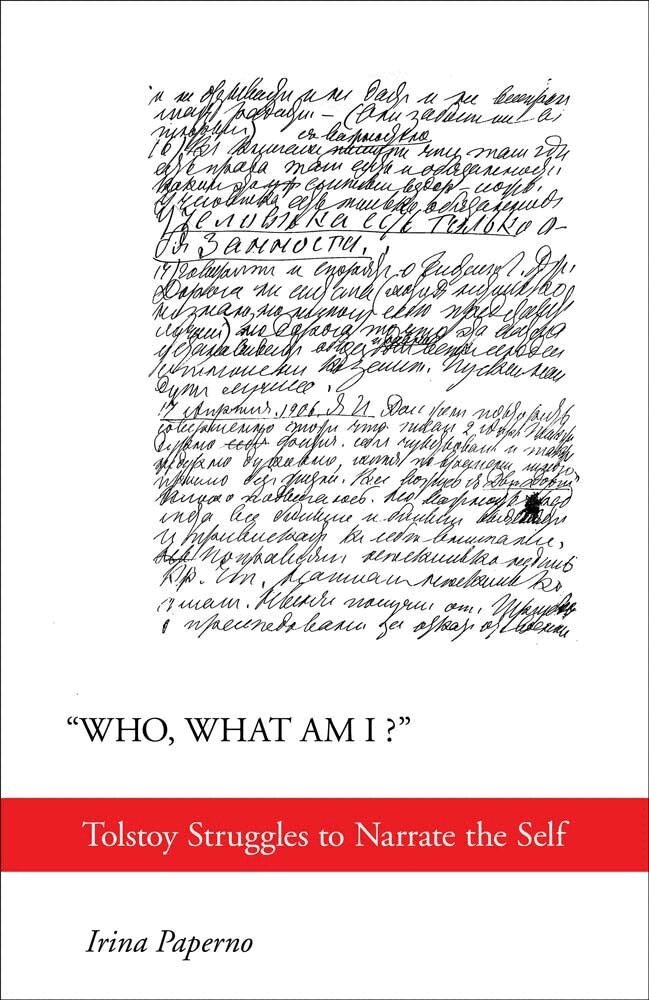
    "Who, What Am I?"

    Tolstoy Struggles to Narrate the Self

    AvIrina Paperno

    Inbunden, Engelska, 2014

    638 kr

    Beställningsvara. Skickas inom 5-8 vardagar. Fri frakt över 249 kr.

    Fler format och utgåvor

    Häftad

    423 kr

    Beskrivning

    "God only knows how many diverse, captivating impressions and thoughts evoked by these impressions... pass in a single day. If it were only possible to render them in such a way that I could easily read myself and that others could read me as I do." Such was the desire of the young Tolstoy. Although he knew that this narrative utopia—turning the totality of his life into a book—would remain unfulfilled, Tolstoy would spend the rest of his life attempting to achieve it. "Who, What Am I?" is an account of Tolstoy's lifelong attempt to find adequate ways to represent the self, to probe its limits and, ultimately, to arrive at an identity not based on the bodily self and its accumulated life experience. This book guides readers through the voluminous, highly personal nonfiction writings that Tolstoy produced from the 1850s until his death in 1910. The variety of these texts is enormous, including diaries, religious tracts, personal confessions, letters, autobiographical fragments, and the meticulous accounts of dreams. For Tolstoy, inherent in the structure of the narrative form was a conception of life that accorded linear temporal order a predominant role, and this implied finitude. Tolstoy refused to accept that human life stopped with death and that the self was limited to what could be remembered and told. In short, Tolstoy's was a philosophical and religious quest, and he followed in the footsteps of many, from Plato and Augustine to Rousseau and Schopenhauer. In reconstructing Tolstoy's struggles, this book reflects on the problems of self and narrative as well as provides an intellectual and psychological biography of the writer.

    Produktinformation

    • Utgivningsdatum:2014-11-20
    • Mått:152 x 229 x undefined mm
    • Vikt:907 g
    • Format:Inbunden
    • Språk:Engelska
    • Antal sidor:240
    • Förlag:Cornell University Press
    • ISBN:9780801453342
    • Utmärkelser:Winner, Aldo and Jeanne Scaglione Prize for Studie

    Utforska kategorier

    • Litteraturvetenskap inom Skönlitteratur

    Mer om författaren

    Irina Paperno teaches Russian literature and intellectual history at the University of California, Berkeley. She is the author of Stories of the Soviet Experience: Memoirs, Diaries, Dreams and Suicide as a Cultural Institution in Dostoevsky's Russia.

    Recensioner i media

    Offers a rare exploration into the internal world of Tolstoy by examining his nonfictional, first-person writings, including diaries, letters, reminiscences, autobiographical and confessional statements, and essays.... Paperno makes an invaluable contribution to Tolstoy scholarship.- R. A. Erb (CHOICE) Paperno deftly shows how Tolstoi's attempt to write an autobiography failed, but his perceived failure at capturing the moral, philosophical, and technical issues accurately becomes a testament to his literary honesty (102). "Who, What Am I?" is highly important for any Tolstoi researcher, as it brings together the whole of his writings dealing with the exploration of the self.- Radha Balasubramanian (Slavic Review) This is a relatively short book, yet it is rich in content, taking on some of the most important and challenging problems Tolstoy faced as a writer and thinker. [Irina Paperno] draws on a full range of Tolstoy's nonfiction writings from the 1850s until his death in 1910: diaries, letters, reminiscences, autobiographical and confessional statements, essays, and religious tracts. In addition, her book is informed by vast reading in other sources, primary and secondary.- Randall A. Poole (The Russian Review) Paperno reads all his [Tolstoy's] writings in relation to the central project of his life: the transformation of his life into a book that would teach others how to live.... 'Who, What Am I?' is an important book that will become a standard source for students, general readers and scholars alike.(SLAVONIC AND EAST EUROPEAN REVIEW)

    Innehållsförteckning

    • IntroductionChapter 1. "So That I Could Easily Read Myself": Tolstoy's Early DiariesTolstoy Starts a Diary—The Moral Vision of Self and the Temporal Order of Narrative—What Is Time? Cultural Precedents—“A History of Yesterday”— Time and Narrative—The Dream: The Hidden Recesses of Time—What Am I? The Young Tolstoy Defines Himself—What Am I? Cultural PrecedentsInterlude: Between Personal Documents and FictionFrom Diaries to Childhood: Tolstoy Becomes a Writer (1852)—“I Think I Will Never Write Again”: Tolstoy Attempts to Renounce Literature (1859)—“I . . . Don’t Even Think about the Accursed Lit-t-terature and Lit-t-terateurs”: Tolstoy Renounces Literature Again (1870); and Again (1874–75)Chapter 2. “To Tell One’s Faith Is Impossible. . . . How to Tell That Which I Live By. I’ll Tell You, All the Same. . . .” Tolstoy in His Correspondence“What Is My Life? What Am I?”: Tolstoy’s Philosophical Dialogue with Nikolai Strakhov—“I Wish that You, Instead of Reading Anna Kar [ enina ], Would Finish It. . . .”—“In the Form of Catechism,” “In the Form of a Dialogue”—To Tell One’s Life—Rousseau and His Profession/Confession—The Parting of Ways: Tolstoy Writes His Confession, and Strakhov Continues to Confess in His Letters to TolstoyChapter 3. Tolstoy’s Confession : What Am I?Tolstoy Publishes his Confession—The Conversion Narrative: Excursus on the Genre—Tolstoy’s Confession : Step by Step—Tolstoy’s Confession Related to Rousseau’s and Augustine’s—After Confession: “Presenting Christ’s Teaching as Something New after 1,800 Years of Christianity”—Coda: Tolstoy’s InfluenceChapter 4. “To Write My Life ”: Tolstoy Tries, and Fails, to Produce a Memoir or AutobiographyThe Author Biography—“My Life”: “On the Basis of My Own Memories”—“Reminiscences”: “More Useful Than All That Artistic Prattle with Which the Twelve Volumes of My Works Are Filled”—“Reminiscences”: “I Cannot Provide a Coherent Description of Events and States of Mind”—“The Green Stick”: “Où Suis-Je? Pourquoi Suis-Je? Que Suis-Je?”—Tolstoy and the Autobiographical TraditionChapter 5. “What Should We Do Then?”: Tolstoy on Self and Other“Why Have You, a Man from a Different World, Stopped near Us? Who Are You?”—Master and Slave: Tolstoy Rewrites Hegel—Tolstoy and the Washerwoman—The Order of Things: The Church, the State, the Arts and Sciences—“Master and Man”—Coda: Nonparticipation in EvilChapter 6. “I Felt a Completely New Liberation from Personality”: Tolstoy’s Late DiariesTolstoy Resumes his Diary—The Temporal Order of Narrative: The Last Day—“On Life and Death ”—The Diary as a Spiritual Exercise—“I, the Body, Is Such a Disgusting Chamber Pot”—“I Am Conscious of Myself Being Conscious of Myself Being Conscious of Myself. . . .”—“I Have Lost the Memory of Everything, Almost Everything. . . . How Can One Not Rejoice at the Loss of Memory?”—Sleeping, Dreaming, and Awakening—Tolstoy’s Dreams—Dreams: The World beyond Time and Representation—The Book of life: “It Is Written on Time”—The Circle of Reading: “To Replace the Consciousness of Leo Tolstoy with the Consciousness of All Humankind”—“The Death of Socrates”—Tolstoy’s DeathAppendix: Russian QuotationsNotesIndex