• Fri frakt över 249 kr
  • •
  • Snabba leveranser
  • •
  • Billiga böcker
Kundservice

Du är på sajten för privatpersoner.

Företag, bibliotek eller offentlig verksamhet?

Du handlar på classic.bokus.com, där alla dina funktioner finns intakta.
Till classic.bokus.com
Bokus logotyp. Gå till startsidan.
  • Erbjudanden
  • Nyheter
  • Student
  • Topplistor
  • Barn & ungdom
  • Bokus Play
  • E-böcker
  • Pocketböcker
  • Spel & pussel

10% rabatt på allt med kod NYSTART10 →

Sidfot

Mina sidor

    Hjälp

    • Kundservice
    • Vanliga frågor och svar
    • Frakt och leverans
    • Retur vid ångerrätt
    • Reklamera vara
    • Betalning
    • Köpvillkor
    • Allmänna villkor
    • Information om webbplatsens tillgänglighet

    Om Bokus

    • Om oss
    • Pressrum
    • För studenter
    • För företag
    • För bibliotek och offentlig verksamhet
    • För leverantörer
    • Hållbarhet

    Populärt

    • Aktuella erbjudanden
    • Presentkort
    • Studentlitteratur
    • Nya böcker
    • Topplistor
    • Signerade böcker
    • Engelska böcker

    Inspiration

    • Boktips
    • BookTok
    • Populära bokserier
    • Barnbokskaraktärer
    • Populära författare
    Logotyp för Bokus
    Följ oss på Facebook (extern länk)Följ oss på Instagram (extern länk)Följ oss på YouTube (extern länk)Följ oss på TikTok (extern länk)
    bokus @ CookiesAnpassa cookiesIntegritetspolicyKöpvillkor
    Till Citymail hemsida (extern länk)Till Budbee hemsida (extern länk)Till Postnord hemsida (extern länk)Till Schenker hemsida (extern länk)Till Early Bird hemsida (extern länk)Till Walleys hemsida (extern länk)
    1. Ekonomi och Ledarskap
    2. Nationalekonomi
    3. Internationell ekonomi

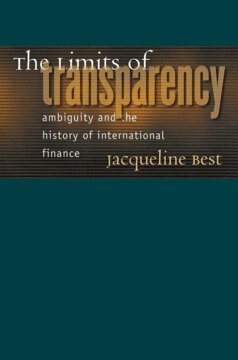
    Limits of Transparency

    Ambiguity and the History of International Finance

    AvJacqueline Best

    Häftad, Engelska, 2007

    Del i serien Cornell Studies in Money

    350 kr

    Beställningsvara. Skickas inom 10-15 vardagar. Fri frakt över 249 kr.

    Fler format och utgåvor

    Inbunden

    797 kr

    Beskrivning

    A decade of crises has reminded us of the fragility of the international financial system. Conventional wisdom holds that uncertainty is the basic problem of financial governance, and attempts to contain ambiguity have dominated recent financial reform efforts. Jacqueline Best, however, contends that ambiguity can play a valuable role in international political and economic stability. The stability of the postwar era depended, Best suggests, on a carefully maintained balance between coherence and ambiguity. In her view, the collapse of the Bretton Woods exchange-rate regime was caused in large part by the increasing rigidity of the system and its corresponding inability to accommodate ambiguity.This is a novel argument in an area much discussed by economists and political scientists. Their debate has focused on uncertainty as a technical problem and transparency as the solution. Although such policies are presented as technical, Best demonstrates that they are also political, have cultural consequences, and may prove counterproductive. Rather than assume that transparency is the ultimate goal, Best argues, we must recognize that ambiguity is pervasive, substantive, and potentially constructive. To read this book is to comprehend more deeply the ways in which politics is fundamental to economic theory and practice and to understand why the economy requires political leadership in order to flourish.

    Produktinformation

    • Utgivningsdatum:2007-02-05
    • Mått:155 x 235 x 14 mm
    • Vikt:454 g
    • Format:Häftad
    • Språk:Engelska
    • Serie:Cornell Studies in Money
    • Antal sidor:234
    • Förlag:Cornell University Press
    • ISBN:9780801473777

    Utforska kategorier

    • Internationell ekonomi inom Ekonomi och Ledarskap
    • Ekonomisk politik inom Ekonomi och Ledarskap

    Mer om författaren

    Jacqueline Best is Associate Professor of Political Studies at the University of Ottawa.

    Recensioner i media

    The Limits of Transparency demonstrates that many of the puzzles confronting us regarding the politics of money and finance can be unlocked if we move from a narrowly rationalist understanding of political economy to one also informed by constructivist insights. This book demonstrates that constructivism, done well, can be a model of theoretical clarity, empirically grounded, and can produce practical policy recommendations.- Kathleen R. McNamara (Perspectives on Politics) Jacqueline Best presents three forms of ambiguity: technical... contested... and intersubjective.... Having defined three types of ambiguity, Best sets out very ambitious objectives including reframing international theory, the history of Bretton Woods and—most important—redirecting contemporary policy debate.- Sylvia Ostry (Literary Review of Canada)