• Fri frakt över 249 kr
  • •
  • Snabba leveranser
  • •
  • Billiga böcker
Kundservice

Du är på sajten för privatpersoner.

Företag, bibliotek eller offentlig verksamhet?

Du handlar på classic.bokus.com, där alla dina funktioner finns intakta.
Till classic.bokus.com
Bokus logotyp. Gå till startsidan.
  • Erbjudanden
  • Nyheter
  • Student
  • Topplistor
  • Barn & ungdom
  • Bokus Play
  • E-böcker
  • Pocketböcker
  • Spel & pussel

10% studentrabatt med kod TERM26

Sidfot

Mina sidor

    Hjälp

    • Kundservice
    • Vanliga frågor och svar
    • Frakt och leverans
    • Retur vid ångerrätt
    • Reklamera vara
    • Betalning
    • Köpvillkor
    • Allmänna villkor
    • Information om webbplatsens tillgänglighet

    Om Bokus

    • Om oss
    • Pressrum
    • För studenter
    • För företag
    • För bibliotek och offentlig verksamhet
    • För leverantörer
    • Hållbarhet

    Populärt

    • Aktuella erbjudanden
    • Presentkort
    • Studentlitteratur
    • Nya böcker
    • Topplistor
    • Signerade böcker
    • Engelska böcker

    Inspiration

    • Boktips
    • BookTok
    • Populära bokserier
    • Barnbokskaraktärer
    • Populära författare
    Logotyp för Bokus
    Följ oss på Facebook (extern länk)Följ oss på Instagram (extern länk)Följ oss på YouTube (extern länk)Följ oss på TikTok (extern länk)
    bokus @ CookiesAnpassa cookiesIntegritetspolicyKöpvillkor
    Till Citymail hemsida (extern länk)Till Budbee hemsida (extern länk)Till Postnord hemsida (extern länk)Till Schenker hemsida (extern länk)Till Early Bird hemsida (extern länk)Till Walleys hemsida (extern länk)
    1. Filosofi och religion
    2. Filosofi
    3. Filosofiska discipliner

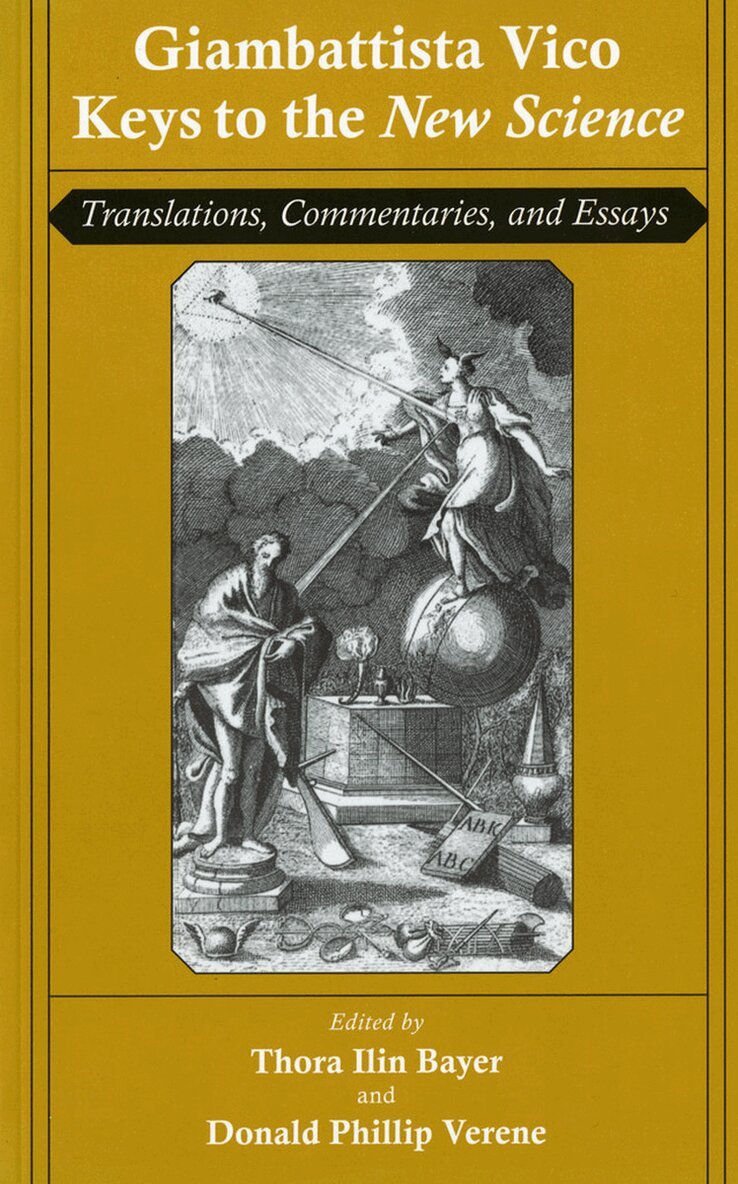
    Giambattista Vico: Keys to the "New Science"

    Translations, Commentaries, and Essays

    AvGiambattista Vico,Thora Ilin Bayer

    Häftad, Engelska, 2008

    243 kr

    Beställningsvara. Skickas inom 10-15 vardagar. Fri frakt över 249 kr.

    Beskrivning

    Giambattista Vico: Keys to the "New Science" brings together in one volume translations, commentaries, and essays that illuminate the background of Giambattista Vico's major work. Thora Ilin Bayer and Donald Phillip Verene have collected a series of texts that help us to understand the progress of Vico's thinking, culminating in the definitive version of the New Science, which was published in 1744.Bayer and Verene provide useful introductions both to the collection as a whole and to the individual writings. What emerges is a clear picture of the decades-long process through which Vico elaborated his revolutionary theory of history and culture. Of particular interest are the first sketch of the new science from his earlier work, the Universal Law, and Vico's response to the false book notice regarding the first version of his New Science.The volume also includes additions to the 1744 edition that Vico had written out but that do not appear in the English translations—including his brief chapter on the "Reprehension of the Metaphysics of Descartes, Spinoza, and Locke"—and a bibliography of all of Vico's writings that have appeared in English. Giambattista Vico: Keys to the "New Science" is a unique and vital companion for anyone reading or rereading this landmark of Western intellectual history.

    Produktinformation

    • Utgivningsdatum:2008-11-15
    • Mått:140 x 216 x 13 mm
    • Vikt:454 g
    • Format:Häftad
    • Språk:Engelska
    • Antal sidor:224
    • Förlag:Cornell University Press
    • ISBN:9780801474729

    Utforska kategorier

    • Filosofiska discipliner inom Filosofi och religion

    Mer om författaren

    Thora Ilin Bayer is RosaMary Foundation Professor of Liberal Arts at Xavier University of Louisiana. She is the author of Cassirer's Metaphysics of Symbolic Forms: A Philosophical Commentary. Donald Phillip Verene is Charles Howard Candler Professor of Metaphysics and Moral Philosophy and Director of the Institute for Vico Studies at Emory University. His many books include Vico's Science of Imagination and The Art of Humane Education, both from Cornell.

    Recensioner i media

    "This is a fine and comprehensive summary of a controversial and many-faceted thinker. It draws upon Vico's lesser known writings in his long and complex pilgrimage from humanist philology through jurisprudence and Homeric poetry to philosophy. This includes not only the crucial published work on universal law but also a manuscript fragment relating to it, Vico's reply to the early review of his 'new science,' additions to the second edition of work, his late conception of the classical muses, his 'tree of knowledge,' and his critique of Descartes, Spinoza, and Locke. All of these, not always available in the existing English translations, come with important and valuable interpretation, commentary, and a review of Vico's metaphysics. A complete bibliography of English-language translations of Vico's writings is appended. Vico's work is seldom, if ever, seen historically and as a whole. This work is much more significant than the numerous speculative interpretations that place him in fanciful contexts, and it is essential to a correct and comprehensive view of the scholar who was at once one of the last of the humanists and one of the first practitioners and theoreticians of the modern human sciences."

    Innehållsförteckning

    • Introduction: Interpreting the New SciencePart 1: Background of the New Science in the Universal Law (1720–2722)Synopsis of Universal LawThe True and the Certain: From On the One Principle and One End of Universal LawA New Science Is Essayed: From On the Constancy of the JurisprudentOn Homer and His Two Poems: From the DissertationsVico's Address to His Readers from a Lost Manuscript on JurisprudencePart 2: Reception of the First New Science (1725)Vico's Reply to the False Book Notice: The Vici VindiciaePart 3: Additions to the Second New Science (1730/1744)Vico's "IGNOTA LATEBAT": On the Impresa and the DipinturaVico's Addition to the Tree of the Poetic Sciences and His Use of the MusesVico's Reprehension of the Metaphysics of René Descartes, Benedict Spinoza, and John Locke