• Fri frakt över 249 kr
  • •
  • Snabba leveranser
  • •
  • Billiga böcker
Kundservice

Du är på sajten för privatpersoner.

Företag, bibliotek eller offentlig verksamhet?

Du handlar på classic.bokus.com, där alla dina funktioner finns intakta.
Till classic.bokus.com
Bokus logotyp. Gå till startsidan.
  • Erbjudanden
  • Nyheter
  • Student
  • Topplistor
  • Barn & ungdom
  • Bokus Play
  • E-böcker
  • Pocketböcker
  • Spel & pussel

10% studentrabatt med kod TERM26

Sidfot

Mina sidor

    Hjälp

    • Kundservice
    • Vanliga frågor och svar
    • Frakt och leverans
    • Retur vid ångerrätt
    • Reklamera vara
    • Betalning
    • Köpvillkor
    • Allmänna villkor
    • Information om webbplatsens tillgänglighet

    Om Bokus

    • Om oss
    • Pressrum
    • För studenter
    • För företag
    • För bibliotek och offentlig verksamhet
    • För leverantörer
    • Hållbarhet

    Populärt

    • Aktuella erbjudanden
    • Presentkort
    • Studentlitteratur
    • Nya böcker
    • Topplistor
    • Signerade böcker
    • Engelska böcker

    Inspiration

    • Boktips
    • BookTok
    • Populära bokserier
    • Barnbokskaraktärer
    • Populära författare
    Logotyp för Bokus
    Följ oss på Facebook (extern länk)Följ oss på Instagram (extern länk)Följ oss på YouTube (extern länk)Följ oss på TikTok (extern länk)
    bokus @ CookiesAnpassa cookiesIntegritetspolicyKöpvillkor
    Till Citymail hemsida (extern länk)Till Budbee hemsida (extern länk)Till Postnord hemsida (extern länk)Till Schenker hemsida (extern länk)Till Early Bird hemsida (extern länk)Till Walleys hemsida (extern länk)
    1. Kultur
    2. Konstböcker
    3. Konsthistoria

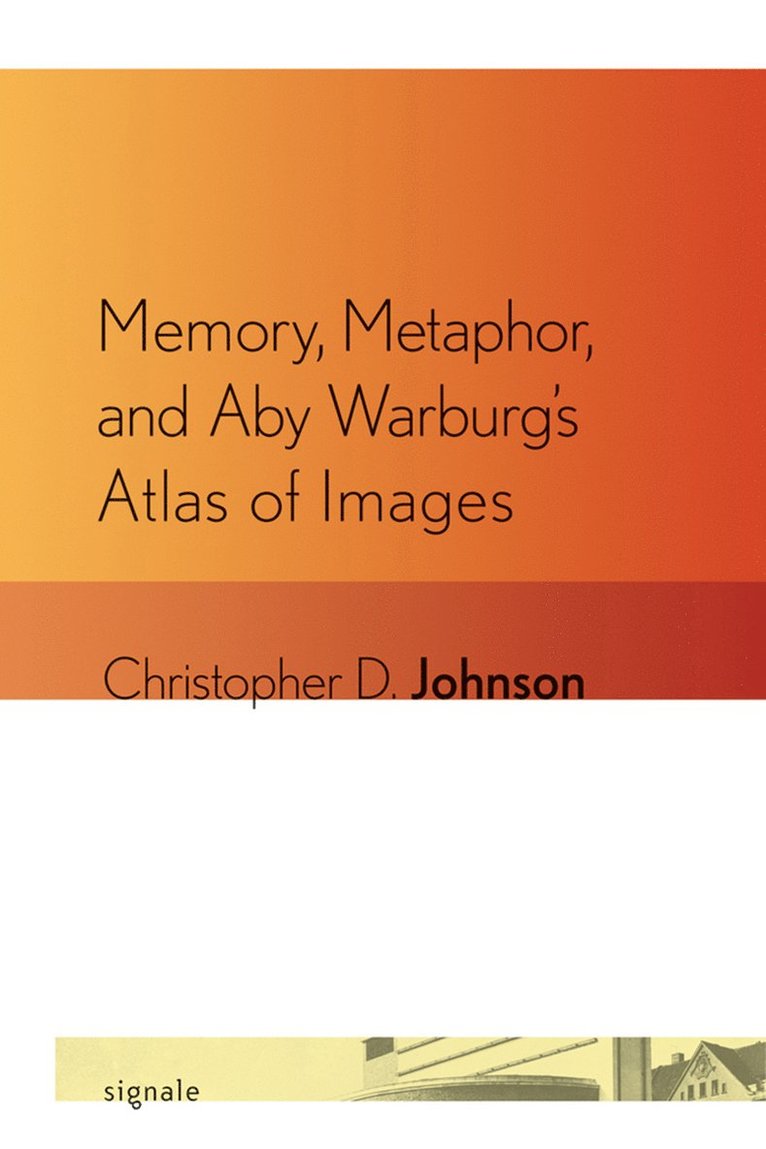
    Memory, Metaphor, and Aby Warburg's Atlas of Images

    AvChristopher D. Johnson

    Häftad, Engelska, 2012

    Del i serien Signale: Modern German Letters, Cultures, and Thought

    522 kr

    Beställningsvara. Skickas inom 10-15 vardagar. Fri frakt över 249 kr.

    Beskrivning

    The work of German cultural theorist and art historian Aby Warburg (1866–1929) has had a lasting effect on how we think about images. This book is the first in English to focus on his last project, the encyclopedic Atlas of Images: Mnemosyne. Begun in earnest in 1927, and left unfinished at the time of Warburg's death in 1929, the Atlas consisted of sixty-three large wooden panels covered with black cloth. On these panels Warburg carefully, intuitively arranged some thousand black-and-white photographs of classical and Renaissance art objects, as well as of astrological and astronomical images ranging from ancient Babylon to Weimar Germany. Here and there, he also included maps, manuscript pages, and contemporary images taken from newspapers. Trying through these constellations of images to make visible the many polarities that fueled antiquity's afterlife, Warburg envisioned the Atlas as a vital form of metaphoric thought.While the nondiscursive, frequently digressive character of the Atlas complicates any linear narrative of its themes and contents, Christopher D. Johnson traces several thematic sequences in the panels. By drawing on Warburg's published and unpublished writings and by attending to Warburg's cardinal idea that "pathos formulas" structure the West's cultural memory, Johnson maps numerous tensions between word and image in the Atlas. In addition to examining the work itself, he considers the literary, philosophical, and intellectual-historical implications of the Atlas. As Johnson demonstrates, the Atlas is not simply the culmination of Warburg's lifelong study of Renaissance culture but the ultimate expression of his now literal, now metaphoric search for syncretic solutions to the urgent problems posed by the history of art and culture.

    Produktinformation

    • Utgivningsdatum:2012-08-15
    • Mått:155 x 235 x 16 mm
    • Vikt:454 g
    • Format:Häftad
    • Språk:Engelska
    • Serie:Signale: Modern German Letters, Cultures, and Thought
    • Antal sidor:304
    • Förlag:Cornell University Press
    • ISBN:9780801477423

    Utforska kategorier

    • Konsthistoria inom Kultur

    Mer om författaren

    Christopher D. Johnson is Associate Professor of Comparative Literature at Harvard University. He is the author of Hyperboles: The Rhetoric of Excess in Baroque Literature and Thought.

    Recensioner i media

    Johnson's dense, rich, often digressive book defies summary. It is centrally concerned with Mnemosyne as a work of cultural memory based not on metonymy, like modernist montages, but on metaphor.... He does much both to illuminate the Mnemosyne project and to place Warburg in the larger context of philosophical and critical thinking about metaphor.- Ritchie Robertson (Modern Language Review) Johnson's intellectual reach is far, his commentary theoretically complex and intuitive. It provides the reader, Warburg scholar and novice alike, with many different points of entry into the material, concisely summarizes and contextualizes Warburg's project with a wealth of references and background information, and weaves these elements into a presentation of great erudition and scope that is at once deeply informed, methodologically reflective, and winningly whimsical. Johnson's approach and relationship to his material are quintessentially Warburgian: he develops his method (and lines of investigation) out of his subject matter, traces its 'implication threads' into remote areas of knowledge, follows with fascination the transtemporal and transregional migration of ideas, and moves expertly and with remarkable insight and intellectual daring between numerous discourses. Contemplative, tenacious, and thoroughly comparative, Johnson's work shares its subject's disdain for disciplinary, conceptual, or chronological boundaries.- Doris McGonagill (German Studies Review)

    Innehållsförteckning

    • 1. Atlas Gazed: Mnemosyne—Its Origins, Motives, and Scope2. Ad oculos: Ways of Seeing, Reading, and Collecting3. Metaphor Lost and Found in Mnemosyne4. Translating the Symbol: Warburg and Cassirer5. Metaphorologies: Nietzsche, Blumenberg, and Hegel6. Exemplary Figures and Diagrammatic Thought7. Synderesis: The "Bruno-Reise"IllustrationsBibliographyIndex