• Fri frakt över 249 kr
  • •
  • Snabba leveranser
  • •
  • Billiga böcker
Kundservice

Du är på sajten för privatpersoner.

Företag, bibliotek eller offentlig verksamhet?

Du handlar på classic.bokus.com, där alla dina funktioner finns intakta.
Till classic.bokus.com
Bokus logotyp. Gå till startsidan.
  • Erbjudanden
  • Nyheter
  • Student
  • Topplistor
  • Barn & ungdom
  • Bokus Play
  • E-böcker
  • Pocketböcker
  • Spel & pussel

10% rabatt på allt med kod NYSTART10 →

Sidfot

Mina sidor

    Hjälp

    • Kundservice
    • Vanliga frågor och svar
    • Frakt och leverans
    • Retur vid ångerrätt
    • Reklamera vara
    • Betalning
    • Köpvillkor
    • Allmänna villkor
    • Information om webbplatsens tillgänglighet

    Om Bokus

    • Om oss
    • Pressrum
    • För studenter
    • För företag
    • För bibliotek och offentlig verksamhet
    • För leverantörer
    • Hållbarhet

    Populärt

    • Aktuella erbjudanden
    • Presentkort
    • Studentlitteratur
    • Nya böcker
    • Topplistor
    • Signerade böcker
    • Engelska böcker

    Inspiration

    • Boktips
    • BookTok
    • Populära bokserier
    • Barnbokskaraktärer
    • Populära författare
    Logotyp för Bokus
    Följ oss på Facebook (extern länk)Följ oss på Instagram (extern länk)Följ oss på YouTube (extern länk)Följ oss på TikTok (extern länk)
    bokus @ CookiesAnpassa cookiesIntegritetspolicyKöpvillkor
    Till Citymail hemsida (extern länk)Till Budbee hemsida (extern länk)Till Postnord hemsida (extern länk)Till Schenker hemsida (extern länk)Till Early Bird hemsida (extern länk)Till Walleys hemsida (extern länk)
    1. Psykologi och pedagogik
    2. Pedagogik
    3. Skolväsen och utbildningssystem
    4. Examination och betygsättning

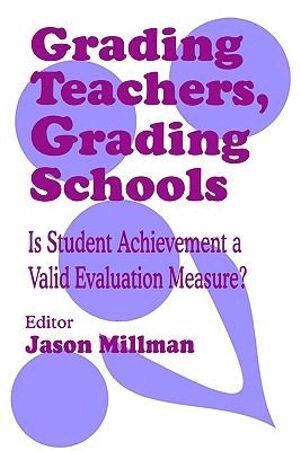
    Grading Teachers, Grading Schools

    Is Student Achievement a Valid Evaluation Measure?

    AvJason Millman

    Häftad, Engelska, 1997

    630 kr

    Beställningsvara. Skickas inom 3-6 vardagar. Fri frakt över 249 kr.

    Beskrivning

    A masterful compilation of diverse perspectives. Daniel L. Stufflebeam, Director, The Evaluation Center, Western Michigan University It′s not a question of whether student learning is an important goal of teaching. Everyone agrees it is. The issue explored here is can you (and should you) use student learning as a measurement tool for assessing teacher effectiveness? This book examines four high-profile, high-stakes, contemporary methods for evaluating teaching through learning gains. It offers a rationale and background for each one along with a discussion on supporting evidence and practical implications. The chapter authors provide these criteria for judging a teacher valuation system: * Is this method fair? * Will this method provide comprehensive data? * How does this method compare to other methods? * What are the positive and negative consequences of using this method? You′ll find out how well each method stacks up, how cumbersome or easy it is to use, and what kind of support or heel-dragging to expect from participants. Measuring teacher effectiveness through student learning can also result in: * Higher levels of instruction * Important data for school and program evaluation * A model for continuous school improvement * A more accurate picture of what (and how) students are learning If you′re interested in the future of teacher assessment, or if you′re ready to make changes in the way your school or district assesses its teachers, you need to read this book.

    Produktinformation

    • Utgivningsdatum:1997-09-29
    • Mått:152 x 228 x 18 mm
    • Vikt:420 g
    • Format:Häftad
    • Språk:Engelska
    • Antal sidor:304
    • Förlag:SAGE Publications Inc
    • ISBN:9780803964020

    Utforska kategorier

    • Examination och betygsättning inom Psykologi och pedagogik

    Mer om författaren

    ITHACA, N.Y. -- Jason Millman, a Cornell University professor of education and an expert on standardized testing methods, died Feb. 22 in Lake Oswego, Ore., where he was visiting family. He died from complications arising from Shy-Drager Syndrome. He was 64.Millman spent a large part of his career studying standardized testing of high school and college students, developing evaluation guidelines for teachers and trying to find accurate ways to measure human performance in an academic setting.In 1992, Millman was commissioned by the New York State Court of Appeals to study whether the New York Bar examination was biased. In his study, released in May 1993, Millman concluded that although passing rates differed across groups, the bar examination was not biased. Later, in a 1994 study on testing accommodations, he developed a methodology for investigating whether the completion of tasks within a prescribed amount of time is an important lawyering skill.Millman also studied the appropriate use of the Scholastic Aptitude Test and was critical of states that compared schools to each other through a "pervasive, simplistic, misleading and dangerous" use of scores. The SAT, he claimed, is taken by motivated, college-bound students and is designed to predict how individual students will perform in college, not to measure schools′ effectiveness.In addition to evaluating the performance of students and teachers on standardized tests, Millman and his colleagues also published a 1983 study in the journal Research in Higher Education, indicating that grade inflation was threatening the reliability and validity of grade-point averages.Millman served as co-editor, with Linda Darling-Hammond, of The New Handbook for Teacher Evaluation: Assessing Elementary and Secondary School Teachers (1990), a popular book in the education field. His other books included Grading Teachers, Grading Schools: Is Student Achievement a Valid Evaluation Measure? (1997) and How to Take Tests (1969). He also served as editor of two professional journals, Education Researcher (1964-68) and Journal of Education Measurement (1968-71).Millman grew up in Albany, N.Y., and graduated from Albany High School in 1951. He earned a bachelor′s degree in mathematics education in 1955 and a doctorate in psychometrics in 1960, both from the University of Michigan. He joined the Cornell faculty in 1960 as an assistant professor, teaching educational research methodology. He was named a professor in 1969.He served as president of the National Council on Measurement in Education (1978-81) and president of the Educational Research Association of New York State (1963-64). He held elective offices with the Measurement and Research Methodology Division, American Research Association. He served a four-year term as an executive committee member of the National Assessment Governing Board. In 1996 he was awarded the National Council on Measurement in Education Career Award.In addition to his academic accomplishments, he was active in the Suicide Prevention and Crisis Service in Tompkins County, N.Y. He was a writer of the handbook Talking With the Callers: Guidelines for Crisis Line and Other Volunteer Counselors (1998).Millman lived in Ithaca and is survived by his wife, Meredith; sons Jeffrey of San Francisco, Almar of Oswego Lake, Ore., and David of Ithaca; five grandchildren; a brother, Russell Millman of Cincinnati; and a sister, Miriam Biglow of Palm Harbor, Fla.

    Innehållsförteckning

    • PART ONE: ORIGINS AND UNDERPINNINGSBeginnings and Introduction - Jason Millman and H Del SchalockPART TWO: THE OREGON WORK SAMPLE METHODOLOGYOregon′s Teacher Effectiveness Work Sample Methodology - Bill Cowart and David MytonRationale and BackgroundOregon′s Teacher Effectiveness Work Sample as Used at Western Oregon State College - H Del Schalock, Mark Schalock and Gerald GirodOregon′s Teacher Effectiveness Work Sample Methodology - Peter W AirasianPotential and ProblemsOregon′s Teacher Effectiveness Work Sample Methodology - Daniel L StufflebeamEducational Policy ReviewReflections on Comments by Professors Airasian and Stufflebeam - H Del Schalock, Mark Schalock and Gerald GirodPART THREE: THE DALLAS VALUE-ADDED ACCOUNTABILITY SYSTEMIn the Beginning - Luvern L CunninghamThe Dallas Value-Added Accountability System - William J Webster and Robert L MendroValue-Added Productivity Indicators - Yeow Meng Thum and Anthony S BrykThe Dallas SystemOn Trial - Gary SykesThe Dallas Value Added Accountability SystemLittle Practical Difference and Pie in the Sky - William J Webster et alA Response to Thum and Bryk and a Rejoinder to SykesPART FOUR: THE TENNESSEE VALUE-ADDED ASSESSMENT SYSTEMThe Impetus for Tennessee′s Value-Added Assessment System - Patricia E Ceperley and Kip ReelThe Tennessee Value-Added Assessment System - William L Sanders, Arnold M Saxton and Sandra P HornA Quantitative Outcomes-Based Approach to Educational AssessmentTVAAS - Richard B DarlingtonA Challenge to Familiar Assessment MethodsResponse to the Reviewers - William L Sanders et alPART FIVE: THE KENTUCKY INSTRUCTIONAL RESULTS INFORMATIONS SYSTEMHistorical Background - Doris Redfield and Roger PankratzThe Kentucky School Accountability IndexRonald K Hambleton - Neal Kingston and Ed ReidyMeasurement Quality of the Kentucky Instructional Results Information System, 1991-1994Overview and Assessment of the Kentucky Instructional Results Informations System - Daniel L StufflebeamKIRIS Meets the Critics - Neal Kingston and Ed ReidyA Little Light and Much HeatPART SIX: SYNTHESIS AND PERSPECTIVESHow Do I Judge Thee? Let Me Count the Ways - Jason MillmanToward What End? - Linda Darling-HammondThe Evaluation of Student Learning for the Improvement of TeachingThe Moth and the Flame - W James PophamStudent Learning as a Criterion of Instructional Competence