• Fri frakt över 249 kr
  • •
  • Snabba leveranser
  • •
  • Billiga böcker
Kundservice

Du är på sajten för privatpersoner.

Företag, bibliotek eller offentlig verksamhet?

Du handlar på classic.bokus.com, där alla dina funktioner finns intakta.
Till classic.bokus.com
Bokus logotyp. Gå till startsidan.
  • Erbjudanden
  • Nyheter
  • Student
  • Topplistor
  • Barn & ungdom
  • Bokus Play
  • E-böcker
  • Pocketböcker
  • Spel & pussel

10% rabatt på allt med kod: NYSTART10 →

Sidfot

Mina sidor

    Hjälp

    • Kundservice
    • Vanliga frågor och svar
    • Frakt och leverans
    • Retur vid ångerrätt
    • Reklamera vara
    • Betalning
    • Köpvillkor
    • Allmänna villkor
    • Information om webbplatsens tillgänglighet

    Om Bokus

    • Om oss
    • Pressrum
    • För studenter
    • För företag
    • För bibliotek och offentlig verksamhet
    • För leverantörer
    • Hållbarhet

    Populärt

    • Aktuella erbjudanden
    • Presentkort
    • Studentlitteratur
    • Nya böcker
    • Topplistor
    • Signerade böcker
    • Engelska böcker

    Inspiration

    • Boktips
    • BookTok
    • Populära bokserier
    • Barnbokskaraktärer
    • Populära författare
    Logotyp för Bokus
    Följ oss på Facebook (extern länk)Följ oss på Instagram (extern länk)Följ oss på YouTube (extern länk)Följ oss på TikTok (extern länk)
    bokus @ CookiesAnpassa cookiesIntegritetspolicyKöpvillkor
    Till Citymail hemsida (extern länk)Till Budbee hemsida (extern länk)Till Postnord hemsida (extern länk)Till Schenker hemsida (extern länk)Till Early Bird hemsida (extern länk)Till Walleys hemsida (extern länk)
    1. Skönlitteratur
    2. Litteraturvetenskap
    3. Litteraturvetenskap

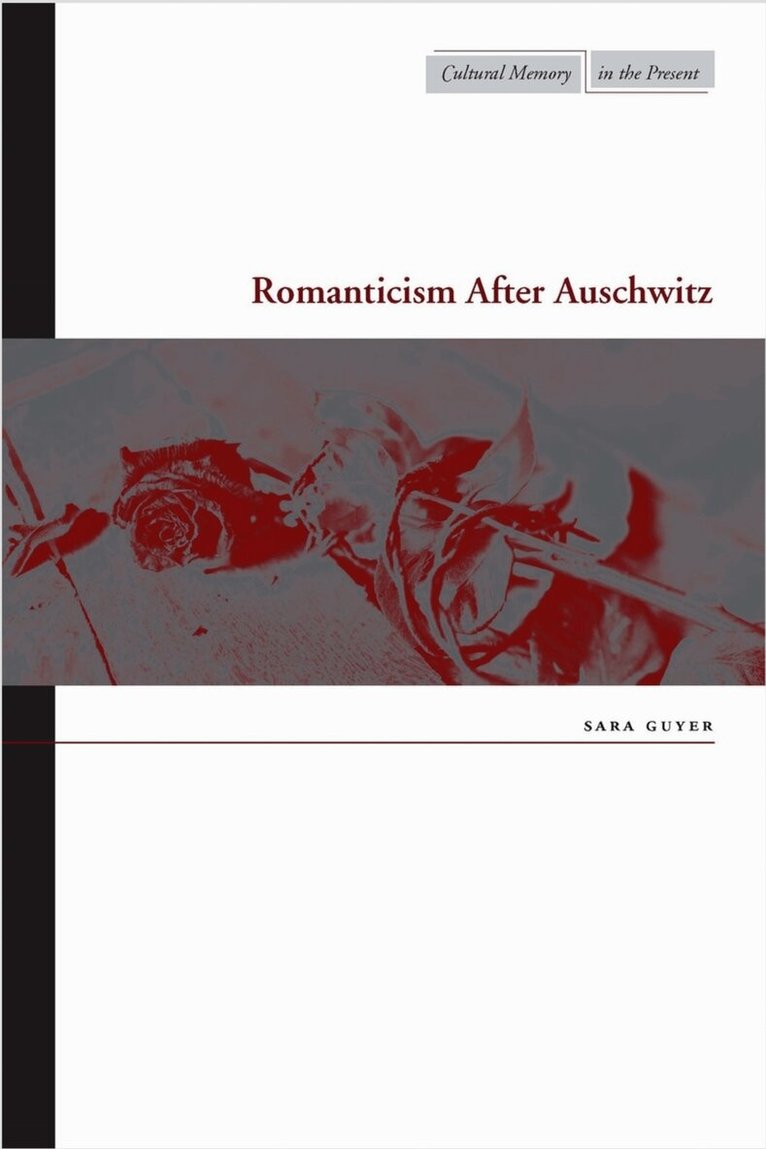
    Romanticism After Auschwitz

    AvSara Guyer

    Inbunden, Engelska, 2007

    Del i serien Cultural Memory in the Present

    952 kr

    Beställningsvara. Skickas inom 5-8 vardagar. Fri frakt över 249 kr.

    Beskrivning

    Romanticism After Auschwitz reveals how post-Holocaust testimony remains romantic, and shows why romanticism must therefore be rethought. The book argues that what literary historians have traditionally called "romanticism," and characterized as a literary movement stretching roughly between 1785 and 1832, should be redescribed in light of two circumstances. The first is the specific inadequacy of literary-historical models before "romantic" works. The second is the particular function that these unsettling aspects of "romantic" works have after Auschwitz. The book demonstrates that certain figures (of speech, writing, and argument) central to normative accounts of "romanticism," serve in their most radical—most genuinely "romantic"—form as vehicles for posing a conception of life (and death) revealed in the camps. In these pages, Agamben meets Wordsworth, Shakespeare meets Celan, film meets lyric poetry, survivors' accounts meet fiction, de Man encounters Nancy. The book offers new readings of highly canonical works—Mary Shelley's Frankenstein, Wordsworth and Coleridge's Lyrical Ballads, Alain Resnais's Night and Fog—and introduces unfamiliar texts. It elaborates a fascinating account of the rhetoric of ethical dispositions and gives its readers an attentive, moving way of understanding the condition of human survival after the Holocaust.

    Produktinformation

    • Utgivningsdatum:2007-08-13
    • Mått:152 x 229 x 26 mm
    • Vikt:644 g
    • Format:Inbunden
    • Språk:Engelska
    • Serie:Cultural Memory in the Present
    • Antal sidor:384
    • Förlag:Stanford University Press
    • ISBN:9780804755245

    Utforska kategorier

    • Litteraturvetenskap inom Skönlitteratur
    • Litteraturteori inom Skönlitteratur

    Mer om författaren

    Sara Guyer is Assistant Professor of English and Jewish Studies at the University of Wisconsin-Madison, where she teaches courses in Romanticism, Literary Theory, and Post-Holocaust Literature.

    Recensioner i media

    "A good book about the pain of surviving." - Marion Spies (Religion and the Arts.) "This is, moreover, a challenging and often contentious book that deserves to be viewed as a significant contribution to the question of the survival of Romanticism even where it seems to be disavowed most forcefully." - Time Literary Supplement "At a time when studies of the field remain predominantly structured by historicist paradigms, Romanticism after Auschwitz demonstrates that romanticism cannot be bound by periodization, that it simply remains good to think with. Any reader of Guyer's sober, poignant argument that lyric figure bears witness to a survival that is neither redemptive nor privative will come away from this book both sadder and wiser." - Stephen Goldsmith (University of California at Berkeley) "This is a bracing, brilliant book. In compelling fashion Guyer weaves back and forth between Romantic literature and culture in the aftermath of Auschwitz. She uncovers untold dynamics in texts we thought we knew—by Mary Shelley, Wordsworth, and Coleridge—and provides precise and painstaking readings of Celan, Shakespeare and Resnais' Night and Fog. Altogether, a haunting book about haunting and testimony." - Ian Balfour (York University)

    Innehållsförteckning

    • @fmct:Contents @toc4:Acknowledgmentsiii @toc2:Introduction: The Rhetoric of Survival1 1.Romanticism, Testimony, Prosopopoeia000 2.Naked Language, Naked Life: Wordsworth's Rhetoric of Survival000 3.Testimony and Trope in Frankenstein000 4.Anthropomorphizing the Human000 5.The Rhetoric of Wakefulness000 6.Breath, Today: Celan's Translation of Shakespeare's Sonnet 71000 7.The Remains of Figure: Nuit et Brouillard, Nacht und Nebel000 Ending in Romanticism000 @toc4:Notes000 Bibliography000 Index