• Fri frakt över 249 kr
  • •
  • Snabba leveranser
  • •
  • Billiga böcker
Kundservice

Du är på sajten för privatpersoner.

Företag, bibliotek eller offentlig verksamhet?

Du handlar på classic.bokus.com, där alla dina funktioner finns intakta.
Till classic.bokus.com
Bokus logotyp. Gå till startsidan.
  • Erbjudanden
  • Nyheter
  • Student
  • Topplistor
  • Barn & ungdom
  • Bokus Play
  • E-böcker
  • Pocketböcker
  • Spel & pussel

10% rabatt på allt med kod: NYSTART10 →

Sidfot

Mina sidor

    Hjälp

    • Kundservice
    • Vanliga frågor och svar
    • Frakt och leverans
    • Retur vid ångerrätt
    • Reklamera vara
    • Betalning
    • Köpvillkor
    • Allmänna villkor
    • Information om webbplatsens tillgänglighet

    Om Bokus

    • Om oss
    • Pressrum
    • För studenter
    • För företag
    • För bibliotek och offentlig verksamhet
    • För leverantörer
    • Hållbarhet

    Populärt

    • Aktuella erbjudanden
    • Presentkort
    • Studentlitteratur
    • Nya böcker
    • Topplistor
    • Signerade böcker
    • Engelska böcker

    Inspiration

    • Boktips
    • BookTok
    • Populära bokserier
    • Barnbokskaraktärer
    • Populära författare
    Logotyp för Bokus
    Följ oss på Facebook (extern länk)Följ oss på Instagram (extern länk)Följ oss på YouTube (extern länk)Följ oss på TikTok (extern länk)
    bokus @ CookiesAnpassa cookiesIntegritetspolicyKöpvillkor
    Till Citymail hemsida (extern länk)Till Budbee hemsida (extern länk)Till Postnord hemsida (extern länk)Till Schenker hemsida (extern länk)Till Early Bird hemsida (extern länk)Till Walleys hemsida (extern länk)
    1. Samhälle och politik
    2. Politik och statsskick
    3. Statsskick och politiska processer

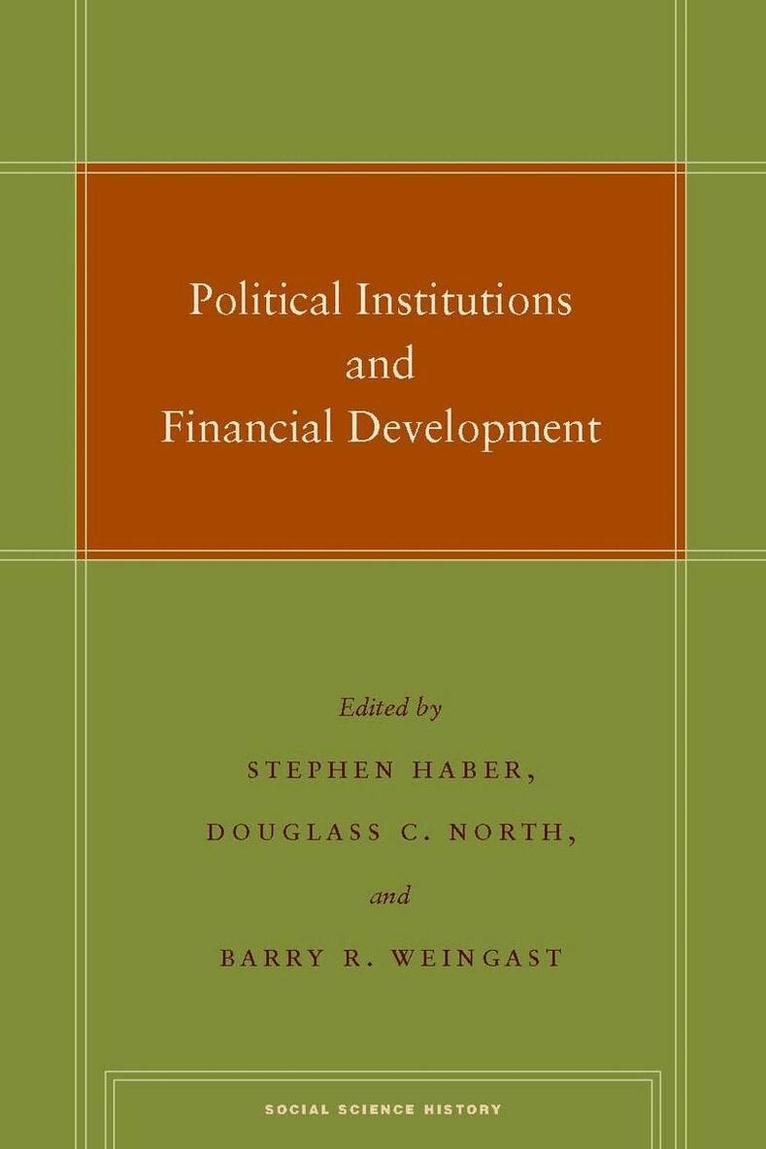
    Political Institutions and Financial Development

    AvStephen Haber,Douglass C. North

    Inbunden, Engelska, 2007

    Del i serien Social Science History

    1 672 kr

    Beställningsvara. Skickas inom 10-15 vardagar. Fri frakt över 249 kr.

    Beskrivning

    Economists have long maintained that a well-developed and functioning financial system is a vital prerequisite to economic growth. Countries with robust banking sectors and securities markets—that is, countries in which credit cards, loans, mortgages, and the ability to issue stocks and bonds are available to a broad swath of consumers and businesses—are more prosperous than countries that restrict such access to a favored elite. What is less clear is why some countries develop better financial systems than others. The essays in this volume employ the insights and techniques of political science, economics, and history to provide a fresh answer to this question. While scholarly tradition points to the colonial origin of a country's legal system as the most important determinant of the health of its financial system, this volume points instead to a country's political institutions—its governmental structures and the rules of the political game—as the key. Specifically, the openness and competitiveness of a country's political system tends to reflect itself in the openness and competitiveness of its financial system.

    Produktinformation

    • Utgivningsdatum:2007-12-14
    • Mått:152 x 229 x 23 mm
    • Vikt:544 g
    • Format:Inbunden
    • Språk:Engelska
    • Serie:Social Science History
    • Antal sidor:320
    • Förlag:Stanford University Press
    • ISBN:9780804756921

    Utforska kategorier

    • Statsskick och politiska processer inom Samhälle och politik
    • Internationell ekonomi inom Ekonomi och Ledarskap

    Mer om författaren

    Stephen Haber is A.A. and Jeanne Welch Milligan Professor in the School of Humanities at Stanford University and a Senior Fellow of the Hoover Institution. He is the author of How Latin America Fell Behind: Essays on the Economic Histories of Brazil and Mexico, 1800-1914; Industry and Underdevelopment: The Industrialization of Mexico, 1890-1940; and The Politics of Property Rights: Political Instability, Credible Commitments, and Economic Growth in Mexico, 1876-1929 (with Armando Razo and Noel Maurer). Douglass C. North is a pioneering economic historian and the co-recipient of the Nobel Prize in Economics (1993). A Professor of Economics at Washington University and a Senior Fellow of the Hoover Institution, he is the author of Institutions, Institutional Change and Economic Performance and Understanding the Process of Economic Change. Barry R. Weingast is the Ward C. Krebs Professor of Political Science at Stanford University and a Senior Fellow of the Hoover Institution as well as a member of the American Academy of Arts and Sciences. He is the author of Positive Theories of Congressional Institutions (with Kenneth A. Shepsle); Preferences and Situations: Points of Contact between Historical and Rational Choice Institutionalisms (with Ira Katznelson); and The Handbook Political Economy (with Donald Wittman).

    Recensioner i media

    "The greatest virtue of this book is the frontal assault it launches against the 'legal origins' view of financial development—the view that traces a country's current financial situation back to its history, especially its history as a colony. Political Institutions and Financial Development should drive a stake through its heart and move scholars on to more fruitful areas of research." —Philip T. Hoffman, California Institute of Technology

    Innehållsförteckning

    • Contents Contributors000 Acknowledgments000 Chapter 1: Political Institutions and Financial Development000 Stephen Haber, Douglass C. North, and Barry R. Weingast Chapter 2: Political Institutions and Financial Development: Evidence from the Political Economy of Bank Regulation in Mexico and the United States000 Stephen Haber Chapter 3: The Political Economy of Early U.S. Financial Development000 Richard Sylla Chapter 4: Answering Mary Shirley's Question, or: What Can the World Bank Learn from American History?000 John Joseph Wallis Chapter 5: Beyond Legal Origin and Checks and Balances: Political Credibility, Citizen Information, and Financial Sector Development000 Philip Keefer Chapter 6: The Microeconomic Effects of Different Approaches to Bank Supervision 000 James R. Barth, Gerard Caprio, and Ross Levine Chapter 7: Political Drivers of Diverging Corporate Governance Patterns000 Peter Gourevitch and James Shinn Chapter 8: Credible Commitment and Sovereign Default Risk: Two Bond Markets and Imperial Brazil000 William R. Summerhill Chapter 9: Legal Origin vs. the Politics of Creditor Rights: Bond Markets in Brazil, 1850\-2002000 Aldo Musacchio Chapter 10: Conclusion: Economics, Political Institutions, and Financial Markets000 Douglass C. North and Mary Shirley Index000