• Fri frakt över 249 kr
  • •
  • Snabba leveranser
  • •
  • Billiga böcker
Kundservice

Du är på sajten för privatpersoner.

Företag, bibliotek eller offentlig verksamhet?

Du handlar på classic.bokus.com, där alla dina funktioner finns intakta.
Till classic.bokus.com
Bokus logotyp. Gå till startsidan.
  • Erbjudanden
  • Nyheter
  • Student
  • Topplistor
  • Barn & ungdom
  • Bokus Play
  • E-böcker
  • Pocketböcker
  • Spel & pussel

10% rabatt på allt med kod NYSTART10 →

Sidfot

Mina sidor

    Hjälp

    • Kundservice
    • Vanliga frågor och svar
    • Frakt och leverans
    • Retur vid ångerrätt
    • Reklamera vara
    • Betalning
    • Köpvillkor
    • Allmänna villkor
    • Information om webbplatsens tillgänglighet

    Om Bokus

    • Om oss
    • Pressrum
    • För studenter
    • För företag
    • För bibliotek och offentlig verksamhet
    • För leverantörer
    • Hållbarhet

    Populärt

    • Aktuella erbjudanden
    • Presentkort
    • Studentlitteratur
    • Nya böcker
    • Topplistor
    • Signerade böcker
    • Engelska böcker

    Inspiration

    • Boktips
    • BookTok
    • Populära bokserier
    • Barnbokskaraktärer
    • Populära författare
    Logotyp för Bokus
    Följ oss på Facebook (extern länk)Följ oss på Instagram (extern länk)Följ oss på YouTube (extern länk)Följ oss på TikTok (extern länk)
    bokus @ CookiesAnpassa cookiesIntegritetspolicyKöpvillkor
    Till Citymail hemsida (extern länk)Till Budbee hemsida (extern länk)Till Postnord hemsida (extern länk)Till Schenker hemsida (extern länk)Till Early Bird hemsida (extern länk)Till Walleys hemsida (extern länk)
    1. Filosofi och religion
    2. Filosofi
    3. Filosofiska discipliner

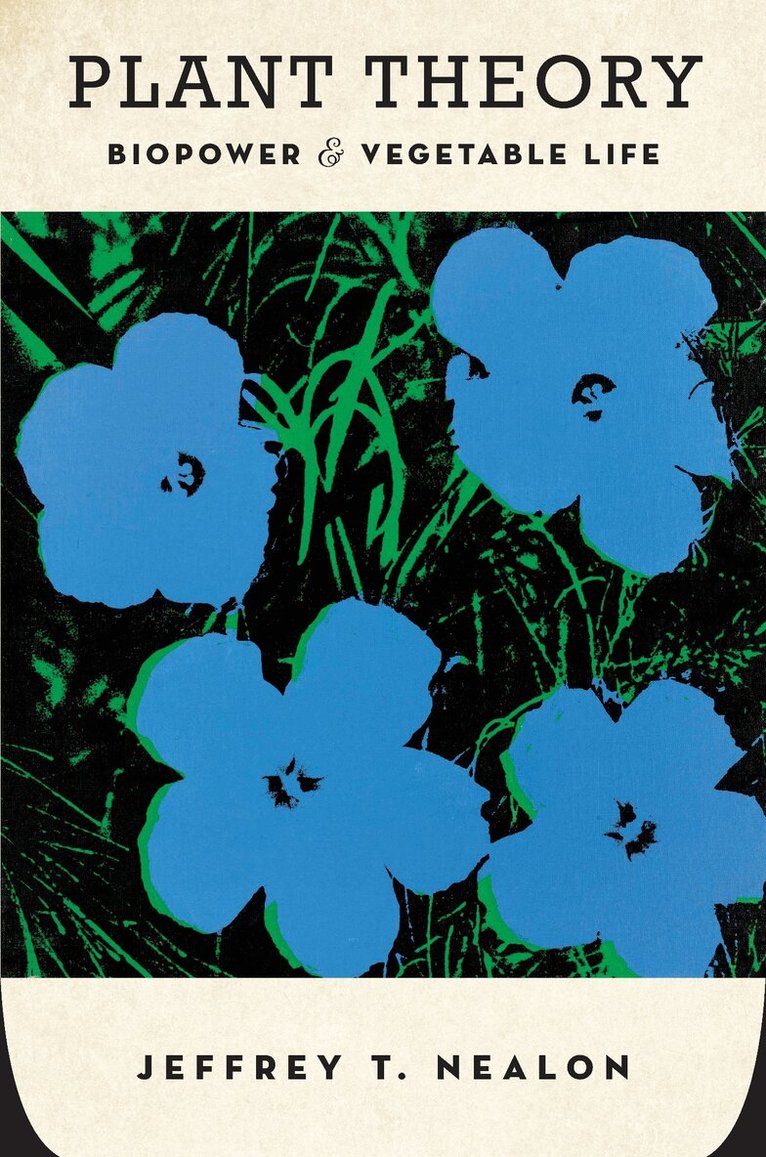
    Plant Theory

    Biopower and Vegetable Life

    AvJeffrey T. Nealon

    Häftad, Engelska, 2015

    257 kr

    Beställningsvara. Skickas inom 10-15 vardagar. Fri frakt över 249 kr.

    Fler format och utgåvor

    Inbunden

    1 062 kr

    E-bok

    302 kr

    Beskrivning

    In our age of ecological disaster, this book joins the growing philosophical literature on vegetable life to ask how our present debates about biopower and animal studies change if we take plants as a linchpin for thinking about biopolitics. Logically enough, the book uses animal studies as a way into the subject, but it does so in unexpected ways. Upending critical approaches of biopolitical regimes, it argues that it is plants rather than animals that are the forgotten and abjected forms of life under humanist biopower. Indeed, biopolitical theory has consistently sidestepped the issue of vegetable life, and more recently, has been outright hostile to it. Provocatively, Jeffrey T. Nealon wonders whether animal studies, which has taken the "inventor" of biopower himself to task for speciesism, has not misread Foucault, thereby managing to extend humanist biopower rather than to curb its reach. Nealon is interested in how and why this is the case. Plant Theory turns to several other thinkers of the high theory generation in an effort to imagine new futures for the ongoing biopolitical debate.

    Produktinformation

    • Utgivningsdatum:2015-10-14
    • Mått:152 x 229 x 16 mm
    • Vikt:272 g
    • Format:Häftad
    • Språk:Engelska
    • Antal sidor:168
    • Förlag:Stanford University Press
    • ISBN:9780804796750

    Utforska kategorier

    • Filosofiska discipliner inom Filosofi och religion

    Mer om författaren

    Jeffrey T. Nealon is the Edwin Erle Sparks Professor of English and Philosophy at Pennsylvania State University.

    Recensioner i media

    "In this powerful and original book, Jeffrey Nealon engages some of today's urgent problems, giving us a new perspective on both the ethical issues raised by recent work in animal studies and related disciplines and the political issues at stake in any analysis of biopower and neoliberalism."—Steven Shaviro, Wayne State University "Ironic but mercifully not postmodern, patient and eminently readable, Jeffrey Nealon's book engages with and ultimately calls into question some of the guiding principles of animal studies. It is without question a singular contribution to recent research on biopolitics, animal studies, and the burgeoning field of 'plant theory.'"—Timothy Campbell, Cornell University "Jeffrey Nealon's deeply thoughtful and strongly felt meditation on the meaning of "life" will surprise you on every page."—John McGowan, Symploke

    Innehållsförteckning

    • Contents and Abstracts0Preface: Plant Theory? chapter abstractThe Preface discusses biopolitical discourse's strange elision of vegetable life (especially within Animal Studies), and suggests that if we really do want to take the discussion of life and power beyond the human, we might want to look at vegetable life as well. Likewise, the preface argues that Foucault, Derrida, and Deleuze & Guattari are privileged sites for thinking about vegetable life.1The First Birth of Biopower: From Plant to Animal Life in Foucault chapter abstractChapter 1 looks at the "first birth of biopower" in Michel Foucault's 1966 The Order of Things. There Foucault suggests, contra Animal Studies, that it is not the animal who is the "other" of the biopolitical human, but the plant. In the turn to "life" as a kind of obsessive topic in the humanities in the early 19th century, the animal took over from the plant as the primary marker for what all life is, and how human life works (as infinite "animal" desire). This Chapter then goes on to examine critically Giorgio Agamben's work on Foucault.2Thinking Plants, with Aristotle and Heidegger chapter abstractChapter 2 examines the philosophical background for the turn to "life" in contemporary theory, focusing its reading especially on Aristotle's De Anima and Heidegger's The Fundamental Concepts of Metaphysics: World, Finitude, Solitude. The chapter looks closely at what these foundational thinkers have to say about vegetable life, and how it relates to their thinking on human and animal life.3Animal and Plant, Life and World in Derrida; or, The Plant and the Sovereign chapter abstractChapter 3 takes up Derrida's work on animality, and focuses on his strange elision of plant life within his extensive interrogation of animal life. Several times Derrida brings up the status of vegetable life within the discourse of animality, but each and every time he simply passes over offering a sustained analysis of plant life. By backtracking from his work on animality to his 1974 Glas, this chapter tries to suture that gap in Derrida's work. This chapter concludes by arguing that Derrida's work on emergence (physis, Walten) is the key to thinking about vegetable life in his work, and offers a challenge to the charge of "correlationism" leveled against deconstruction.4From the World to the Territory: Vegetable Life in Deleuze and Guattari; or, What is a Rhizome? chapter abstractChapter 4 highlights Deleuze and Guattari's attempts, following Simondon, to think "life" outside the individual organism, thereby offering us a more robust and distributed notion of life (and death) as a kind of mesh or swarm of forms of life, rather than an individual organism striving to maintain its life at all costs. Going forward, I suggest this may be the only way to think about "life" in a world facing ecological disaster.5What Difference Does It Make? chapter abstractThe Coda suggests the myriad ways that taking vegetable life seriously as a form of life would change current debates about the fate of the human. Plants are of course the basis of the food chain on land and in the sea, and if one is concerned about the neoliberal corporate patenting of life, this chapter suggests that one look closely at the plant kingdom, where it's already happened.