• Fri frakt över 249 kr
  • •
  • Snabba leveranser
  • •
  • Billiga böcker
Kundservice

Du är på sajten för privatpersoner.

Företag, bibliotek eller offentlig verksamhet?

Du handlar på classic.bokus.com, där alla dina funktioner finns intakta.
Till classic.bokus.com
Bokus logotyp. Gå till startsidan.
  • Erbjudanden
  • Nyheter
  • Student
  • Topplistor
  • Barn & ungdom
  • Bokus Play
  • E-böcker
  • Pocketböcker
  • Spel & pussel

10% rabatt på allt med kod NYSTART10 →

Sidfot

Mina sidor

    Hjälp

    • Kundservice
    • Vanliga frågor och svar
    • Frakt och leverans
    • Retur vid ångerrätt
    • Reklamera vara
    • Betalning
    • Köpvillkor
    • Allmänna villkor
    • Information om webbplatsens tillgänglighet

    Om Bokus

    • Om oss
    • Pressrum
    • För studenter
    • För företag
    • För bibliotek och offentlig verksamhet
    • För leverantörer
    • Hållbarhet

    Populärt

    • Aktuella erbjudanden
    • Presentkort
    • Studentlitteratur
    • Nya böcker
    • Topplistor
    • Signerade böcker
    • Engelska böcker

    Inspiration

    • Boktips
    • BookTok
    • Populära bokserier
    • Barnbokskaraktärer
    • Populära författare
    Logotyp för Bokus
    Följ oss på Facebook (extern länk)Följ oss på Instagram (extern länk)Följ oss på YouTube (extern länk)Följ oss på TikTok (extern länk)
    bokus @ CookiesAnpassa cookiesIntegritetspolicyKöpvillkor
    Till Citymail hemsida (extern länk)Till Budbee hemsida (extern länk)Till Postnord hemsida (extern länk)Till Schenker hemsida (extern länk)Till Early Bird hemsida (extern länk)Till Walleys hemsida (extern länk)
    1. Psykologi och pedagogik
    2. Psykologi

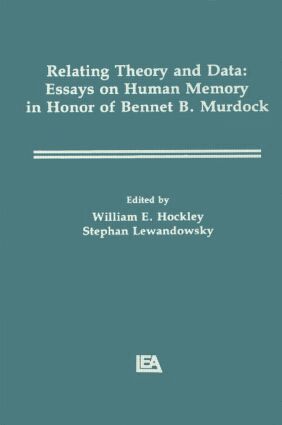
    Relating Theory and Data

    Essays on Human Memory in Honor of Bennet B. Murdock

    AvWilliam E. Hockley,Stephan Lewandowsky

    Inbunden, Engelska, 1991

    2 355 kr

    Beställningsvara. Skickas inom 10-15 vardagar. Fri frakt över 249 kr.

    Beskrivning

    This festschrift represents the proceedings of a conference held in honor of Bennet B. Murdock, one of the foremost researchers and theoreticians on human memory and cognition. A highly renowned investigator respected for both his empirical and theoretical contributions to the field, Murdock summarized and focused a large amount of research activity with his 1974 book Human Memory: Theory and Data. This unique collection of articles addresses many of the issues discussed in his classic text. Divided into five principal sections, its coverage includes: theoretical perspectives on human memory ranging from a biological view to an exposition of the value of formal models; recent progress in the study of processes in immediate memory and recognition memory; and new developments in componential and distributed approaches to the modeling of human memory. Each section concludes with an integrative commentary provided by some of Murdock’s eminent colleagues from the University of Toronto. Thus, this book offers a diversity of perspectives on contemporary topics in the discipline, and will be of interest to students and scholars in all branches of cognitive science.

    Produktinformation

    • Utgivningsdatum:1991-10-01
    • Mått:152 x 229 x 35 mm
    • Vikt:884 g
    • Format:Inbunden
    • Språk:Engelska
    • Antal sidor:574
    • Förlag:Taylor & Francis Inc
    • ISBN:9780805807325

    Utforska kategorier

    • Psykologi inom Psykologi och pedagogik
    • Kognitiv psykologi inom Psykologi och pedagogik

    Mer om författaren

    Stephan Lewandowsky, William E. Hockley

    Recensioner i media

    "...the chapters in this book provide a nice overview of the current status of many of the various theoretical debates....the chapters in this volume provide sufficient data to enable the reader to come to his or her own conclusion regarding the relative value of different kinds of models of human memory."—Contemporary Psychology

    Innehållsförteckning

    • Contents: Part I: Introduction.S. Lewandowsky, W.E. Hockley, Relating Theory and Data: Towards an Integration. Part II: Perspectives on Human Memory.M.C. Corballis, Memory, Growth, Evolution, and Laterality. D.L. Hintzman, Why Are Formal Models Useful in Psychology? L-G. Nilsson, J.M. Gardiner, Memory Theory and the Boundary Conditions of the Tulving-Wiseman Law. E.U. Weber, W.M. Goldstein, J.R. Busemeyer, Beyond Strategies: Implications of Memory Representation and Memory Processes for Models of Judgment and Decision Making. R.S. Lockhart, Varieties of Theoretical Perspectives. Part III: Processes in Immediate Memory.R.G. Crowder, I. Neath, The Microscope Metaphor in Human Memory. A.F. Healy, T.F. Cunningham, A.T. Gesi, R.G. Till, L.E. Bourne, Jr., Comparing Short-Term Recall of Item, Temporal, and Spatial Information in Children and Adults. W.K. Estes, On Types of Item Coding and Source of Recall in Short-Term Memory. A.D. Baddeley, C. Papagno, D. Norris, Phonological Memory and Serial Order: A Sandwich for TODAM. F.I.M. Craik, Peace Pipes Around the TODAM Pole: A Puff for Short-Term Memory. Part IV: Processes in Recognition.G. Mandler, Your Face Looks Familiar but I Can't Remember Your Name: A Review of Dual Process Theory. W.E. Hockley, Recognition Memory for Item and Associative Information: A Comparison of Forgetting Rates. B.A. Dosher, Bias and Discrimination in Cuing of Memory: A Weighted Decisions Model. R. Ratcliff, G. McKoon, Using ROC Data and Priming Results to Test Global Memory Models. N.J. Slamecka, The Analysis of Recognition. Part V: Componential Approaches to Memory.M.S. Humphreys, J.D. Bain, Episodic and Strength Components in Recognition Memory. R.M. Shiffrin, K. Murnane, Composition, Distribution, and Interference in Memory. G.D. Logan, Automaticity and Memory. W. Kintsch, D.M. Welsch, The Construction-Integration Model: A Framework for Studying Memory for Text. E. Tulving, Ben Murdock and Complexity of Memory. Part VI: Distributed Approaches to Memory.J. Metcalfe, Composite Memories. D.J.K. Mewhort, D. Popham, Serial Recall of Tachistoscopic Letter Strings. S. Lewandowsky, Gradual Unlearning and Catastrophic Interference: A Comparison of Distributed Architectures. J.A. Anderson, Why, Having So Many Neurons, Do We Have So Few Thoughts? R.P. Goebel, S. Lewandowsky, Retrieval Measures in Distributed Memory Models.