• Fri frakt över 249 kr
  • •
  • Snabba leveranser
  • •
  • Billiga böcker
Kundservice

Du är på sajten för privatpersoner.

Företag, bibliotek eller offentlig verksamhet?

Du handlar på classic.bokus.com, där alla dina funktioner finns intakta.
Till classic.bokus.com
Bokus logotyp. Gå till startsidan.
  • Erbjudanden
  • Nyheter
  • Student
  • Topplistor
  • Barn & ungdom
  • Bokus Play
  • E-böcker
  • Pocketböcker
  • Spel & pussel

10% rabatt på allt med kod NYSTART10 →

Sidfot

Mina sidor

    Hjälp

    • Kundservice
    • Vanliga frågor och svar
    • Frakt och leverans
    • Retur vid ångerrätt
    • Reklamera vara
    • Betalning
    • Köpvillkor
    • Allmänna villkor
    • Information om webbplatsens tillgänglighet

    Om Bokus

    • Om oss
    • Pressrum
    • För studenter
    • För företag
    • För bibliotek och offentlig verksamhet
    • För leverantörer
    • Hållbarhet

    Populärt

    • Aktuella erbjudanden
    • Presentkort
    • Studentlitteratur
    • Nya böcker
    • Topplistor
    • Signerade böcker
    • Engelska böcker

    Inspiration

    • Boktips
    • BookTok
    • Populära bokserier
    • Barnbokskaraktärer
    • Populära författare
    Logotyp för Bokus
    Följ oss på Facebook (extern länk)Följ oss på Instagram (extern länk)Följ oss på YouTube (extern länk)Följ oss på TikTok (extern länk)
    bokus @ CookiesAnpassa cookiesIntegritetspolicyKöpvillkor
    Till Citymail hemsida (extern länk)Till Budbee hemsida (extern länk)Till Postnord hemsida (extern länk)Till Schenker hemsida (extern länk)Till Early Bird hemsida (extern länk)Till Walleys hemsida (extern länk)
    1. Psykologi och pedagogik
    2. Psykologi

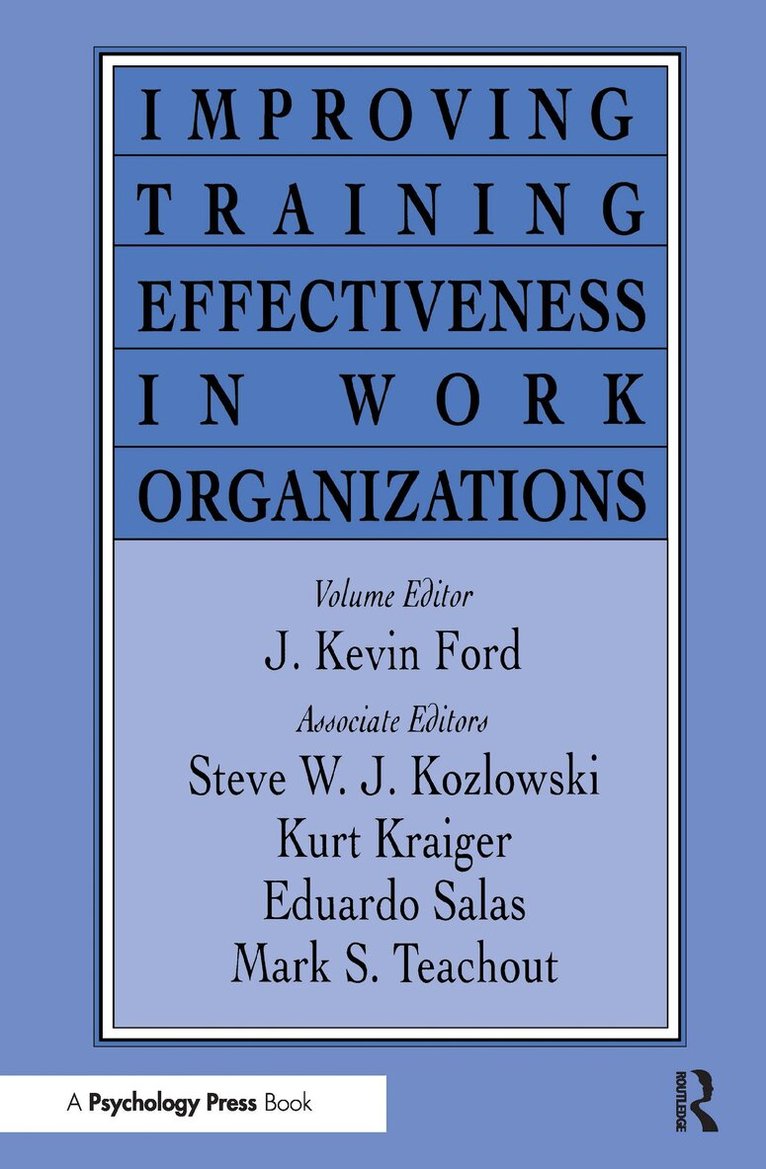
    Improving Training Effectiveness in Work Organizations

    AvJ. Kevin Ford

    Inbunden, Engelska, 1996

    Del i serien Applied Psychology Series

    2 354 kr

    Beställningsvara. Skickas inom 10-15 vardagar. Fri frakt över 249 kr.

    Beskrivning

    This compelling volume presents the work of innovative researchers dealing with current issues in training and training effectiveness in work organizations. Each chapter provides an integrative summary of a research area with the goal of developing a specific research agenda that will not only stimulate thinking in the training field but also direct future research. By concentrating on new ideas and critical methodological and measurement issues rather than summarizing existing literature, the volume offers definitive suggestions for advancing the effectiveness of the training field.Its chapters focus on emerging issues in training that have important implications for improving both training design and efficacy. They discuss various levels of analysis-- intra-individual, inter-individual, team, and organizational issues--and the factors relevant to achieving a better understanding of training effectiveness from these different perspectives. This type of coverage provides a theoretically driven scientist/practitioner orientation to the book.

    Produktinformation

    • Utgivningsdatum:1996-10-01
    • Mått:152 x 229 x 27 mm
    • Vikt:920 g
    • Format:Inbunden
    • Språk:Engelska
    • Serie:Applied Psychology Series
    • Antal sidor:412
    • Förlag:Taylor & Francis Inc
    • ISBN:9780805813876

    Utforska kategorier

    • Psykologi inom Psykologi och pedagogik
    • Studievägledning och yrkesorientering inom Psykologi och pedagogik
    • Ledarskapsböcker inom Ekonomi och Ledarskap

    Recensioner i media

    "This book addresses the concerns of practice and theory without sacrificing key elements of either perspective....we recommend this book for the Personnel Psychology reader's library. The book has much to offer the practitioner and the academician. In addition, graduate students in training seminars or thinking of conducting research on training would find this book extremely valuable."—Personnel Psychology

    Innehållsförteckning

    • Contents: E.A. Fleishman, Foreword. Preface. J.K. Ford, Advances in Training Research and Practice: An Historical Perspective. Part I:Integrating Advances in Cognitive Science With Training Assessment, Design, and Evaluation Constructs.W. Rogers, T. Maurer, E. Salas A. Fisk, Task Analysis and Cognitive Theory: Controlled and Automatic Processing Task Analytic Methodology. M. Coovert, J.P. Craiger, Performance Modeling for Training Effectiveness. T. Goldsmith, K. Kraiger, Structural Knowledge Assessment and Training Evaluation. Part II:Viewing Learning as a Continuous Process: Implications for Training, Socialization, and Employee Development.T. Baldwin, R.J. Magjuka, Organizational Context and Training Effectiveness. G.T. Chao, Unstructured Training and Development: The Role of Organizational Socialization. R.A. Noe, S.L. Wilk, E.J. Mullen, J.E. Wanek, Employee Development: Construct Validation Issues. Part III:Understanding How Context Affects Training Evaluation and Transfer.J.E. Mathieu, J.W. Martineau, Individual and Situational Influences in Training Motivation. G.M. Alliger, S. Katzman, Reconsidering Training Evaluation: Heterogeneity of Variance as a Training Effect. S.W.J. Kozlowski, E. Salas, An Organizational Systems Approach for the Implementation and Transfer of Training. Part IV:Applied Psychology and Training: Methods for Improving the Linkage Between Training Research and Practice.E. Salas, J.A. Cannon-Bowers, E.L. Blickensderfer, Enhancing Reciprocity Between Training Theory and Training Practice: Principles, Guidelines, and Specifications. K.J. Klein, R.S. Ralls, An Exploration of the Unintended Organizational Consequences of Technology Training: Implications of Practice for Training Theory and Research. Part V:Final Observations.E. Salas, J.A. Cannon-Bowers, S.W.J. Kozlowski, The Science and Practice of Training--Current Trends and Emerging Themes.