• Fri frakt över 249 kr
  • •
  • Snabba leveranser
  • •
  • Billiga böcker
Kundservice

Du är på sajten för privatpersoner.

Företag, bibliotek eller offentlig verksamhet?

Du handlar på classic.bokus.com, där alla dina funktioner finns intakta.
Till classic.bokus.com
Bokus logotyp. Gå till startsidan.
  • Erbjudanden
  • Nyheter
  • Student
  • Topplistor
  • Barn & ungdom
  • Bokus Play
  • E-böcker
  • Pocketböcker
  • Spel & pussel

10% rabatt på allt med kod NYSTART10 →

Sidfot

Mina sidor

    Hjälp

    • Kundservice
    • Vanliga frågor och svar
    • Frakt och leverans
    • Retur vid ångerrätt
    • Reklamera vara
    • Betalning
    • Köpvillkor
    • Allmänna villkor
    • Information om webbplatsens tillgänglighet

    Om Bokus

    • Om oss
    • Pressrum
    • För studenter
    • För företag
    • För bibliotek och offentlig verksamhet
    • För leverantörer
    • Hållbarhet

    Populärt

    • Aktuella erbjudanden
    • Presentkort
    • Studentlitteratur
    • Nya böcker
    • Topplistor
    • Signerade böcker
    • Engelska böcker

    Inspiration

    • Boktips
    • BookTok
    • Populära bokserier
    • Barnbokskaraktärer
    • Populära författare
    Logotyp för Bokus
    Följ oss på Facebook (extern länk)Följ oss på Instagram (extern länk)Följ oss på YouTube (extern länk)Följ oss på TikTok (extern länk)
    bokus @ CookiesAnpassa cookiesIntegritetspolicyKöpvillkor
    Till Citymail hemsida (extern länk)Till Budbee hemsida (extern länk)Till Postnord hemsida (extern länk)Till Schenker hemsida (extern länk)Till Early Bird hemsida (extern länk)Till Walleys hemsida (extern länk)
    1. Medicin
    2. Andra medicinska specialiteter
    3. Klinisk psykologi

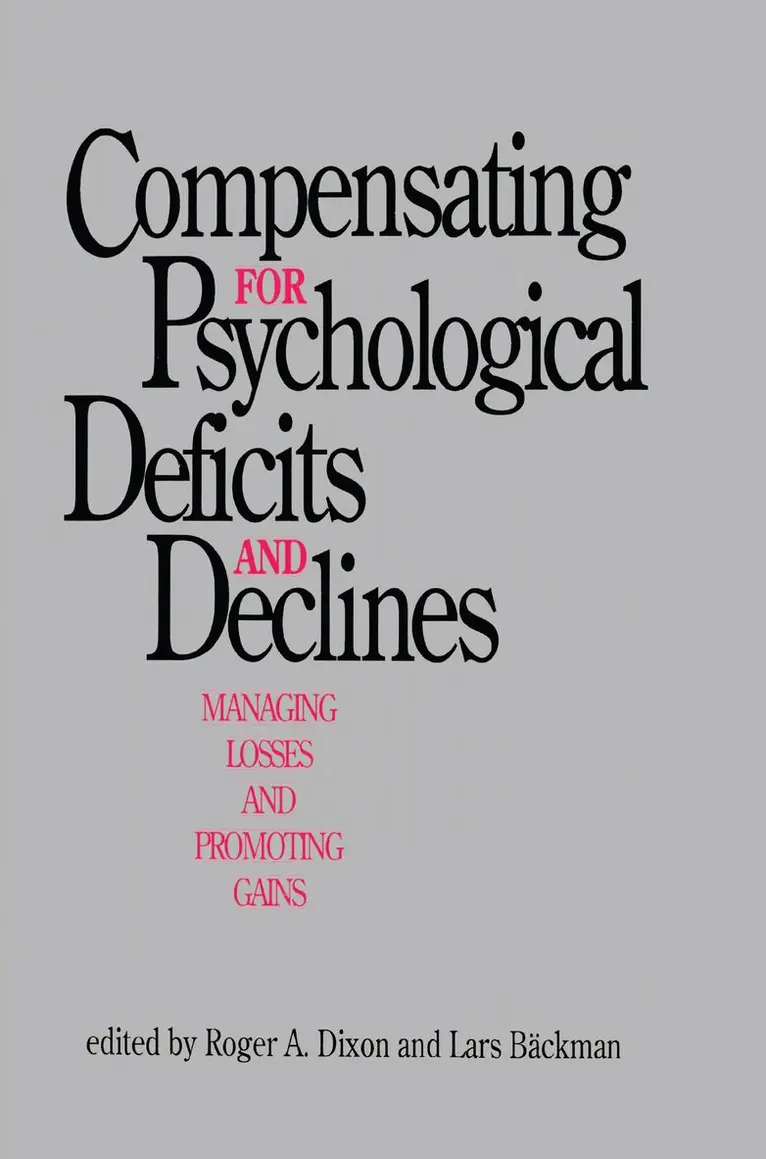
    Compensating for Psychological Deficits and Declines

    Managing Losses and Promoting Gains

    AvRoger A. Dixon,Lars B„ckman

    Inbunden, Engelska, 1995

    2 495 kr

    Beställningsvara. Skickas inom 10-15 vardagar. Fri frakt över 249 kr.

    Beskrivning

    The concept of compensation in psychology refers to processes through which a gap or mismatch between current accessible skills and environmental demands is reduced or closed. These gaps can be principally the result of losses, such as those associated with aging or interpersonal role changes; injuries, such as those that may occur to the neurological or sensory systems; organic or functional diseases, such as the dementias or schizophrenia; and congenital deficits, such as those apparent in autism or some learning disabilities.Whether the demand-skill gaps can be bridged completely, reduced only moderately, or are impossible to close, depends on a variety of factors. In every case, however, the guiding notions of compensation are that: * some such deficits may be amendable, * the continuation of the effects of the gap may be avoidable, and * some functioning may be recoverable.In this sense, compensation is related to adaptation; it is about overcoming deficits, managing the effects of losses, and promoting improvement in psychological functioning.Compensation is a concept that has a long and rich history in numerous domains of psychological research and practice. To date, however, few of the relevant research domains have benefitted explicitly or optimally from considering alternative perspectives on the concept of compensation. Although researchers and practitioners in several areas of psychology have actively pursued programs with compensation as a central concept, communication across disciplinary divides has been lacking. Comparing and contrasting the uses and implications of the concept across neighboring (and even not-so-adjacent) areas of psychology can promote advances in both theoretical and practical pursuits.The goal of this book is to carry inchoate integrative efforts to a new level of clarity. To this end, the editors have recruited major authors from selected principal areas of research and practice in psychological compensation. The authors review the current state of compensation scholarship in their domains of specialization. State-of-the-art reviews of this rapidly expanding area of scholarship are, therefore, collected under one cover for the first time. In this way, a wide variety of readers who might otherwise rarely cross professional paths with one another, can quickly learn about alternative preferences, agendas and methods, as well as novel research results, interpretations, and practical applications.Designed to contain broad, deep, and current perspectives on compensation, this volume continues the processes of: * explicating the concept of compensation; * linking and distinguishing compensation from neighboring concepts; * describing the variety of compensatory mechanisms operating in a wide range of phenomena; and * illustrating how compensatory mechanisms can be harnessed or trained to manage losses or deficits and to promote gains or at least maintenance of functioning.

    Produktinformation

    • Utgivningsdatum:1995-10-01
    • Mått:152 x 229 x undefined mm
    • Vikt:748 g
    • Format:Inbunden
    • Språk:Engelska
    • Antal sidor:360
    • Förlag:Taylor & Francis Inc
    • ISBN:9780805815597

    Utforska kategorier

    • Klinisk psykologi inom Medicin
    • Socialpsykologi och gruppsykologi inom Psykologi och pedagogik
    • Psykologi: jaget, identitet och personlighet inom Psykologi och pedagogik

    Mer om författaren

    Roger A. Dixon, Lars B„ckman, Lars Backman

    Innehållsförteckning

    • Contents: Preface. Part I: Conceptual Issues in Psychological Compensation.R.A. Dixon, L. Bäckman, Concepts of Compensation: Integrated, Differentiated, and Janus-Faced. T.A. Salthouse, Refining the Concept of Psychological Compensation. M. Marsiske, F.R. Lang, P.B. Baltes, M.M. Baltes, Selective Optimization With Compensation: Life-Span Perspectives on Successful Human Development. Part II: Compensation in the Life Course.J. Brandtstädter, D. Wentura, Adjustment to Shifting Possibility Frontiers in Later Life: Complementary Adaptive Modes. L.L. Carstensen, K.A. Hanson, A.M. Freund, Selection and Compensation in Adulthood. K.F. Ferraro, M.M. Farmer, Social Compensation in Adulthood and Later Life. N. Charness, E.A. Bosman, Compensation Through Environmental Modification. Part III: Compensation for Neurological Impairments.B.A. Wilson, Memory Rehabilitation: Compensating for Memory Problems. D.S. Woodruff-Pak, C. Hanson, Plasticity and Compensation in Brain Memory Systems in Aging. L.J. Gonzalez Rothi, Behavioral Compensation in the Case of Treatment of Acquired Language Disorders Resulting From Brain Damage. C.L. Grady, R. Parasuraman, Functional Compensation in Alzheimer's Disease. Part IV: Compensation in Sensory and Skill Domains.J. Rönnberg, Perceptual Compensation in the Deaf and Blind: Myth or Reality? R.F. West, K.E. Stanovich, A.E. Cunningham, Compensatory Processes in Reading. M.J. Stones, A. Kozma, Compensation in Athletic Sport.