• Fri frakt över 249 kr
  • •
  • Snabba leveranser
  • •
  • Billiga böcker
Kundservice

Du är på sajten för privatpersoner.

Företag, bibliotek eller offentlig verksamhet?

Du handlar på classic.bokus.com, där alla dina funktioner finns intakta.
Till classic.bokus.com
Bokus logotyp. Gå till startsidan.
  • Erbjudanden
  • Nyheter
  • Student
  • Topplistor
  • Barn & ungdom
  • Bokus Play
  • E-böcker
  • Pocketböcker
  • Spel & pussel

10% studentrabatt med kod TERM26

Sidfot

Mina sidor

    Hjälp

    • Kundservice
    • Vanliga frågor och svar
    • Frakt och leverans
    • Retur vid ångerrätt
    • Reklamera vara
    • Betalning
    • Köpvillkor
    • Allmänna villkor
    • Information om webbplatsens tillgänglighet

    Om Bokus

    • Om oss
    • Pressrum
    • För studenter
    • För företag
    • För bibliotek och offentlig verksamhet
    • För leverantörer
    • Hållbarhet

    Populärt

    • Aktuella erbjudanden
    • Presentkort
    • Studentlitteratur
    • Nya böcker
    • Topplistor
    • Signerade böcker
    • Engelska böcker

    Inspiration

    • Boktips
    • BookTok
    • Populära bokserier
    • Barnbokskaraktärer
    • Populära författare
    Logotyp för Bokus
    Följ oss på Facebook (extern länk)Följ oss på Instagram (extern länk)Följ oss på YouTube (extern länk)Följ oss på TikTok (extern länk)
    bokus @ CookiesAnpassa cookiesIntegritetspolicyKöpvillkor
    Till Citymail hemsida (extern länk)Till Budbee hemsida (extern länk)Till Postnord hemsida (extern länk)Till Schenker hemsida (extern länk)Till Early Bird hemsida (extern länk)Till Walleys hemsida (extern länk)
    1. Psykologi och pedagogik
    2. Psykologi
    3. Kognitiv psykologi

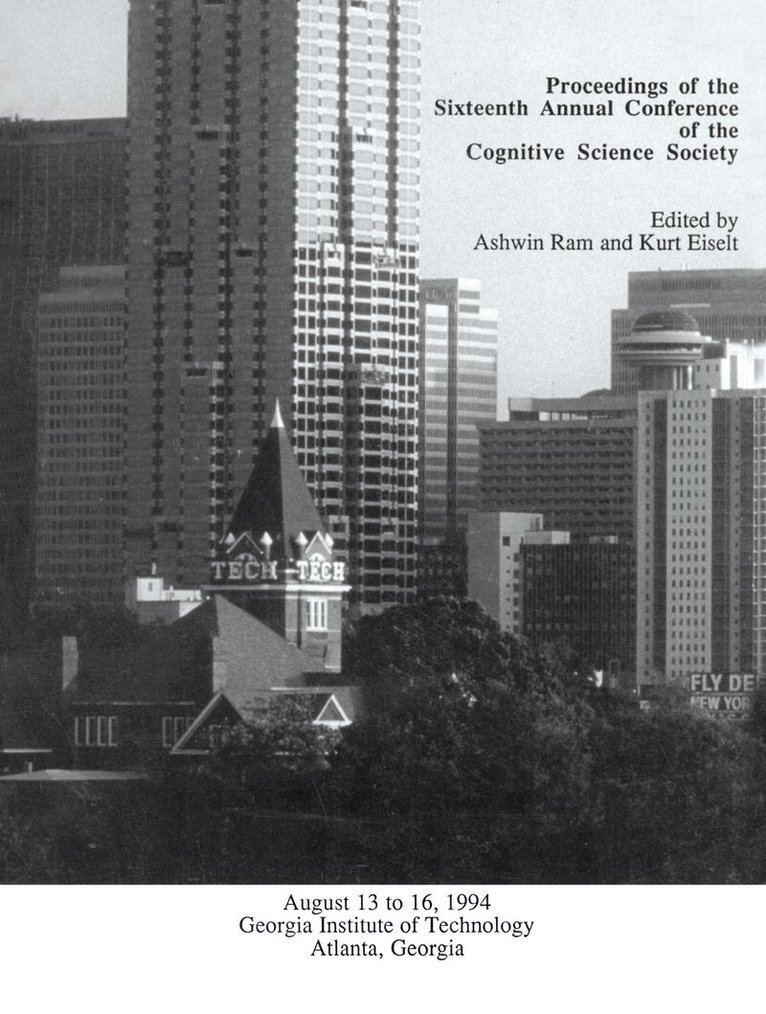
    Proceedings of the Sixteenth Annual Conference of the Cognitive Science Society

    Atlanta, Georgia, 1994

    AvAshwin Ram,Kurt Eiselt

    Inbunden, Engelska, 1994

    3 477 kr

    Beställningsvara. Skickas inom 3-6 vardagar. Fri frakt över 249 kr.

    Beskrivning

    This volume features the complete text of all regular papers, posters, and summaries of symposia presented at the 16th annual meeting of the Cognitive Science Society.

    Produktinformation

    • Utgivningsdatum:1994-08-01
    • Mått:210 x 280 x 52 mm
    • Vikt:2 290 g
    • Format:Inbunden
    • Språk:Engelska
    • Antal sidor:1 014
    • Förlag:Taylor & Francis Inc
    • ISBN:9780805818031

    Utforska kategorier

    • Kognitiv psykologi inom Psykologi och pedagogik

    Innehållsförteckning

    • Contents: Part I: Refereed Papers.M. Abu-Bakar, N. Chater, Distribution and Frequency: Modelling the Effects of Speaking Rate on Category Boundaries Using a Recurrent Neural Network. W. Ahn, J. Bailenson, B. Gordon, Causal Attribution as Mechanism-Based Story Construction: An Explanation of the Conjunction Fallacy and the Discounting Principle. B.G. Bara, M. Bucciarelli, P.N. Johnson-Laird, V. Lombardo, Mental Models in Propositional Reasoning. J.A. Barnden, S. Helmreich, E. Iverson, G.C. Stein, Combining Simulative and Metaphor-Based Reasoning About Beliefs. J. Batali, Artificial Evolution of Syntactic Aptitude. B. Bell, S. Kedar, R. Bareiss, Interactive Model-Driven Case Adaptation for Instructional Software Design. K. Bielaczyc, P.L. Pirolli, A.L. Brown, Collaborative Explanations and Metacognition: Identifying Successful Learning Activities in the Acquisition of Cognitive Skills. A. Blackwell, E. Bates, Inducing Agrammatic Profiles in Normals. S.B. Blessing, B.H. Ross,Problem Content Affects the Categorization and Solutions of Problems. N. Braisby, B. Franks, J. Hampton, On the Psychological Basis for Rigid Designation. W.F. Brewer, C.A. Chinn, The Theory-Ladenness of Data: An Experimental Demonstration. A. Brook ,Kant and Cognitive Science. D. Buckingham, T.R Shultz, A Connectionist Model of the Development of Velocity, Time, and Distance Concepts. J.A. Bullinaria ,Connectionist Modelling of Spelling. J.A. Bullinaria, Internal Representations of a Connectionist Model of Reading Aloud. C. Burgess, K. Lund, Multiple Constraints in Syntactic Ambiguity Resolution: A Connectionist Account of Psycholinguistic Data. C. Burgess, M.K. Tanenhaus, M. Hoffman, Parafoveal and Semantic Effects on Syntactic Ambiguity Resolution. B.D. Burns, K.J. Holyoak, Competing Models of Analogy: ACME Versus Copycat. M.H. Burstein, Case Age: Selecting the Best Exemplars for Plausible Reasoning Using Distance in Time or Space. J.G. Bush, H.M. Johnson, C.M. Seifert, The Implications of Corrections: Then Why Did You Mention It? M.D. Byrne, Integrating, Not Debating, Situated Action and Computational Models: Taking the Environment Seriously. R.M.J. Byrne, A. Tasso, Counterfactual Reasoning: Inferences From Hypothetical Conditionals. A. Cabrera, Functional and Conditional Equivalence: Conceptual Contributions From Behavior Analysis. P. Cairns, R. Shillcock, N. Chater, J. Levy,Lexical Segmentation: The Role of Sequential Statistics in Supervised and Un-Supervised Models. T. Carpenter, R. Alterman, A Taxonomy for Planned Reading. T.A. Cartwright, M.R. Brent, Segmenting Speech Without a Lexicon: Evidence for a Bootstrapping Model of Lexical Acquisition. J. Cassell, M. Stone, B. Douville, S. Prevost, B. Achorn, M. Steedman, N. Badler, C. Pelachaud, Modeling the Interaction Between Speech and Gesture. R. Catrambone, The Effects of Labels in Examples on Problem Solving Transfer. H. Chalupsky, S.C. Shapiro,SL: A Subjective, Intensional Logic of Belief. P.C-H. Cheng, An Empirical Investigation of Law Encoding Diagrams for Instruction. C.A. Chinn, Are Scientific Theories That Predict Data More Believable Than Theories That Retrospectively Explain Data? A Psychological Investigation. M.M. Chiu, J. Gutwill, The Architecture of Intuition: Converging Views From Physics Education and Linguistics. T.C. Clausner, Commonsense Knowledge and Conceptual Structure in Container Metaphors. C. Cleary, R. Bareiss, A Descriptive Model of Question Asking During Acquisition Interviews. J. Clement,Imagistic Simulation and Physical Intuition in Expert Problem Solving. A. Content, P. Sternon, Modelling Retroactive Context Effects in Spoken Word Recognition With a Simple Recurrent Network. A.T. Corbett, J.R. Anderson, V.H Carver, S.A. Brancolini, Individual Differences and Predictive Validity in Student Modeling. S. Coulson, N.V. Flor, Rational Choice and Framing Devices: Argumentation and Computer Programming. M.T. Cox,Machines That Forget: Learning From Retrieval Failure of Mis-Indexed Explanations. M.T. Cox, A. Ram, Failure-Driven Learning as Input Bias. R. Cox, K. Stenning, J. Oberlander, Graphical Effects in Learning Logic: Reasoning, Representation and Individual Differences. S. Dennis, The Null List Strength Effect in Recognition Memory: Environmental Statistics and Connectionist Accounts. S. Derry, K. Tookey, Effects of Collaborative Interaction and Computer Tool Use. S.M. Doane, Y.W. Sohn. D. Adams, D.S. McNamara, Learning From Instruction: A Comprehension-Based Approach. R. Elio, F.J. Pelletier, The Effect of Syntactic Form on Simple Belief Revisions and Updates. R.A. Engle, J.G. Greeno, Managing Disagreement in Intellectual Conversations Coordinating Interpersonal and Conceptual Concerns in the Collaborative Construction of Mathematical Explanations. J. Epelboim, H. Collewijn, E. Kowler, C.J. Erkelens, M. Edwards, Z. Pizlo, R.M. Steinman, Natural Oculomotor Performance in Looking and Tapping Tasks. J.M. Faries, K.R. Schlossberg, The Effect of Similarity on Memory for Prior Problems. R.W. Ferguson, MAGI: Analogy-Based Encoding Using Regularity and Symmetry. E.C. Ferstl, The Construction-Integration Model: A Framework for Studying Context Effects in Sentence Processing. E.C. Ferstl, Context Effects in Syntactic Ambiguity Resolution: The Location of Prepositional Phrase Attachment. S. Finch, N. Chater, Distributional Bootstrapping: From Word Class to Proto-Sentence. M.H. Fischer, Attention Allocation During Movement Preparation. K.D. Forbus, R.W. Ferguson, D. Gentner, Incremental Structure-Mapping. N. Forrester, K. Plunkett, Learning the Arabic Plural: The Case for Minority Default Mappings in Connectionist Networks. S. Fox, D. Leake, Using Introspective Reasoning to Guide Index Refinement in Case-Based Reasoning. G. Francis, S. Grossberg, How Do Representations of Visual Form Organize Our Percepts of Visual Motion? R.M. French, Dynamically Constraining Connectionist Networks to Produce Distributed, Orthogonal Representations to Reduce Catastrophic Interference. G. Gaskell, W. Marslen-Wilson, Inference Processes in Speech Perception. M. Gattis, K.J. Holyoak, How Graphs Mediate Analog and Symbolic Representation. D. Gentner, B.F. Bowdle, The Coherence Imbalance Hypothesis: A Functional Approach to Asymmetry in Comparison. E. Gibson, J. Loomis, A Corpus Analysis of Recency Preference and Predicate Proximity. S.A. Gilbert, W. Richards, Using Trajectory Mapping to Analyze Musical Intervals. S. Gillis, W. Daelemans, G. Durieux, Are Children 'Lazy Learners'? A Comparison of Natural and Machine Learning of Stress. J. Glasgow, Array Representations for Model-Based Spatial Reasoning. A. Gordon, P. Edwards, D. Sleeman, Y. Kodratoff, Scientific Discovery in a Space of Structural Models: An Example From the History of Solution Chemistry. A. Grunewald, S. Grossberg, Binding of Object Representations by Synchronous Cortical Dynamics Explains Temporal Order and Spatial Pooling Data. M. Harm, L. Altmann, M.S. Seidenberg, Using Connectionist Networks to Examine the Role of Prior Constraints in Human Learning. P.M. Hastings, S.L. Lytinen, Objects, Actions, Nouns, and Verbs. C. Hewson, Empirical Evidence Regarding the Folk Psychological Concept of Belief. C. Hewson, C. Vogel, Psychological Evidence for Assumptions of Path-Based Inheritance Reasoning. K. Hiraki, Abstraction of Sensory-Motor F