• Fri frakt över 249 kr
  • •
  • Snabba leveranser
  • •
  • Billiga böcker
Kundservice

Du är på sajten för privatpersoner.

Företag, bibliotek eller offentlig verksamhet?

Du handlar på classic.bokus.com, där alla dina funktioner finns intakta.
Till classic.bokus.com
Bokus logotyp. Gå till startsidan.
  • Erbjudanden
  • Nyheter
  • Student
  • Topplistor
  • Barn & ungdom
  • Bokus Play
  • E-böcker
  • Pocketböcker
  • Spel & pussel

10% rabatt på allt med kod: NYSTART10 →

Sidfot

Mina sidor

    Hjälp

    • Kundservice
    • Vanliga frågor och svar
    • Frakt och leverans
    • Retur vid ångerrätt
    • Reklamera vara
    • Betalning
    • Köpvillkor
    • Allmänna villkor
    • Information om webbplatsens tillgänglighet

    Om Bokus

    • Om oss
    • Pressrum
    • För studenter
    • För företag
    • För bibliotek och offentlig verksamhet
    • För leverantörer
    • Hållbarhet

    Populärt

    • Aktuella erbjudanden
    • Presentkort
    • Studentlitteratur
    • Nya böcker
    • Topplistor
    • Signerade böcker
    • Engelska böcker

    Inspiration

    • Boktips
    • BookTok
    • Populära bokserier
    • Barnbokskaraktärer
    • Populära författare
    Logotyp för Bokus
    Följ oss på Facebook (extern länk)Följ oss på Instagram (extern länk)Följ oss på YouTube (extern länk)Följ oss på TikTok (extern länk)
    bokus @ CookiesAnpassa cookiesIntegritetspolicyKöpvillkor
    Till Citymail hemsida (extern länk)Till Budbee hemsida (extern länk)Till Postnord hemsida (extern länk)Till Schenker hemsida (extern länk)Till Early Bird hemsida (extern länk)Till Walleys hemsida (extern länk)
    1. Psykologi och pedagogik
    2. Psykologi
    3. Psykologisk metod

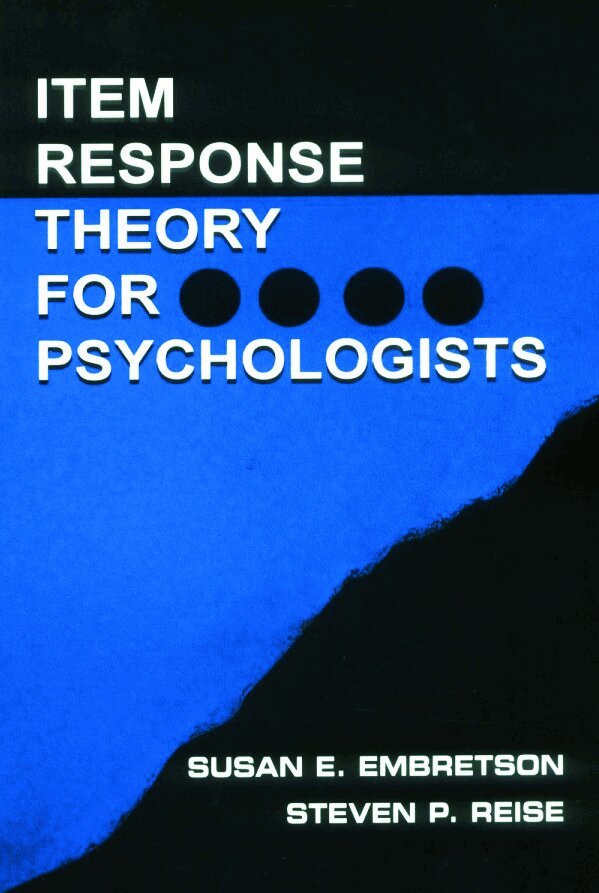
    Item Response Theory for Psychologists

    AvSusan E. Embretson,Steven P. Reise

    Häftad, Engelska, 2000

    Del i serien Multivariate Applications Series

    1 145 kr

    Tillfälligt slut

    Beskrivning

    This book develops an intuitive understanding of IRT principles through the use of graphical displays and analogies to familiar psychological principles. It surveys contemporary IRT models, estimation methods, and computer programs. Polytomous IRT models are given central coverage since many psychological tests use rating scales.Ideal for clinical, industrial, counseling, educational, and behavioral medicine professionals and students familiar with classical testing principles, exposure to material covered in first-year graduate statistics courses is helpful. All symbols and equations are thoroughly explained verbally and graphically.

    Produktinformation

    • Utgivningsdatum:2000-05-01
    • Mått:152 x 229 x 24 mm
    • Vikt:710 g
    • Format:Häftad
    • Språk:Engelska
    • Serie:Multivariate Applications Series
    • Antal sidor:384
    • Förlag:Taylor & Francis Inc
    • ISBN:9780805828191

    Utforska kategorier

    • Psykologisk metod inom Psykologi och pedagogik

    Mer om författaren

    Susan E. Embretson Georgia Institute of Technology, Atlanta, USA. Steven P. Reise University of California, Losa Angeles, USA

    Recensioner i media

    "It will be a useful book for a first course in IRT....a good book...for the working psychologist and the psychologist's mentor to share..."—Contemporary Psychology"...useful to anyone wanting to learn how to use IRT or to teach a course on it..."—British Journal of Mathematical and Statistical Psychology"...strongly recommended to psychologists interested in psychometric issues or researchers aiming to use this approach to analyze scales used in their own research."—Studia Psychologica"...a thorough and comprehensive introduction to IRT and is a very useful reference book. It would be a helpful source to use when teaching students about IRT."—Quality of Life Research

    Innehållsförteckning

    • Contents: Preface. Part I: Introduction. Introduction. Part II: Item Response Theory Principles: Some Contrasts and Comparisons. The New Rules of Measurement. Item Response Theory as Model-Based Measurement. Part III: The Fundamentals of Item Response Theory. Binary IRT Models. Polytomous IRT Models. The Trait Level Measurement Scale: Meaning, Interpretations, and Measurement-Scale Properties. Measuring Persons: Scoring Examinees With IRT Models. Calibrating Items: Estimation. Assessing the Fit of IRT Models. Part IV: Applications of IRT Models. IRT Applications: DIF, CAT, and Scale Analysis. IRT Applications in Cognitive and Developmental Assessment. Applications of IRT in Personality and Attitude Assessment. Computer Programs for Conducting IRT Parameter Estimation.