• Fri frakt över 249 kr
  • •
  • Snabba leveranser
  • •
  • Billiga böcker
Kundservice

Du är på sajten för privatpersoner.

Företag, bibliotek eller offentlig verksamhet?

Du handlar på classic.bokus.com, där alla dina funktioner finns intakta.
Till classic.bokus.com
Bokus logotyp. Gå till startsidan.
  • Erbjudanden
  • Nyheter
  • Student
  • Topplistor
  • Barn & ungdom
  • Bokus Play
  • E-böcker
  • Pocketböcker
  • Spel & pussel

10% rabatt på allt med kod NYSTART10 →

Sidfot

Mina sidor

    Hjälp

    • Kundservice
    • Vanliga frågor och svar
    • Frakt och leverans
    • Retur vid ångerrätt
    • Reklamera vara
    • Betalning
    • Köpvillkor
    • Allmänna villkor
    • Information om webbplatsens tillgänglighet

    Om Bokus

    • Om oss
    • Pressrum
    • För studenter
    • För företag
    • För bibliotek och offentlig verksamhet
    • För leverantörer
    • Hållbarhet

    Populärt

    • Aktuella erbjudanden
    • Presentkort
    • Studentlitteratur
    • Nya böcker
    • Topplistor
    • Signerade böcker
    • Engelska böcker

    Inspiration

    • Boktips
    • BookTok
    • Populära bokserier
    • Barnbokskaraktärer
    • Populära författare
    Logotyp för Bokus
    Följ oss på Facebook (extern länk)Följ oss på Instagram (extern länk)Följ oss på YouTube (extern länk)Följ oss på TikTok (extern länk)
    bokus @ CookiesAnpassa cookiesIntegritetspolicyKöpvillkor
    Till Citymail hemsida (extern länk)Till Budbee hemsida (extern länk)Till Postnord hemsida (extern länk)Till Schenker hemsida (extern länk)Till Early Bird hemsida (extern länk)Till Walleys hemsida (extern länk)
    1. Psykologi och pedagogik
    2. Pedagogik
    3. Skolan och förskolan

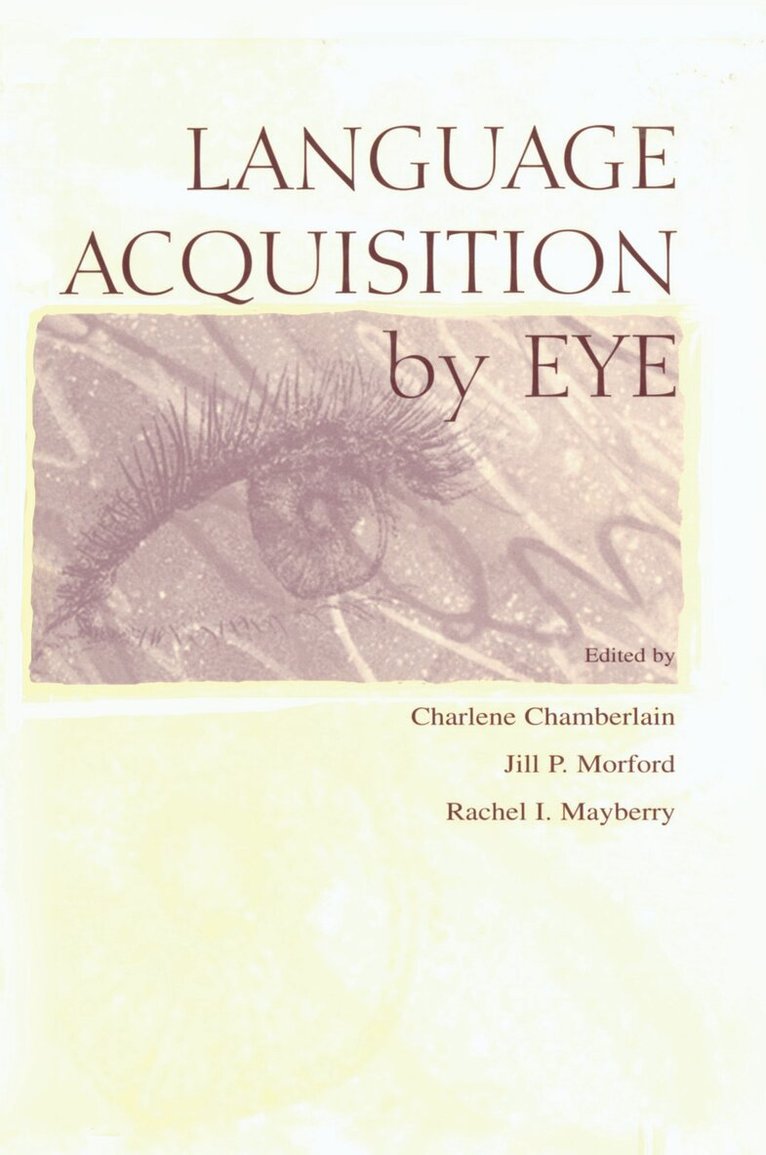
    Language Acquisition By Eye

    AvCharlene Chamberlain,Jill P. Morford

    Inbunden, Engelska, 1999

    2 354 kr

    Beställningsvara. Skickas inom 10-15 vardagar. Fri frakt över 249 kr.

    Beskrivning

    This book focuses on the early acquisition of signed languages and the later development of reading by children who use signed languages. It represents the first collection of research papers focused solely on the acquisition of various signed languages by very young children--all of whom are acquiring signed languages natively, from deaf parents. It is also the first collection to investigate the possible relationships between the acquisition of signed language and reading development in school-aged children. The underlying questions addressed by the chapters are how visual-gestural languages develop and whether and how visual languages can serve the foundation for learning a second visual representation of language, namely, reading. Language Acquisition by Eye is divided into two parts, anchored in the toddler phase and the school-pupil phase. The central focus of Part I is on the earliest stages of signed language acquisition. The chapters in this part address important questions as to what "babytalk" looks like in signed language and the effect it has on babies' attention, what early babbling looks like in signed language, what babies' earliest signs look like, how parents talk to their babies in signed language to ensure that their babies "see" what's being said, and what the earliest sentences in signed languages tell us about the acquisition of grammar. With contrasting research paradigms, these chapters all show the degree to which parents and babies are highly sensitive to one another's communicative interactions in subtle and complex ways. Such observations cannot be made for spoken language acquisition because speech does not require that the parent and child look at each other during communication whereas signed language does. Part II focuses on the relationship between signed language acquisition and reading development in children who are deaf. All of these chapters report original research that investigates and uncovers a positive relationship between the acquisition and knowledge of signed language and the development of reading skills and as a result, represents a historical first in reading research. This section discusses how current theory applies to the case of deaf children's reading and presents new data that illuminates reading theory. Using a variety of research paradigms, each chapter finds a positive rather than a negative correlation between signed language knowledge and usage, and the development of reading skill. These chapters are sure to provide the foundation for new directions in reading research.

    Produktinformation

    • Utgivningsdatum:1999-08-01
    • Mått:152 x 229 x 22 mm
    • Vikt:521 g
    • Format:Inbunden
    • Språk:Engelska
    • Antal sidor:294
    • Förlag:Taylor & Francis Inc
    • ISBN:9780805829372

    Utforska kategorier

    • Skolan och förskolan inom Psykologi och pedagogik
    • Språkvetenskap och lingvistik inom Språk och ordböcker
    • Specialundervisning inom Psykologi och pedagogik

    Mer om författaren

    Jill P. Morford, Charlene Chamberlain, Rachel I. Mayberry

    Innehållsförteckning

    • Contents: R.I. Mayberry, J.P. Morford, C. Chamberlain, Preface. D.I. Slobin, N. Hoiting, Foreword. Part I:Early Language Acquisition.N. Masataka, The Role of Modality and Input in the Earliest Stage of Language Acquisition: Studies of Japanese Sign Language. A.S. Holzrichter, R.P. Meier, Child-Directed Signing in American Sign Language. L.A. Petitto, The Acquisition of Natural Signed Languages: Lessons in the Nature of Human Language and Its Biological Foundations. K.E. Conlin, G.R. Mirus, C. Mauk, R.P. Meier, The Acquisition of First Signs: Place, Handshape, and Movement. P.F. Marentette, R.I. Mayberry, Principles for an Emerging Phonological System: A Case Study of Early ASL Acquisition. J.A. Coerts, Early Sign Combinations in the Acquisition of Sign Language of the Netherlands: Evidence for Language-Specific Features. J.P. Morford, R.I. Mayberry, A Reexamination of "Early Exposure" and Its Implications for Language Acquisition by Eye. Part II:Reading Development.M. Strong, P. Prinz, Is American Sign Language Skill Related to English Literacy? R.J. Hoffmeister, A Piece of the Puzzle: ASL and Reading Comprehension in Deaf Children. C. Padden, C. Ramsey, American Sign Language and Reading Ability in Deaf Children. S.M. Mather, A. Thibeault, Creating an Involvement-Focused Style in Book Reading With Deaf and Hard of Hearing Students: The Visual Way. C. Chamberlain, R.I. Mayberry, Theorizing About the Relationship Between American Sign Language and Reading.