• Fri frakt över 249 kr
  • •
  • Snabba leveranser
  • •
  • Billiga böcker
Kundservice

Du är på sajten för privatpersoner.

Företag, bibliotek eller offentlig verksamhet?

Du handlar på classic.bokus.com, där alla dina funktioner finns intakta.
Till classic.bokus.com
Bokus logotyp. Gå till startsidan.
  • Erbjudanden
  • Student
  • Topplistor
  • Barn & ungdom
  • Bokus Play
  • E-böcker
  • Ljudböcker
  • Pocketböcker
  • Spel och pussel

Pocketfynda! Hundratals böcker för 49 kr/st →

Sidfot

Mina sidor

    Hjälp

    • Kundservice
    • Vanliga frågor och svar
    • Frakt och leverans
    • Retur vid ångerrätt
    • Reklamera vara
    • Betalning
    • Köpvillkor
    • Allmänna villkor
    • Information om webbplatsens tillgänglighet

    Om Bokus

    • Om oss
    • Pressrum
    • För studenter
    • För företag
    • För bibliotek och offentlig verksamhet
    • För leverantörer
    • Hållbarhet

    Populärt

    • Aktuella erbjudanden
    • Presentkort
    • Studentlitteratur
    • Nya böcker
    • Topplistor
    • Signerade böcker
    • Engelska böcker

    Inspiration

    • Boktips
    • BookTok
    • Barnbokskaraktärer
    • Populära författare
    Logotyp för Bokus
    Följ oss på Facebook (extern länk)Följ oss på Instagram (extern länk)Följ oss på YouTube (extern länk)Följ oss på TikTok (extern länk)
    bokus @ CookiesAnpassa cookiesIntegritetspolicyKöpvillkor
    Till Citymail hemsida (extern länk)Till Budbee hemsida (extern länk)Till Postnord hemsida (extern länk)Till Schenker hemsida (extern länk)Till Early Bird hemsida (extern länk)Till Walleys hemsida (extern länk)
    1. Samhälle och politik
    2. Sociologi och antropologi
    3. Sociologi

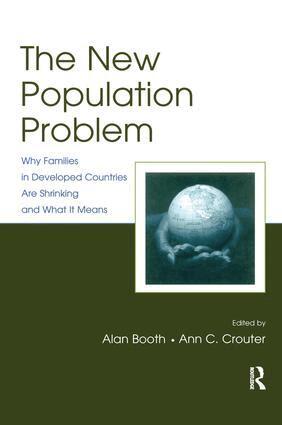
    New Population Problem

    Why Families in Developed Countries Are Shrinking and What It Means

    AvAlan Booth,Ann C. Crouter

    Häftad, Engelska, 2005

    Del i serien Penn State University Family Issues Symposia Series

    720 kr

    Beställningsvara. Skickas inom 10-15 vardagar. Fri frakt över 249 kr.

    Beskrivning

    This book is based on the presentations and discussions from a national symposium on "Creating the Next Generation: Social, Economic, and Psychological Processes Underlying Fertility in Developed Countries," held at the Pennsylvania State University in 2003. The papers address some of the antecedents and consequences of the recent steep declines in fertility in developed countries from different theoretical and disciplinary angles. While fertility rates are still high in some less-developed parts of the world, the new population problem with many countries in Europe, Asia, and North America is declining fertility. With fertility decline comes a reshaping of the population pyramid. The topic of fertility decline is interesting not only at the level of the individuals and couples, but also at the level of the societies that must come to grips with their long-term implications.Divided into four Parts, the text:*looks at contemporary trends in U.S. fertility, thus setting the stage for the entire volume;*discusses social and cultural values and attitudes;*analyzes fertility decisions in different countries; and*focuses on the possible long-term consequences of current fertility trends for individuals, families, and societies.

    Produktinformation

    • Utgivningsdatum:2005-04-06
    • Mått:152 x 229 x undefined mm
    • Vikt:408 g
    • Format:Häftad
    • Språk:Engelska
    • Serie:Penn State University Family Issues Symposia Series
    • Antal sidor:276
    • Förlag:Taylor & Francis Inc
    • ISBN:9780805849790

    Utforska kategorier

    • Sociologi inom Samhälle och politik

    Mer om författaren

    Alan Booth (Edited by) ,  Ann C. Crouter (Edited by)

    Recensioner i media

    "This volume would be of interest to all with an interest in changes affecting fertility and childbearing in developed countries."—Australian Institute of Family Studies

    Innehållsförteckning

    • Contents: Preface. Part I: Contemporary Patterns and Trends in U.S. Fertility: Where Have We Come From, and Where Are We Headed?S.P. Morgan, K. Hagewen, Is Very Low Fertility Inevitable in America? Insights and Forecasts From an Integrative Model of Fertility. R.K. Raley, The Role Of Nonmarital Births in Sustaining Replacement Fertility in the United States. M.B. Tucker, When the Rule Applies: Commentary on "Is Very Low Fertility Inevitable in America?" S.M. Bianchi, Time and Money: Market Work, Nonmarket Work, Gender Equality, and Fertility. Part II: How Do Social and Cultural Values and Attitudes Shape Fertility Patterns in the Developed World?J.S. Barber, W.G. Axinn, How Do Attitudes Shape Childbearing in the United States? S. Lundberg, Childbearing Decisions: Can Attitude Measures Play a Role in Casual Modeling? H-P. Kohler, Attitudes and Low Fertility: Reflections Based on Danish Twin Data. D.F. Alwin, Attitudes, Beliefs, and Childbearing. Part III: How and Why Is Fertility Tied to Marriage--Or Not?E. Thompson, Partnerships and Parenthood: A Comparative View of Cohabitation, Marriage, and Childbearing. S. Jaffee, Partnership Stability and Marital Outcomes in a Representative UK Sample. H.B. Presser, The Importance of Gender Relations for Understanding Low Fertility and Single Motherhood. N.S. Landale, The Changing Partnership Context of Parenthood: Where Do Researchers Go From Here? Part IV: What Are the Long-Term Consequences of Current Fertility Trends for Individuals, Families, and Society.C. Bachrach, R. King, A. Yuan, Children as Private and Public Goods: Implications of Fertility Trends. L. White, Creating the Next Generation: Whose Responsibility? D.T. Lichter, J. Wooton, The Concentration of Reproduction in Low-Fertility Societies: The Case of the United States. Panel Discussion: W.G. Axinn, C. Bachrach, J.S. Barber, D. Lichter, S.P. Morgan, E. Thomson, L. White, The Future of Low Fertility. T. St. Pierre, J.K. Dariotis, Understanding Low Fertility: The Impact of Life-Course Competition on Fertility Behavior in Developed Nations.