• Fri frakt över 249 kr
  • •
  • Snabba leveranser
  • •
  • Billiga böcker
Kundservice

Du är på sajten för privatpersoner.

Företag, bibliotek eller offentlig verksamhet?

Du handlar på classic.bokus.com, där alla dina funktioner finns intakta.
Till classic.bokus.com
Bokus logotyp. Gå till startsidan.
  • Erbjudanden
  • Nyheter
  • Student
  • Topplistor
  • Barn & ungdom
  • Bokus Play
  • E-böcker
  • Pocketböcker
  • Spel & pussel

10% rabatt på allt med kod NYSTART10 →

Sidfot

Mina sidor

    Hjälp

    • Kundservice
    • Vanliga frågor och svar
    • Frakt och leverans
    • Retur vid ångerrätt
    • Reklamera vara
    • Betalning
    • Köpvillkor
    • Allmänna villkor
    • Information om webbplatsens tillgänglighet

    Om Bokus

    • Om oss
    • Pressrum
    • För studenter
    • För företag
    • För bibliotek och offentlig verksamhet
    • För leverantörer
    • Hållbarhet

    Populärt

    • Aktuella erbjudanden
    • Presentkort
    • Studentlitteratur
    • Nya böcker
    • Topplistor
    • Signerade böcker
    • Engelska böcker

    Inspiration

    • Boktips
    • BookTok
    • Populära bokserier
    • Barnbokskaraktärer
    • Populära författare
    Logotyp för Bokus
    Följ oss på Facebook (extern länk)Följ oss på Instagram (extern länk)Följ oss på YouTube (extern länk)Följ oss på TikTok (extern länk)
    bokus @ CookiesAnpassa cookiesIntegritetspolicyKöpvillkor
    Till Citymail hemsida (extern länk)Till Budbee hemsida (extern länk)Till Postnord hemsida (extern länk)Till Schenker hemsida (extern länk)Till Early Bird hemsida (extern länk)Till Walleys hemsida (extern länk)
    1. Psykologi och pedagogik
    2. Psykologi
    3. Psykologiska teorier och skolor

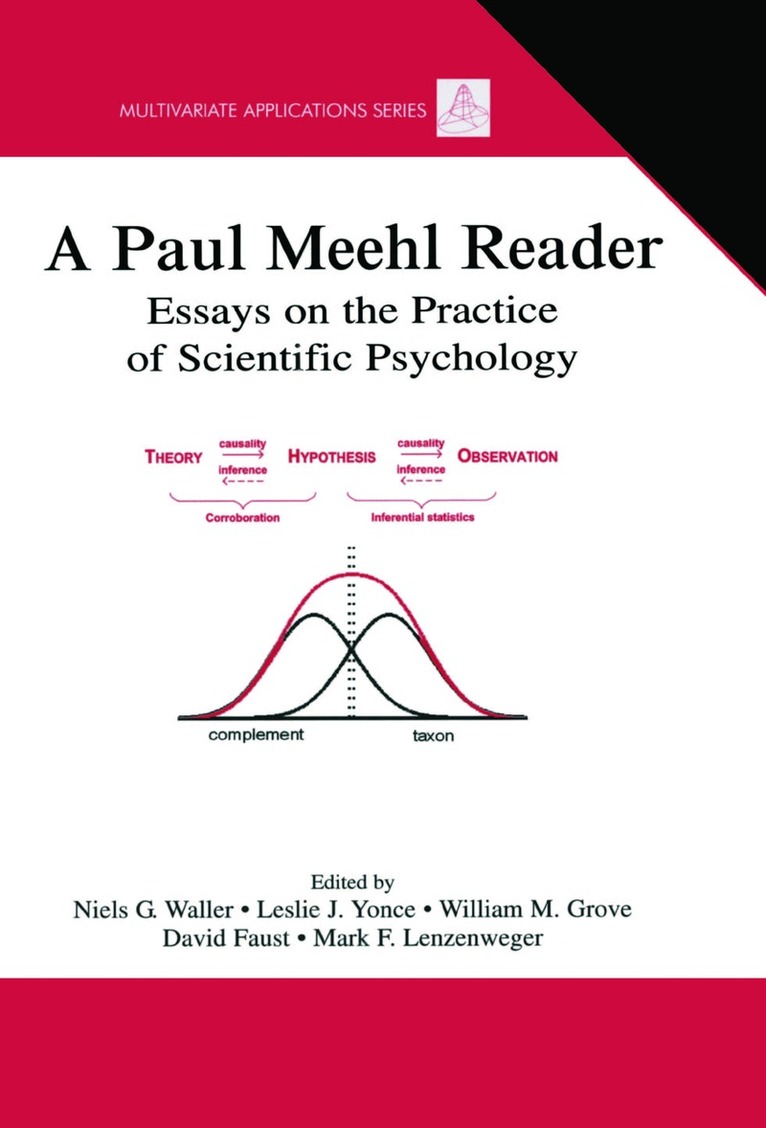
    Paul Meehl Reader

    Essays on the Practice of Scientific Psychology

    AvNiels G. Waller,Leslie J. Yonce

    Inbunden, Engelska, 2006

    Del i serien Multivariate Applications Series

    2 354 kr

    Beställningsvara. Skickas inom 10-15 vardagar. Fri frakt över 249 kr.

    Beskrivning

    This new book introduces a new generation to the important insights of Paul Meehl. In addition to selected papers from the classic reader, Psychodiagnosis, this book features new material selected from Meehl's most influential writings. The resulting collection is a tour de force illustrating quantitative analysis of life science problems, an examination of the inadequacy of some methods of analysis, and a review of the application of taxometrics.A Paul Meehl Reader is organized into five content areas: theory building and appraisal - how we discover and test the true causal relations of psychological constructs; specific etiology - an examination of genetic, behavioral, and environmental etiology in psychopathology; diagnosis and prediction - a review of the appropriate use of base rates; taxometrics - a look at Meehl's development of the method he invented; thinking effectively about psychological questions - a critique of correlation research and the power of quantitative thinking in psychology.The Reader features section introductions to orient the reader and provide a context and structure for Paul Meehl's work. The section on diagnosis and prediction features problem sets with solutions to guide the reader through practical applications of the principles described. Accompanying downloadable resources contain footage from Paul Meehl's engaging seminar on clinical versus statistical prediction. This book appeals to advanced students and professionals in psychology, sociology, law, education, human development, and philosophy.

    Produktinformation

    • Utgivningsdatum:2006-04-07
    • Mått:152 x 229 x 36 mm
    • Vikt:1 260 g
    • Format:Inbunden
    • Språk:Engelska
    • Serie:Multivariate Applications Series
    • Antal sidor:592
    • Förlag:Taylor & Francis Inc
    • ISBN:9780805852509

    Utforska kategorier

    • Psykologiska teorier och skolor inom Psykologi och pedagogik

    Mer om författaren

    Niels G. Waller (University of Minnesota), Leslie J. Yonce (Minneapolis, Minnesota), William M. Grove (University of Minnesota), David Faust (University of Rhode Island), Mark F. Lenzenweger (State University of New York at Binghamton)

    Recensioner i media

    "...A valuable resource for all scientifically minded clinical psychologists as well as for all other scientific psychologists... the book provides excellent analyses of philosophy of science, the history of science, behavior genetics, descriptive psychopathology, and multivariate statistics …Superb."—Scott Lilienfeld, Ph.D. Emory University"This volume does not just reproduce his good work, but it offers lots of extra 'goodies' like exercises, explanations, and the video."—David Rindskopf, Ph.D. Graduate Center, City University of New York

    Innehållsförteckning

    • Contents: Preface. Part I: Theory Building and Theory Appraisal. Construct Validity in Psychological Tests. High School Yearbooks: A Reply to Schwarz. Nuisance Variables and the Ex Post Facto Design. Theoretical Risks and Tabular Asterisks: Sir Karl, Sir Ronald, and the Slow Progress of Soft Psychology. Appraising and Amending Theories: The Strategy of Lakatosian Defense and Two Principles That Warrant It. Part II: Specific Etiology. Specific Etiology and Other Forms of Strong Influence: Some Quantitative Meanings. Specific Genetic Etiology, Psychodynamics, and Therapeutic Nihilism. Part III: Diagnosis and Prediction. Antecendent Probability and the Efficiency of Psychometric Signs, Patterns, or Cutting Scores. Problem Sets and Solutions for Bayes Theorem, Base Rates, and Prediction. Wanted--A Good Cookbook. When Shall We Use Our Heads Instead of the Formula? Some Ruminations on the Validation of Clinical Procedures. Comparative Efficiency of Informal (Subjective, Impressionistic) and Formal (Mechanical, Algorithmic) Prediction Procedures: The Clinical-Statistical Controversy. Part IV: Taxometrics: Coherent Cut Kinetics. Factors and Taxa, Traits, and Types, Differences of Degree and Differences in Kind. Bootstraps Taxometrics: Solving the Classification Problem in Psychopathology. Clarifications About Taxometric Method. Part V: Thinking Clearly About Psychology. Philosophy of Science: Help or Hindrance? The Power of Quantitative Thinking. Why Summaries of Research on Psychological Theories Are Often Uninterpretable.