• Fri frakt över 249 kr
  • •
  • Snabba leveranser
  • •
  • Billiga böcker
Kundservice

Du är på sajten för privatpersoner.

Företag, bibliotek eller offentlig verksamhet?

Du handlar på classic.bokus.com, där alla dina funktioner finns intakta.
Till classic.bokus.com
Bokus logotyp. Gå till startsidan.
  • Erbjudanden
  • Nyheter
  • Student
  • Topplistor
  • Barn & ungdom
  • Bokus Play
  • E-böcker
  • Pocketböcker
  • Spel & pussel

10% rabatt på allt med kod: NYSTART10 →

Sidfot

Mina sidor

    Hjälp

    • Kundservice
    • Vanliga frågor och svar
    • Frakt och leverans
    • Retur vid ångerrätt
    • Reklamera vara
    • Betalning
    • Köpvillkor
    • Allmänna villkor
    • Information om webbplatsens tillgänglighet

    Om Bokus

    • Om oss
    • Pressrum
    • För studenter
    • För företag
    • För bibliotek och offentlig verksamhet
    • För leverantörer
    • Hållbarhet

    Populärt

    • Aktuella erbjudanden
    • Presentkort
    • Studentlitteratur
    • Nya böcker
    • Topplistor
    • Signerade böcker
    • Engelska böcker

    Inspiration

    • Boktips
    • BookTok
    • Populära bokserier
    • Barnbokskaraktärer
    • Populära författare
    Logotyp för Bokus
    Följ oss på Facebook (extern länk)Följ oss på Instagram (extern länk)Följ oss på YouTube (extern länk)Följ oss på TikTok (extern länk)
    bokus @ CookiesAnpassa cookiesIntegritetspolicyKöpvillkor
    Till Citymail hemsida (extern länk)Till Budbee hemsida (extern länk)Till Postnord hemsida (extern länk)Till Schenker hemsida (extern länk)Till Early Bird hemsida (extern länk)Till Walleys hemsida (extern länk)
    1. Psykologi och pedagogik
    2. Pedagogik
    3. Pedagogisk psykologi

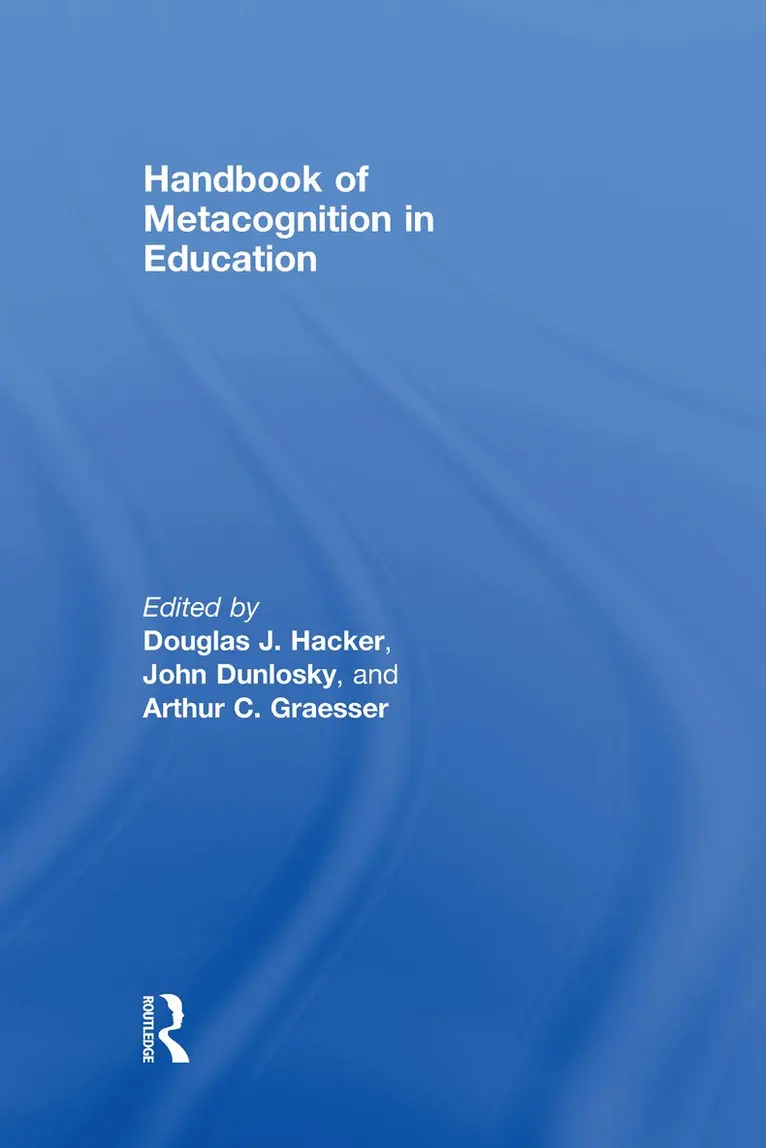
    Handbook of Metacognition in Education

    AvDouglas J. Hacker,John Dunlosky

    Inbunden, Engelska, 2009

    7 099 kr

    Beställningsvara. Skickas inom 10-15 vardagar. Fri frakt över 249 kr.

    Beskrivning

    Providing comprehensive coverage of the theoretical bases of metacognition and its applications to educational practice, this compendium of focused and in-depth discussions from leading scholars in the field: represents an intersection of education, cognitive science, and technology; serves as a gateway to the literature for researchers and practitioners interested in one or more of the wide array of topics included; and sets the standard for scholarship for theoretical research and practical applications in this field.The Handbook of Metacognition in Education — covering Comprehension Strategies, Metacognitive Strategies, Metacomprehension, Writing, Science and Mathematics, Individual Differences, Self-Regulated Learning, Technology, Tutoring, and Measurement — is an essential resource for researchers, faculty, students, curriculum developers, teachers, and others interested in using research and theory on metacognition to guide and inform educational practice.

    Produktinformation

    • Utgivningsdatum:2009-06-23
    • Mått:178 x 254 x 29 mm
    • Vikt:1 020 g
    • Format:Inbunden
    • Språk:Engelska
    • Antal sidor:462
    • Förlag:Taylor & Francis Inc
    • ISBN:9780805863536

    Utforska kategorier

    • Pedagogisk psykologi inom Psykologi och pedagogik
    • Pedagogisk metodik inom Psykologi och pedagogik
    • Kognitiv psykologi inom Psykologi och pedagogik

    Mer om författaren

    Douglas J. Hacker is Chair, Department of Teaching and Learning, and Adjunct Professor Department of Educational Psychology, University of UtahJohn Dunlosky is Associate Professor, Department of Psychology, Kent State University.Arthur C. Graesser is Chair, Department of Psychology, and Co-director, The Institute for Intelligent Systems, University of Memphis.

    Innehållsförteckning

    • Foreword, Robert J. SternbergChapter 1. A Growing Sense of "Agency," Douglas J. Hacker, John Dunlosky, and Arthur C. GraesserPart I: Comprehension Strategies Chapter 2. The Role of Metacognition in Understanding and Supporting Reading Comprehension, Margaret G. McKeown and Isabel L. BeckChapter 3. The Role of Metacognition in Teaching Reading Comprehension to Primary Students, Joanna P. Williams and J. Grant Atkins Part II: Metacognitive Strategies Chapter 4. Question Generation and Anomaly Detection in Texts, José OteroChapter 5. Self-Explanation and Metacognition: The Dynamics of Reading, Danielle S. McNamara and Joseph P. MaglianoPart III: Metacomprehension Chapter 6. Metacognitive Monitoring During and After Reading, Keith W. Thiede, Thomas D. Griffin, Jennifer Wiley, and Joshua RedfordChapter 7. The Importance of Knowing What You Know: A Knowledge Monitoring Framework for Studying Metacognition in Education, Sigmund Tobias and Howard T. EversonPart IV: Writing Chapter 8. Metacognition and Children’s Writing, Karen R. Harris, Steve Graham, Mary Brindle, and Karin SandmelChapter 9. Writing is Applied Metacognition , Douglas J. Hacker, Matt C. Keener, and John C. KircherPart V: Science and Mathematics Chapter 10. The Interplay of Scientific Inquiry and Metacognition: More than a Marriage of Convenience, Barbara White, John Frederiksen, and Allan CollinsChapter 11. The Enigma of Mathematical Learning Disabilities: Metacognition or STICORDI, That’s the Question, Annemie DesoetePart VI: Individual Differences Chapter 12. Context Matters: Gender and Cross-Cultural Differences in Confidence, Mary Lundeberg and Lindsey MohanChapter 13. Teachers as Metacognitive Professionals, Gerald G. Duffy, Samuel Miller, Seth Parsons, and Michael MelothPart VII: Self-Regulated Learning Chapter 14. Supporting Self-Regulated Learning with Cognitive Tools, Philip H. Winne and John C. NesbitChapter 15. Effective Implementation of Metacognition, Michael J. Serra and Janet MetcalfeChapter 16. Self-Regulation: Where Metacognition and Motivation Intersect, Barry J. Zimmerman and Adam R. MoylanPart VIII: Technology Chapter 17. Self-Regulated Learning with Hypermedia, Roger Azevedo and Amy M. WitherspoonChapter 18. Interactive Metacognition: Monitoring and Regulating a Teachable Agent, Daniel L. Schwartz, Catherine Chase, Doris B. Chin, Marily Oppezzo, Henry Kwong, Sandra Okita, Gautam Biswas, Rod Roscoe, Hogyeong Jeong, and John WagsterPart IX: Tutoring Chapter 19. Meta-Knowledge in Tutoring, Arthur C. Graesser, Sidney D’Mello, and Natalie Person Chapter 20. In Vivo Experiments on Whether Supporting Metacognition in Intelligent Tutoring Systems Yields Robust Learning, Ken Koedinger, Vincent Aleven, Ido Roll, and Ryan Baker Part X: Measurement Chapter 21. Measuring Metacognitive Judgments, Gregory Schraw Chapter 22. Sins Committed in the Name of Ecological Validity: A Call for Representative Design in Education Science, John Dunlosky, Sara Bottiroli, and Marissa Hartwig