• Fri frakt över 249 kr
  • •
  • Snabba leveranser
  • •
  • Billiga böcker
Kundservice

Du är på sajten för privatpersoner.

Företag, bibliotek eller offentlig verksamhet?

Du handlar på classic.bokus.com, där alla dina funktioner finns intakta.
Till classic.bokus.com
Bokus logotyp. Gå till startsidan.
  • Erbjudanden
  • Nyheter
  • Student
  • Topplistor
  • Barn & ungdom
  • Bokus Play
  • E-böcker
  • Pocketböcker
  • Spel & pussel

10% rabatt på allt med kod: NYSTART10 →

Sidfot

Mina sidor

    Hjälp

    • Kundservice
    • Vanliga frågor och svar
    • Frakt och leverans
    • Retur vid ångerrätt
    • Reklamera vara
    • Betalning
    • Köpvillkor
    • Allmänna villkor
    • Information om webbplatsens tillgänglighet

    Om Bokus

    • Om oss
    • Pressrum
    • För studenter
    • För företag
    • För bibliotek och offentlig verksamhet
    • För leverantörer
    • Hållbarhet

    Populärt

    • Aktuella erbjudanden
    • Presentkort
    • Studentlitteratur
    • Nya böcker
    • Topplistor
    • Signerade böcker
    • Engelska böcker

    Inspiration

    • Boktips
    • BookTok
    • Populära bokserier
    • Barnbokskaraktärer
    • Populära författare
    Logotyp för Bokus
    Följ oss på Facebook (extern länk)Följ oss på Instagram (extern länk)Följ oss på YouTube (extern länk)Följ oss på TikTok (extern länk)
    bokus @ CookiesAnpassa cookiesIntegritetspolicyKöpvillkor
    Till Citymail hemsida (extern länk)Till Budbee hemsida (extern länk)Till Postnord hemsida (extern länk)Till Schenker hemsida (extern länk)Till Early Bird hemsida (extern länk)Till Walleys hemsida (extern länk)
    1. Samhälle och politik
    2. Samhälle och kultur
    3. Kultur och medier
    4. Kulturvetenskap

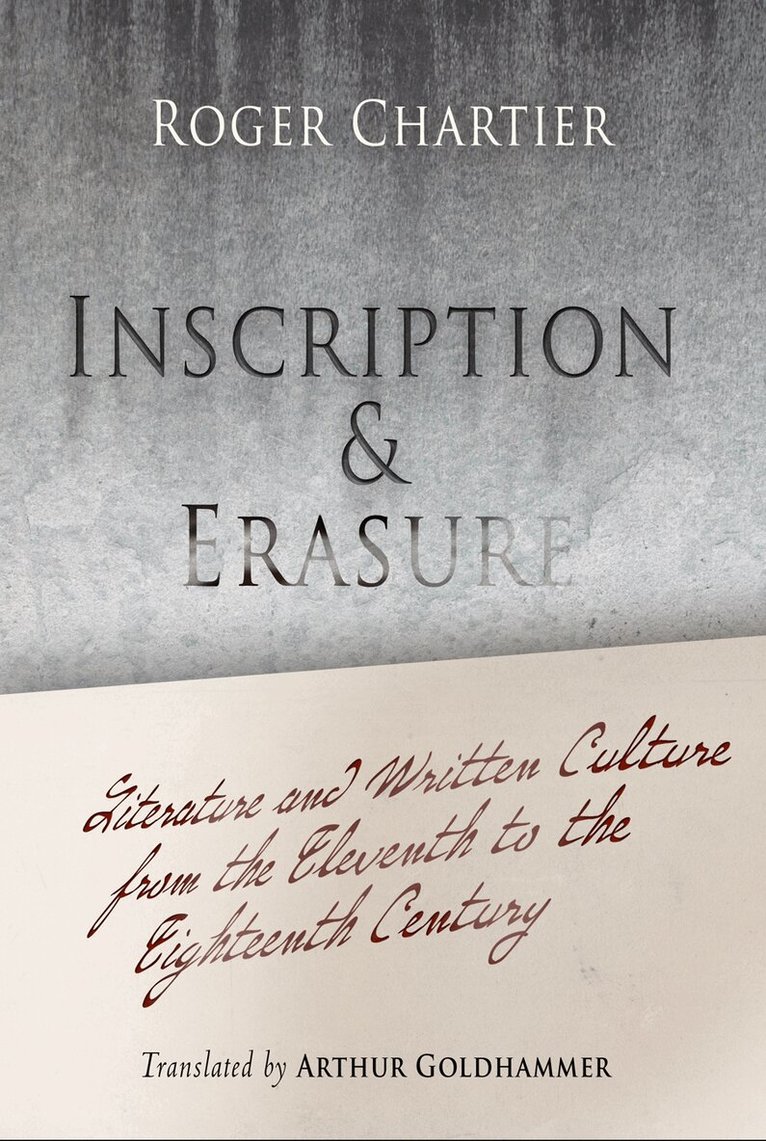
    Inscription and Erasure

    Literature and Written Culture from the Eleventh to the Eighteenth Century

    AvRoger Chartier

    Häftad, Engelska, 2008

    Del i serien Material Texts

    375 kr

    Beställningsvara. Skickas inom 10-15 vardagar. Fri frakt över 249 kr.

    Beskrivning

    The fear of oblivion obsessed medieval and early modern Europe. Stone, wood, cloth, parchment, and paper all provided media onto which writing was inscribed as a way to ward off loss. And the task was not easy in a world in which writing could be destroyed, manuscripts lost, or books menaced with destruction. Paradoxically, the successful spread of printing posed another danger, namely, that an uncontrollable proliferation of textual materials, of matter without order or limit, might allow useless texts to multiply and smother thought. Not everything written was destined for the archives; indeed, much was written on surfaces that allowed one to write, erase, then write again.In Inscription and Erasure, Roger Chartier seeks to demonstrate how the tension between these two concerns played out in the imaginative works of their times. Chartier examines how authors transformed the material realities of writing and publication into an aesthetic resource exploited for poetic, dramatic, or narrative ends. The process that gave form to writing in its various modes-public or private, ephemeral or permanent-thus became the very material of literary invention. Chartier's chapters follow a thread of reading and interpretation that takes us from the twelfth-century French poet Baudri of Bourgueil, sketching out his poems on wax tablets before they are committed to parchment, through Cervantes in the seventeenth century, who places a "book of memory," in which poems and letters are to be recopied, in the path of his fictional Don Quixote.

    Produktinformation

    • Utgivningsdatum:2008-08-25
    • Mått:152 x 229 x 19 mm
    • Vikt:344 g
    • Format:Häftad
    • Språk:Engelska
    • Serie:Material Texts
    • Antal sidor:224
    • Förlag:University of Pennsylvania Press
    • ISBN:9780812220469
    • Översättare:Arthur Goldhammer

    Utforska kategorier

    • Kulturvetenskap inom Samhälle och politik
    • Litteraturvetenskap inom Skönlitteratur

    Mer om författaren

    Roger Chartier is Directeur d'Etudes at the Ecole des Hautes Etudes en Sciences Sociales, Professeur in the College de France, and Annenberg Visiting Professor of History at the University of Pennsylvania. He is the author of numerous books, including Forms and Meanings: Texts, Performances, and Audiences from Codex to Computer, also available from the University of Pennsylvania Press. Arthur Goldhammer has translated more than ninety works from the French. He is an affiliate of the Center for European Studies at Harvard University and a Chevalier de l'Ordre des Arts et des Lettres.

    Recensioner i media

    "This elegant and learned study constitutes a significant addition to Roger Chartier's well-known work on the history of the book in western culture." (Timothy Hampton, H-France Review) "Chartier unites literary analysis with material history to reveal how representations survive. . . . The book takes up subjects from the eleventh-century French abbot Baudri de Bourgueil to the eighteenth-century encyclopedist Denis Diderot. . . . Chartier's singular achievement is to claim authority over a wide range of practices and to focus on their common anxieties and ambitions." (SHARP News) "Any progress achieved within a humanistic discipline that crosses boundaries to neighboring fields has the potential both to find unexplored objects of study and to raise new questions. Inscription and Erasure disputes the long-standing division between the interpretation of texts and the description of the material supports and socio-historical environments in which texts appeared and circulated." (MLN)

    Innehållsförteckning

    • Introduction: Aesthetic Mystery and the Materialities of the WrittenChapter One. Wax and Parchment: The Poems of Baudri de BourgueilChapter Two. Writing and Memory: Cardenio's LibrilloChapter Three. The Press and Fonts: Don Quixote in the Print ShopChapter Four. Handwritten Newsletters, Printed Gazettes: Cymbal and ButterChapter Five. Talking Books and Clandestine Manuscripts: The Travels of DyrconaChapter Six. Text and Fabric: Anzoletto and PhilomelaChapter Seven. Commerce in the Novel: Damilaville's Tears and the Impatient ReaderEpilogue: Diderot and His PiratesNotesIndex