• Fri frakt över 249 kr
  • •
  • Snabba leveranser
  • •
  • Billiga böcker
Kundservice

Du är på sajten för privatpersoner.

Företag, bibliotek eller offentlig verksamhet?

Du handlar på classic.bokus.com, där alla dina funktioner finns intakta.
Till classic.bokus.com
Bokus logotyp. Gå till startsidan.
  • Erbjudanden
  • Nyheter
  • Student
  • Topplistor
  • Barn & ungdom
  • Bokus Play
  • E-böcker
  • Pocketböcker
  • Spel & pussel

10% rabatt på allt med kod NYSTART10 →

Sidfot

Mina sidor

    Hjälp

    • Kundservice
    • Vanliga frågor och svar
    • Frakt och leverans
    • Retur vid ångerrätt
    • Reklamera vara
    • Betalning
    • Köpvillkor
    • Allmänna villkor
    • Information om webbplatsens tillgänglighet

    Om Bokus

    • Om oss
    • Pressrum
    • För studenter
    • För företag
    • För bibliotek och offentlig verksamhet
    • För leverantörer
    • Hållbarhet

    Populärt

    • Aktuella erbjudanden
    • Presentkort
    • Studentlitteratur
    • Nya böcker
    • Topplistor
    • Signerade böcker
    • Engelska böcker

    Inspiration

    • Boktips
    • BookTok
    • Populära bokserier
    • Barnbokskaraktärer
    • Populära författare
    Logotyp för Bokus
    Följ oss på Facebook (extern länk)Följ oss på Instagram (extern länk)Följ oss på YouTube (extern länk)Följ oss på TikTok (extern länk)
    bokus @ CookiesAnpassa cookiesIntegritetspolicyKöpvillkor
    Till Citymail hemsida (extern länk)Till Budbee hemsida (extern länk)Till Postnord hemsida (extern länk)Till Schenker hemsida (extern länk)Till Early Bird hemsida (extern länk)Till Walleys hemsida (extern länk)
    1. Barn och ungdom
    2. Faktaböcker
    3. Kropp och knopp
    4. Sociala frågor

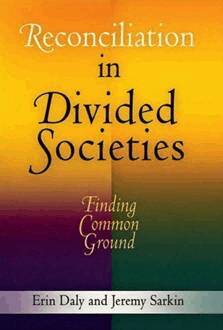
    Reconciliation in Divided Societies

    Finding Common Ground

    AvErin Daly,Jeremy Sarkin

    Häftad, Engelska, 2010

    Del i serien Pennsylvania Studies in Human Rights

    425 kr

    Beställningsvara. Skickas inom 10-15 vardagar. Fri frakt över 249 kr.

    Fler format och utgåvor

    E-bok

    614 kr

    Beskrivning

    "As nations struggling to heal wounds of civil war and atrocity turn toward the model of reconciliation, Reconciliation in Divided Societies takes a systematic look at the political dimensions of this international phenomenon. . . . The book shows us how this transformation happens so that we can all gain a better understanding of how, and why, reconciliation really works. It is an almost indispensable tool for those who want to engage in reconciliation"-from the foreword by Archbishop Emeritus Desmond TutuAs societies emerge from oppression, war, or genocide, their most important task is to create a civil society strong and stable enough to support democratic governance. More and more conflict-torn countries throughout the world are promoting reconciliation as central to their new social order as they move toward peace and stability.Scores of truth and reconciliation commissions are helping bring people together and heal the wounds of deeply divided societies. Since the South African transition, countries as diverse as Timor Leste, Sierra Leone, Fiji, Morocco, and Peru have placed reconciliation at the center of their reconstruction and development programs. Other efforts to promote reconciliation-including trials and governmental programs-are also becoming more prominent in transitional times. But until now there has been no real effort to understand exactly what reconciliation could mean in these different situations. What does true reconciliation entail? How can it be achieved? How can its achievement be assessed? This book digs beneath the surface to answer these questions and explain what the concepts of truth, justice, forgiveness, and reconciliation really involve in societies that are recovering from internecine strife.Looking to the future as much as to the past, Erin Daly and Jeremy Sarkin maintain that reconciliation requires fundamental political and economic reform along with personal healing if it is to be effective in establishing lasting peace and stability. Reconciliation, they argue, is best thought of as a means for transformation. It is the engine that enables victims to become survivors and divided societies to transform themselves into communities where people work together to raise children and live productive, hopeful lives. Reconciliation in Divided Societies shows us how this transformation happens so that we can all gain a better understanding of how and why reconciliation is actually accomplished.

    Produktinformation

    • Utgivningsdatum:2010-09-15
    • Mått:152 x 229 x 28 mm
    • Vikt:514 g
    • Format:Häftad
    • Språk:Engelska
    • Serie:Pennsylvania Studies in Human Rights
    • Antal sidor:344
    • Förlag:University of Pennsylvania Press
    • ISBN:9780812221244

    Utforska kategorier

    • Sociala frågor inom Barn och ungdom

    Mer om författaren

    Erin Daly is Professor of Law at Widener University in Wilmington, Delaware, specializing in American and comparative constitutional law. She is a member of the American Society of International Law and the U.S. Association of Constitutional Law. Jeremy Sarkin is Senior Professor of Law at the University of Western Cape in Cape Town, South Africa. A former acting judge in the Cape High Court, his recent books include Carrots and Sticks: The TRC and the South African Amnesty Process and The Administration of Justice: Comparative Perspectives.

    Recensioner i media

    "Erin Daly and Jeremy Sarkin . . . offer a breath-taking tour de force of the theory and practice of reconciliation. Their work is integrated and interdisciplinary. It moves effortlessly from law to literature, seamlessly from philosophy to psychology, and inclusively from art to history."-International Journal of Transitional Justice"An invaluable contribution to our understanding of conflict and reconciliation."-Negotiation Journal

    Innehållsförteckning

    • Foreword by Archbishop Emeritus Desmond Mpilo TutuPrefacePART I. FINDING COMMON GROUNDChapter 1. The Lay of the LandPART II. RECONCILIATION IN LAYERSChapter 2. The Divided SelfChapter 3. Reconciliation in CommunityChapter 4. National and International ReconciliationPART III. RECONCILIATION'S INTERNAL LOGICChapter 5. The Costs of ReconciliationChapter 6. Truth, Forgiveness, and JusticeChapter 7. Reconciliation RedirectedPART IV. RECONCILIATION RECONSTRUCTEDChapter 8. Politics and MoneyChapter 9. The Mechanics of ReconciliationNotesBibliographyIndex