• Fri frakt över 249 kr
  • •
  • Snabba leveranser
  • •
  • Billiga böcker
Kundservice

Du är på sajten för privatpersoner.

Företag, bibliotek eller offentlig verksamhet?

Du handlar på classic.bokus.com, där alla dina funktioner finns intakta.
Till classic.bokus.com
Bokus logotyp. Gå till startsidan.
  • Erbjudanden
  • Nyheter
  • Student
  • Topplistor
  • Barn & ungdom
  • Bokus Play
  • E-böcker
  • Pocketböcker
  • Spel & pussel

10% rabatt på allt med kod: NYSTART10 →

Sidfot

Mina sidor

    Hjälp

    • Kundservice
    • Vanliga frågor och svar
    • Frakt och leverans
    • Retur vid ångerrätt
    • Reklamera vara
    • Betalning
    • Köpvillkor
    • Allmänna villkor
    • Information om webbplatsens tillgänglighet

    Om Bokus

    • Om oss
    • Pressrum
    • För studenter
    • För företag
    • För bibliotek och offentlig verksamhet
    • För leverantörer
    • Hållbarhet

    Populärt

    • Aktuella erbjudanden
    • Presentkort
    • Studentlitteratur
    • Nya böcker
    • Topplistor
    • Signerade böcker
    • Engelska böcker

    Inspiration

    • Boktips
    • BookTok
    • Populära bokserier
    • Barnbokskaraktärer
    • Populära författare
    Logotyp för Bokus
    Följ oss på Facebook (extern länk)Följ oss på Instagram (extern länk)Följ oss på YouTube (extern länk)Följ oss på TikTok (extern länk)
    bokus @ CookiesAnpassa cookiesIntegritetspolicyKöpvillkor
    Till Citymail hemsida (extern länk)Till Budbee hemsida (extern länk)Till Postnord hemsida (extern länk)Till Schenker hemsida (extern länk)Till Early Bird hemsida (extern länk)Till Walleys hemsida (extern länk)
    1. Samhälle och politik
    2. Samhälle och kultur
    3. Kultur och medier
    4. Referensverk och tvärvetenskap

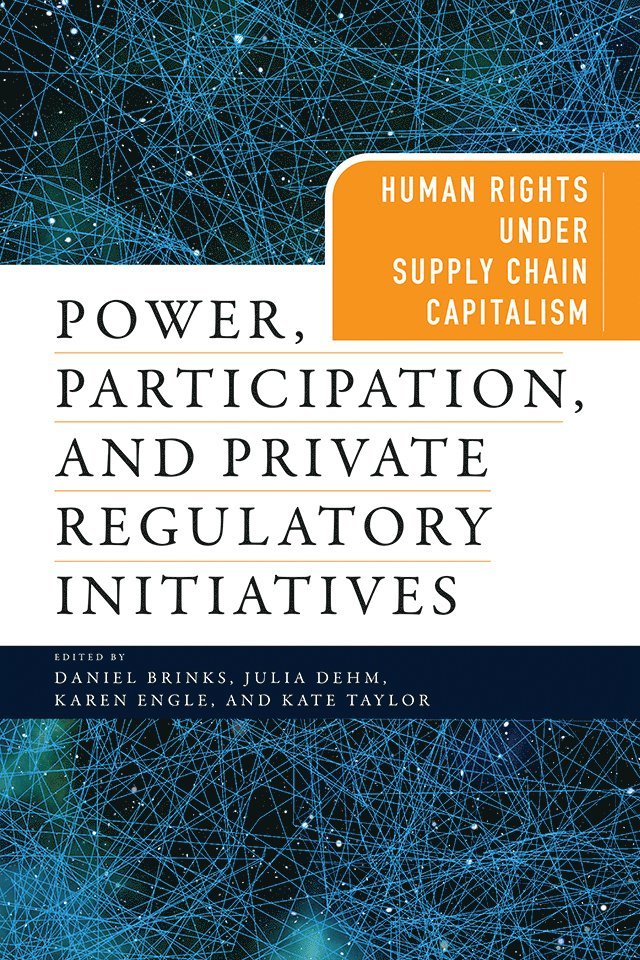
    Power, Participation, and Private Regulatory Initiatives

    Human Rights Under Supply Chain Capitalism

    AvDaniel Brinks,Julia Dehm

    Häftad, Engelska, 2021

    Del i serien Pennsylvania Studies in Human Rights

    390 kr

    Beställningsvara. Skickas inom 5-8 vardagar. Fri frakt över 249 kr.

    Beskrivning

    From unsafe working conditions in garment manufacturing to the failure to consult indigenous communities with regard to extractive industries that affect them, human rights violations remain a pervasive aspect of the global economy. Advocates have long called upon states, as the primary duty bearers and enforcers of human rights, to hold corporations directly accountable for violations committed throughout the supply chain. More recently, many business and human rights advocates have considered the development and enforcement of private regulatory initiatives (PRIs) to certify that actors along the supply chain conform to certain codes of conduct. Many advocates see these PRIs as holding the potential to create better outcomes-whether for workers, affected communities, or the environment-within a global economy structured by supply chain capitalism.This volume brings together academics and practitioners from a number of regions throughout the world to engage in theoretical analysis, case study exploration, and reflection on a variety of PRIs. Theorizing outward from the work of practitioners and activists on the ground, the book brings essential but often overlooked questions to the scholarly debates on business, human rights, and global governance.Ultimately, the contributions coalesce around one basic claim: that the inequalities and disparities of power and wealth that are a key characteristic of the contemporary global economy can also mark the origins and operation of PRIs, and do so to varying degrees. The collection highlights the need for discussions about labor, environmental, and other human rights accountability to be situated within a broader analysis of the political economy of contemporary supply chain capitalism. It seeks to enrich discussions of PRIs by bringing into the conversation concerns about distributive justice and political economy.

    Produktinformation

    • Utgivningsdatum:2021-07-30
    • Mått:152 x 229 x 24 mm
    • Vikt:476 g
    • Format:Häftad
    • Språk:Engelska
    • Serie:Pennsylvania Studies in Human Rights
    • Antal sidor:368
    • Förlag:University of Pennsylvania Press
    • ISBN:9780812253313

    Utforska kategorier

    • Referensverk och tvärvetenskap inom Samhälle och politik
    • Politiskt förtryck inom Samhälle och politik

    Mer om författaren

    Daniel Brinks is Professor of Government at the University of Texas at Austin. Julia Dehm is Senior Lecturer in Law at La Trobe University. Karen Engle holds the Minerva House Drysdale Regents Chair in Law at the University of Texas at Austin. Kate Taylor is a human rights lawyer in Melbourne, Australia.

    Recensioner i media

    "This volume exposes power imbalances that underpin and undermine the efficacy of various private initiatives aimed at regulating human rights abuses in global supply chains. The editors and many authors rightly stress the need to dismantle the current system, which tends to legitimize these asymmetries experienced by workers and affected communities." (Surya Deva, City University of Hong Kong)

    Innehållsförteckning

    • AcknowledgmentsKey AcronymsPart I. Framing the Discussion: Private Regulatory Initiatives, Human Rights, and Supply Chain CapitalismChapter 1. Private Regulatory Initiatives, Human Rights, and Supply Chain CapitalismDaniel Brinks, Julia Dehm, Karen Engle, and Kate TaylorChapter 2. Closing Gaps in the Chain: Regulating Respect for Human Rights in Global Supply Chains and the Role of Multi-stakeholder InitiativesJustine NolanPart II. Multi-stakeholder Initiatives and the Maldistribution of PowerChapter 3. The Kimberley Process Certification Scheme and the Continuation of "Conflict Diamonds"Farai MaguwuChapter 4. Reforming Commodity Certification Systems to Respect Indigenous Peoples' Rights: Prospects for the Forestry Stewardship Council and Roundtable on Sustainable Palm OilMarcus ColchesterChapter 5. What Difference Can Certification Regimes Make? The Mapuche People's Claims for Autonomy and the Forestry Industry in Southern ChileCharles R. Hale and JosÉ AylwinChapter 6. Sustainability Certification and Controversies Surrounding Palm Oil Expansion in GuatemalaGeisselle Vanessa SÁnchez MongePart III. Worker-Driven Social Responsibility Programs: Attempts to Redistribute PowerChapter 7. Assessing Feasibility for Worker-Driven Social Responsibility ProgramsSean SellersChapter 8. From Public Relations to Enforceable Agreements: The Bangladesh Accord as a Model for Supply Chain AccountabilityJessica ChampagneChapter 9. Transformation Through Transparency: Human Rights and Corporate Responsibilities in the Global Food SystemErika GeorgePart IV. Critical ReflectionsChapter 10. Reflections on Labor Standards in Global Supply Chains: Innovation and ScalabilityJames J. BrudneyChapter 11. Situating Human Rights Approaches to Corporate Accountability in the Political Economy of Supply Chain CapitalismDan DanielsenChapter 12. Taking Consumers Seriously: Public Regulatory Tools of AccountabilityLauren FielderChapter 13. Private Regulatory Initiatives and Beyond: Lessons and ReflectionsDaniel Brinks, Julia Dehm, Karen Engle, and Kate TaylorNotesList of ContributorsIndex