• Fri frakt över 249 kr
  • •
  • Snabba leveranser
  • •
  • Billiga böcker
Kundservice

Du är på sajten för privatpersoner.

Företag, bibliotek eller offentlig verksamhet?

Du handlar på classic.bokus.com, där alla dina funktioner finns intakta.
Till classic.bokus.com
Bokus logotyp. Gå till startsidan.
  • Erbjudanden
  • Nyheter
  • Student
  • Topplistor
  • Barn & ungdom
  • Bokus Play
  • E-böcker
  • Pocketböcker
  • Spel & pussel

10% rabatt på allt med kod: NYSTART10 →

Sidfot

Mina sidor

    Hjälp

    • Kundservice
    • Vanliga frågor och svar
    • Frakt och leverans
    • Retur vid ångerrätt
    • Reklamera vara
    • Betalning
    • Köpvillkor
    • Allmänna villkor
    • Information om webbplatsens tillgänglighet

    Om Bokus

    • Om oss
    • Pressrum
    • För studenter
    • För företag
    • För bibliotek och offentlig verksamhet
    • För leverantörer
    • Hållbarhet

    Populärt

    • Aktuella erbjudanden
    • Presentkort
    • Studentlitteratur
    • Nya böcker
    • Topplistor
    • Signerade böcker
    • Engelska böcker

    Inspiration

    • Boktips
    • BookTok
    • Populära bokserier
    • Barnbokskaraktärer
    • Populära författare
    Logotyp för Bokus
    Följ oss på Facebook (extern länk)Följ oss på Instagram (extern länk)Följ oss på YouTube (extern länk)Följ oss på TikTok (extern länk)
    bokus @ CookiesAnpassa cookiesIntegritetspolicyKöpvillkor
    Till Citymail hemsida (extern länk)Till Budbee hemsida (extern länk)Till Postnord hemsida (extern länk)Till Schenker hemsida (extern länk)Till Early Bird hemsida (extern länk)Till Walleys hemsida (extern länk)
    1. Skönlitteratur
    2. Litteraturvetenskap
    3. Litteraturvetenskap

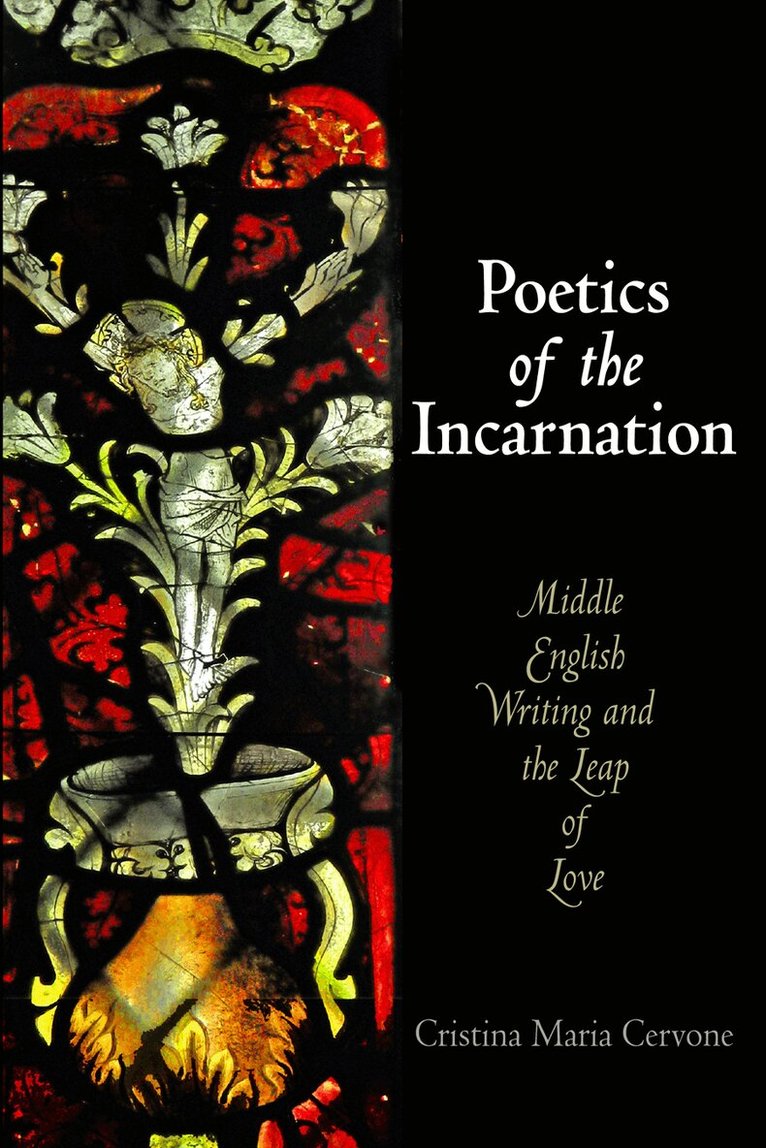
    Poetics of the Incarnation

    Middle English Writing and the Leap of Love

    AvCristina Maria Cervone

    Inbunden, Engelska, 2013

    Del i serien Middle Ages Series

    1 093 kr

    Beställningsvara. Skickas inom 10-15 vardagar. Fri frakt över 249 kr.

    Fler format och utgåvor

    E-bok

    1 542 kr

    Beskrivning

    The Gospel of John describes the Incarnation of Christ as "the Word made flesh"-an intriguing phrase that uses the logic of metaphor but is not traditionally understood as merely symbolic. Thus the conceptual puzzle of the Incarnation also draws attention to language and form: what is the Word; how is it related to language; how can the Word become flesh? Such theological questions haunt the material imagery engaged by medieval writers, the structural forms that give their writing shape, and even their ideas about language itself. In Poetics of the Incarnation, Cristina Maria Cervone examines the work of fourteenth-century writers who, rather than approaching the mystery of the Incarnation through affective identification with the Passion, elected to ponder the intellectual implications of the Incarnation in poetical and rhetorical forms. Cervone argues that a poetics of the Incarnation becomes the grounds for working through the philosophical and theological implications of language, at a point in time when Middle English was emerging as a legitimate, if contested, medium for theological expression.In brief lyrics and complex narratives, late medieval English writers including William Langland, Julian of Norwich, Walter Hilton, and the anonymous author of the Charters of Christ took the relationship between God and humanity as a jumping-off point for their meditations on the nature of language and thought, the elision between the concrete and the abstract, the complex relationship between acting and being, the work done by poetry itself in and through time, and the meaning latent within poetical forms. Where Passion-devoted writing would focus on the vulnerability and suffering of the fleshly body, these texts took imaginative leaps, such as when they depict the body of Christ as a lily or the written word. Their Incarnational poetics repeatedly call attention to the fact that, in theology as in poetics, form matters.

    Produktinformation

    • Utgivningsdatum:2013-02-04
    • Mått:152 x 229 x 28 mm
    • Vikt:680 g
    • Format:Inbunden
    • Språk:Engelska
    • Serie:Middle Ages Series
    • Antal sidor:320
    • Förlag:University of Pennsylvania Press
    • ISBN:9780812244519

    Utforska kategorier

    • Litteraturvetenskap inom Skönlitteratur

    Mer om författaren

    Cristina Maria Cervone teaches English literature and medieval studies at the University of Memphis.

    Recensioner i media

    "Cervone's book deserves to be widely read both for its own richly suggestive content and for placing before us, in highly original readings, the larger issues at stake as medieval studies increasingly turns its attention to formalist concerns." (Journal of English and Germanic Philology) "A very interesting and original book. . . . It impels one to turn again to the texts that it discusses. While I had read most, if not all, of these texts before, I have to confess that I thought many of them too 'manneristic' (to use Curtius's term) to teach or to discuss seriously with colleagues. I have learned better from this book and I am happy to stand corrected." (Speculum) "In this startlingly original, highly suggestive, and lovingly written book, Cristina Maria Cervone writes of incarnational poetics as from the heart of imaginative understanding. Close analyses of major and minor texts find their common appeal in their extraordinary imagining of the metaphorics of incarnation. A work of subtle and meticulous scholarship which is above all about the poetic imagination." (Derek Pearsall, Harvard University) "This is a virtuoso study, a substantial, unusual, often brilliant contribution to Middle English stylistics and poetics." (Nicholas Watson, Harvard University) "Cervone's book is a work of high order-polished, original, stamped by a formidable poetic and philosophical mind." (Barbara Newman, Northwestern University)

    Innehållsförteckning

    • IntroductionChapter 1. The "Enigma" of Signification in "Figurative" LanguageChapter 2. Elisions of Abstract and Concrete, Epitomized in a "True-love"Chapter 3. Agency: When Christ as "Doer" Is Also the "Love Deed"Chapter 4. Time in Narrative: The Teleology of History Meets the Timelessness of God "in plenitudo temporis"Chapter 5. "He is in the mydde point": Poetic Deep Structure and the Frameworks of Incarnational PoeticsConclusionNotesWorks CitedIndexAcknowledgments