• Fri frakt över 249 kr
  • •
  • Snabba leveranser
  • •
  • Billiga böcker
Kundservice

Du är på sajten för privatpersoner.

Företag, bibliotek eller offentlig verksamhet?

Du handlar på classic.bokus.com, där alla dina funktioner finns intakta.
Till classic.bokus.com
Bokus logotyp. Gå till startsidan.
  • Erbjudanden
  • Nyheter
  • Student
  • Topplistor
  • Barn & ungdom
  • Bokus Play
  • E-böcker
  • Pocketböcker
  • Spel & pussel

10% rabatt på allt med kod NYSTART10 →

Sidfot

Mina sidor

    Hjälp

    • Kundservice
    • Vanliga frågor och svar
    • Frakt och leverans
    • Retur vid ångerrätt
    • Reklamera vara
    • Betalning
    • Köpvillkor
    • Allmänna villkor
    • Information om webbplatsens tillgänglighet

    Om Bokus

    • Om oss
    • Pressrum
    • För studenter
    • För företag
    • För bibliotek och offentlig verksamhet
    • För leverantörer
    • Hållbarhet

    Populärt

    • Aktuella erbjudanden
    • Presentkort
    • Studentlitteratur
    • Nya böcker
    • Topplistor
    • Signerade böcker
    • Engelska böcker

    Inspiration

    • Boktips
    • BookTok
    • Populära bokserier
    • Barnbokskaraktärer
    • Populära författare
    Logotyp för Bokus
    Följ oss på Facebook (extern länk)Följ oss på Instagram (extern länk)Följ oss på YouTube (extern länk)Följ oss på TikTok (extern länk)
    bokus @ CookiesAnpassa cookiesIntegritetspolicyKöpvillkor
    Till Citymail hemsida (extern länk)Till Budbee hemsida (extern länk)Till Postnord hemsida (extern länk)Till Schenker hemsida (extern länk)Till Early Bird hemsida (extern länk)Till Walleys hemsida (extern länk)
    1. Samhälle och politik
    2. Samhälle och kultur
    3. Sociala grupper och identitet
    4. Genusvetenskap

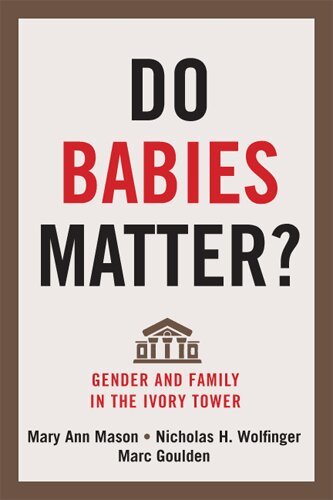
    Do Babies Matter?

    Gender and Family in the Ivory Tower

    AvMary Ann Mason,Nicholas H. Wolfinger

    Häftad, Engelska, 2013

    Del i serien Families in Focus

    431 kr

    Beställningsvara. Skickas inom 5-8 vardagar. Fri frakt över 249 kr.

    Beskrivning

    The new generation of scholars differs in many ways from its predecessor of just a few decades ago. Academia once consisted largely of men in traditional single-earner families. Today, men and women fill the doctoral student ranks in nearly equal numbers and most will experience both the benefits and challenges of living in dual-income households. This generation also has new expectations and values, notably the desire for flexibility and balance between careers and other life goals. However, changes to the structure and culture of academia have not kept pace with young scholars’ desires for work-family balance. Do Babies Matter? is the first comprehensive examination of the relationship between family formation and the academic careers of men and women. The book begins with graduate students and postdoctoral fellows, moves on to early and mid-career years, and ends with retirement. Individual chapters examine graduate school, how recent PhD recipients get into the academic game, the tenure process, and life after tenure. The authors explore the family sacrifices women often have to make to get ahead in academia and consider how gender and family interact to affect promotion to full professor, salaries, and retirement. Concrete strategies are suggested for transforming the university into a family-friendly environment at every career stage.The book draws on over a decade of research using unprecedented data resources, including the Survey of Doctorate Recipients, a nationally representative panel survey of PhDs in America, and multiple surveys of faculty and graduate students at the ten-campus University of California system..

    Produktinformation

    • Utgivningsdatum:2013-06-13
    • Mått:152 x 228 x 14 mm
    • Vikt:300 g
    • Format:Häftad
    • Språk:Engelska
    • Serie:Families in Focus
    • Antal sidor:188
    • Förlag:Rutgers University Press
    • ISBN:9780813560809

    Utforska kategorier

    • Genusvetenskap inom Samhälle och politik

    Mer om författaren

    MARY ANN MASON is Professor of the Graduate School and Faculty Codirector of the Berkeley Law Earl Warren Institute for Law and Social Policy at the University of California at Berkeley. She is the author of Mothers on the Fast Track: How the New Generation Can Balance Career and Family and coeditor of All Our Families: New Policies for the New Century, Second Edition.NICHOLAS H. WOLFINGER is an associate professor in the Department of Family and Consumer Studies and an adjunct associate professor in the Department of Sociology at the University of Utah. He is the author of Understanding the Divorce Cycle, and coeditor of Fragile Families and the Marriage Agenda.MARC GOULDEN is the director of data initiatives at the University of California at Berkeley.

    Recensioner i media

    "Illuminating. Do Babies Matter? is the first comprehensive examination of the relationship between family formation and the academic careers of men and women."(Academe) "Do Babies Matter? argues that the most important factor impeding women’s careers in STEM, and the academy more generally, is the difficulty women face in balancing work and family. An excellent resource for women faculty and graduate students and would work well as a text in a course on gender and work. It would also serve as an excellent primer for university department chairs and administrators on the problems faced by faculty mothers and on the solutions that might make our institutions more family friendly." (American Journal of Sociology) "Do Babies Matter? offers a timely and significant contribution to an ongoing debate regarding women's ability to coordinate the challenges of family life with those of an (academic) career … With its focus on statistical analysis, Do Babies Matter? provides not only deeper insight into the problem at hand but also pragmatic, feasible solutions for a twenty-first century in which 'having it all' becomes attainable for both women and men."  (Journal of American Culture) "Do Babies Matter? is a riveting read, from its startling title to its formidable array of statistical, anecdotal and interpretive evidence of serious gender and family trouble in the contemporary academy, to its visionary policy advice on how to improve things in this important area of cultural life."(Canadian Association of University Teachers Bulletin) "One of the primary strengths of this book is in tracing the impact of marriage and family throughout the academic lifecourse, rather than just during the early years. Do Babies Matter is very successful in explicating the complex relationships between family life and career progression across the academic lifecourse."(Children's Geographies) "Do Babies Matter? provides readers with clear data about the problems associated with merging academic careers and parenthood." (European Political Science) "Do Babies Matter? provides a comprehensive analysis of the relationship between gender, family formation, and academic careers. A major strength of this book is that it brings together several important lines of research on work and family in academia." (Journal of Higher Education) "This towering book of extensive empirical analysis gives us an in-depth portrait of academia as a workplace in the United States. Its deft interweaving of clear narrative and complex data makes it invaluable to anyone and everyone working in higher education today." - Karen V. Hansen (Brandeis University) "Here’s the path-breaking research that convinced the huge University of California system to implement the best package of family friendly policies anywhere. Want to retain women in academia? Read this book." - Joan Williams (Distinguished Professor and Director, WorkLife Law, University of California Hastings) "Do Babies Matter is data rich, empirically sound, and full of practical application. The authors' life course perspective is one that is often missing from research about faculty careers. Their experiences are a welcome addition to what we know about work and family in higher education." - Kelly Anne Ward (author of Academic Motherhood)

    Innehållsförteckning

    • List of Figures and TablesAcknowledgmentsIntroduction1. The Graduate School Years2. Getting into the Game3. Capturing the Golden Ring of Tenure4. Alone in the Ivory Tower5. Life after Tenure6. Toward a Better ModelAppendix: Data and AnalysisNotesBibliographyIndex