• Fri frakt över 249 kr
  • •
  • Snabba leveranser
  • •
  • Billiga böcker
Kundservice

Du är på sajten för privatpersoner.

Företag, bibliotek eller offentlig verksamhet?

Du handlar på classic.bokus.com, där alla dina funktioner finns intakta.
Till classic.bokus.com
Bokus logotyp. Gå till startsidan.
  • Erbjudanden
  • Nyheter
  • Student
  • Topplistor
  • Barn & ungdom
  • Bokus Play
  • E-böcker
  • Pocketböcker
  • Spel & pussel

10% rabatt på allt med kod NYSTART10 →

Sidfot

Mina sidor

    Hjälp

    • Kundservice
    • Vanliga frågor och svar
    • Frakt och leverans
    • Retur vid ångerrätt
    • Reklamera vara
    • Betalning
    • Köpvillkor
    • Allmänna villkor
    • Information om webbplatsens tillgänglighet

    Om Bokus

    • Om oss
    • Pressrum
    • För studenter
    • För företag
    • För bibliotek och offentlig verksamhet
    • För leverantörer
    • Hållbarhet

    Populärt

    • Aktuella erbjudanden
    • Presentkort
    • Studentlitteratur
    • Nya böcker
    • Topplistor
    • Signerade böcker
    • Engelska böcker

    Inspiration

    • Boktips
    • BookTok
    • Populära bokserier
    • Barnbokskaraktärer
    • Populära författare
    Logotyp för Bokus
    Följ oss på Facebook (extern länk)Följ oss på Instagram (extern länk)Följ oss på YouTube (extern länk)Följ oss på TikTok (extern länk)
    bokus @ CookiesAnpassa cookiesIntegritetspolicyKöpvillkor
    Till Citymail hemsida (extern länk)Till Budbee hemsida (extern länk)Till Postnord hemsida (extern länk)Till Schenker hemsida (extern länk)Till Early Bird hemsida (extern länk)Till Walleys hemsida (extern länk)
    1. Naturvetenskap och teknik
    2. Geovetenskap
    3. Miljövetenskap och miljöpolitik

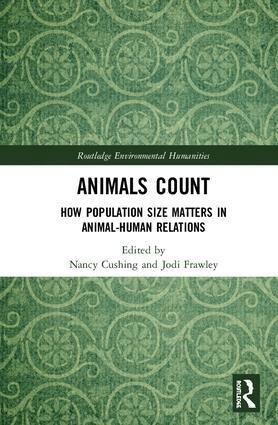
    Animals Count

    How Population Size Matters in Animal-Human Relations

    AvNancy Cushing,Jodi Frawley

    Inbunden, Engelska, 2018

    Del i serien Routledge Environmental Humanities

    2 422 kr

    Beställningsvara. Skickas inom 10-15 vardagar. Fri frakt över 249 kr.

    Beskrivning

    Whether their populations are perceived as too large, just right, too small or non-existent, animal numbers matter to the humans with whom they share environments. Animals in the right numbers are accepted and even welcomed, but when they are seen to deviate from the human-declared set point, they become either enemies upon whom to declare war or victims to be protected. In this edited volume, leading and emerging scholars investigate for the first time the ways in which the size of an animal population impacts how they are viewed by humans and, conversely, how human perceptions of populations impact animals.This collection explores the fortunes of amphibians, mammals, insects and fish whose numbers have created concern in settler Australia and examines shifts in these populations between excess, abundance, equilibrium, scarcity and extinction. The book points to the importance of caution in future campaigns to manipulate animal populations, and demonstrates how approaches from the humanities can be deployed to bring fresh perspectives to understandings of how to live alongside other animals.

    Produktinformation

    • Utgivningsdatum:2018-06-18
    • Mått:156 x 234 x 19 mm
    • Vikt:570 g
    • Format:Inbunden
    • Språk:Engelska
    • Serie:Routledge Environmental Humanities
    • Antal sidor:222
    • Förlag:Taylor & Francis Inc
    • ISBN:9780815381365

    Utforska kategorier

    • Miljövetenskap och miljöpolitik inom Naturvetenskap och teknik
    • Sociala och etiska frågor inom Samhälle och politik

    Mer om författaren

    Nancy Cushing is associate professor in History at the University of Newcastle, Australia. An environmental historian most interested in relations between humans and other animals, she is co-author, with Kevin Markwell, of Snake-bitten, Eric Worrell and the Australian Reptile Park (2010), co-editor of Radical Newcastle (2015) and is writing a history of meat eating in colonial Australia.Jodi Frawley is an honorary research fellow in the Department of History at University of Western Australia, Australia. She is interested in understanding the cultural implications of environmental change in all its guises, from globally mobile biological matter to the ways that race relations impact in the environment. Her current project is a history of fishing in the Great Sandy Strait, Queensland.

    Innehållsförteckning

    • 1. Why count animals? Nancy Cushing and Jodi Frawley Part I Excess The man from Menindie – D.H. Souter 2. Cane toads as sport: conservation practice and animal ethics at odds Libby Robin 3. Taking locust country Andrea Gaynor 4. On the ant frontier: ontological conflict with Iridomyrmex humilis in post-war Sydney Adam Gall 5. A swarm of sheep: colonizing the Esperance bioregion Nicole Chalmer Part II Abundance Life hath its charms 6. Optimism unlimited: prospects for the pearl-shell, bêche-de-mer and trochus industries on Australia’s Great Barrier Reef, 1860–1940 Rohan Lloyd 7. Swamplands: human-animal relationships in place Emily O’Gorman 8. ‘Pain for Animals. Profit for People’: the campaign against live sheep exports’ Gonzalo Villanueva Part III Equilibrium The Ento(M)-uscian – Emma Carmody 9. "Cunning, intractable, destructive animals": pigs as co-colonisers in the Hunter Valley of New South Wales, 1840–1860 Nancy Cushing 10. Wine worlds are animal worlds, too: native Australian animal vine feeders and interspecies relations in the ecologies that host vineyards Julie McIntyre 11. Defending nature: Animals and militarised landscapes in Australia Ben Wilkie Part IV Scarcity Homecoming (Alpine Strata) – Emma Carmody 12. A slow catastrophe? Fishing for sport and commerce in colonial Victoria David Harris 13. The palatability of pests: redfin in the Murray-Darling Basin Jodi Frawley Part V Extinction ‘Tis the last fly of summer 14. After none: memorialising animal species extinction through monuments Dolly Jørgensen